

















![Kingdom Hearts Collection [I-III] Review](https://gazettely.com/wp-content/uploads/2026/10/Kingdom-Hearts-Collection-I-III-1-360x180.webp "Kingdom Hearts Collection [I-III] Review: KHII Holds Steady as Newer Entries Fluctuate 33")







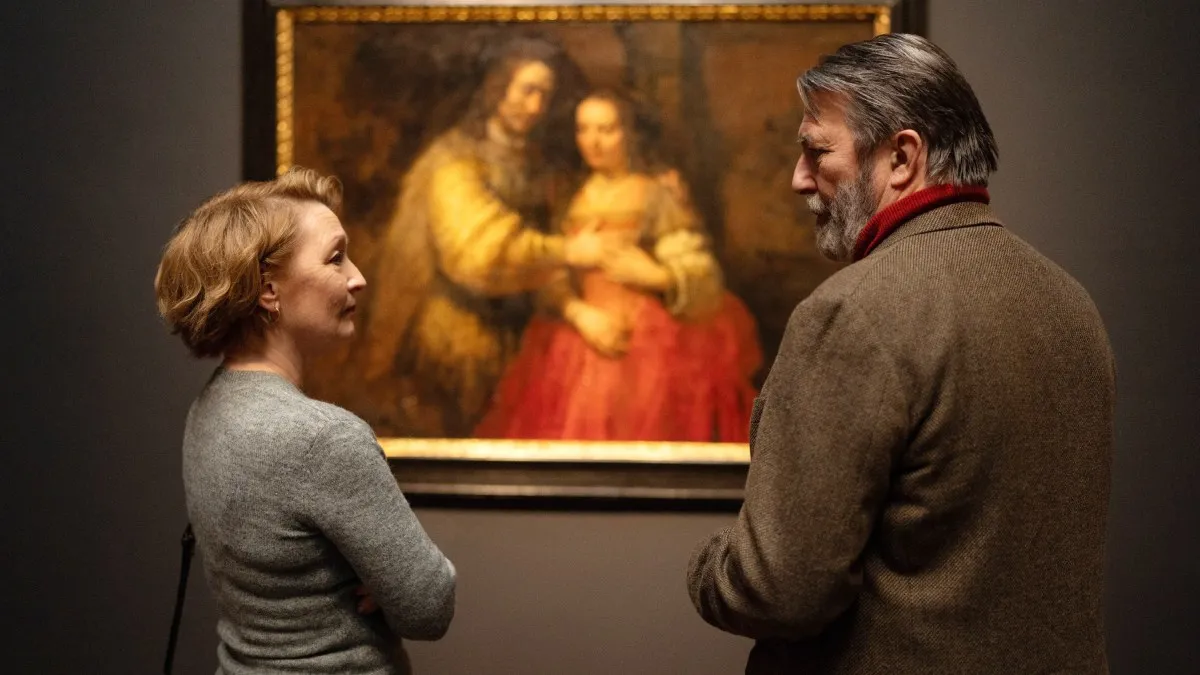

The air in Glasgow often feels like a heavy, translucent curtain. For Stella and Gerry, it functions like a preservative. They live as artifacts of a flight that began decades ago, back in the smoke of Belfast. Their move from the North reads as a frantic shedding of skin. They carried the jagged remnants of the Troubles with them, including the instant a bullet struck Stella’s pregnant body. That moment persists in their lives like an unexploded relic, present even in the rooms where it goes unspoken.
Retirement brings them into a phase where silence stops resembling rest. It turns dense and clinical. They sit under one roof as exiles from each other, occupying different psychological continents. Their home has the hollowed-out feel of an emptied vessel, their son long gone into a life that belongs to him.
Stella tries to build a bridge across the distance. Maybe it is desperate. Maybe it is instinct. She arranges a New Year’s trip to Amsterdam and frames it as a holiday. The city’s grey, watery landscape reflects something wintry in them. The excursion becomes the spark for a final reckoning with the ghosts they have carried across the sea.
The Silent Liturgy of the Living
Lesley Manville and Ciarán Hinds inhabit Stella and Gerry with the weight of years, a sense of accumulated compromises and small daily betrayals. Stella comes across as a woman of fierce internal piety. Her Catholic faith forms a solitary architecture built for survival after the near-death terror that marked her body and her memory. She attends Mass with ritual intensity. Gerry does not share it. He cannot reach it.
For Stella, the church offers shelter from the daily failures of her marriage. Gerry cultivates his own form of communion, and it lives in the bottom of a whiskey bottle. He keeps a hidden, shame-tinged liturgy, drinking in the spaces Stella leaves behind. He depends on her as a caretaker, the person who keeps reality moving forward while he grows eager to soften its edges. The distance between them arrives through slow pressure, like a geological drift. They do not communicate. They refuse to speak the names of what happened, as if naming would grant the past a fresh body.
Manville and Hinds treat their faces like terrain shaped by unspoken history. Their chemistry feels natural and weary. It carries the grim paradox of intimacy without access, of knowing someone’s habits and still failing to know their inner life. The performances stay away from loud melodrama.
Meaning gathers in a sigh, in the exact placement of a hand on a table, in a pause that carries its own argument. Watching them can feel like watching two philosophies of survival collide: devotion as endurance, numbness as refuge. The film does not force certainty about which path is crueler. It lets the question remain open, which feels honest.
The Courtyard of the Begijnhof
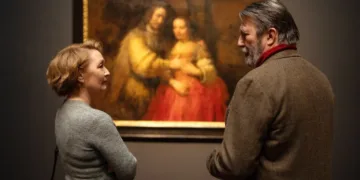
Amsterdam appears as a city of shifting reflections and cold stone, an apt environment for a marriage in motion and in doubt. Stella and Gerry move through the Rijksmuseum and along the canals with a detached tourist curiosity, as if they are visiting their own lives from a distance. Gerry searches for distraction in the tactile world of record stores and architecture. Stella follows a different pull, something like spiritual gravity.
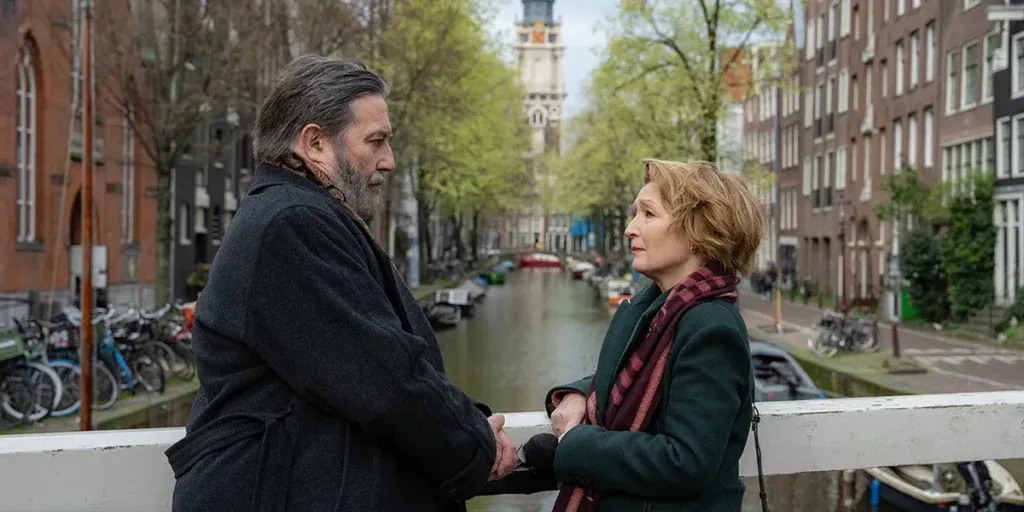
She brings them to the Begijnhof, a sanctuary of medieval houses that once sheltered women who lived for God without the formal constraints of a convent. This place reveals her private aim. She looks at those women as a model for liberation. In the grey Dutch winter, she finally states what she wants: to leave Gerry and the stagnation of their shared life for a communal religious existence. The declaration ruptures the holiday’s surface. It turns the trip into an argument about being, about what remains of the self once the roles of spouse and caretaker have calcified.
The tension that follows comes from incompatible needs. Stella seeks spiritual autonomy, a life shaped by faith and community rather than obligation. Gerry clings to the familiar structure of their union and the comfort of routines that keep the past sealed away.
He wants the ghosts to stay buried in the basement of their shared home. Stella wants them unearthed so she can finally step out from under their weight. Amsterdam, with its history of tolerance and refuge, becomes the stage for an existential divorce. The city does not rescue them. It offers space where truth can finally speak in full sentences.
The Fragmented Lens of the Past
Polly Findlay directs with intimacy and relentless focus. Her approach avoids sweeping gestures associated with traditional cinema. She commits to steady observation and keeps attention on the internal life of the characters. The camera stays close, catching micro-movements in faces as Stella and Gerry pick their way through conversations that feel like wreckage. That proximity can feel almost punitive. It also feels philosophically aligned with the film’s subject, since grief rarely arrives as spectacle. It arrives as breath, hesitation, and the impulse to look away.
Hannah Peel’s score adds melancholic resonance, a low-frequency hum of sorrow beneath the dialogue. The Belfast shooting returns through brief impressionistic flashes. These moments do not exist to tidy the plot. They capture how memory intrudes, how a past event can arrive uninvited and reorder the present. The flashes suggest a principle the film keeps circling: one moment can dictate the rhythm of forty years. It can shape a marriage into a structure built around avoidance.
Later scenes lean heavily on dialogue and carry a hard emotional load. They show how difficult it is to translate a lifetime of suppressed feeling into words that do not collapse on contact. Findlay gives silence the same gravity as speech. The pauses feel like rooms where thought stalls and then starts again, uncertain of its own direction.
The film ends up as a somber examination of endurance: the endurance of faith, the endurance of commitment, and the endurance of two people who remain alive together even when the relationship feels like it has exhausted its language. The honesty comes partly from what it refuses to resolve. Some wounds stay active. Some choices arrive too late to feel clean. The film lets that discomfort stand.
Midwinter Break is a poignant drama directed by Polly Findlay, based on the acclaimed novel by Bernard MacLaverty. The film follows a long-married couple, Stella and Gerry, as they journey to Amsterdam for a winter holiday that ultimately forces them to confront deep-seated tensions in their relationship and individual faiths. Scheduled for a theatrical release on February 20, 2026, the movie is distributed by Focus Features in the United States. Following its world premiere at the Glasgow Film Festival earlier this month, the film will be available to watch in theaters nationwide starting this Friday.
Where to Watch Midwinter Break (2026) Online







Full Credits
Title: Midwinter Break
Distributor: Focus Features, Universal Pictures
Release date: February 20, 2026
Rating: PG-13
Running time: 90 minutes
Director: Polly Findlay
Writers: Bernard MacLaverty, Nick Payne
Producers and Executive Producers: Guy Heeley, Floor Onrust, Reece Cargan, Ollie Madden, Daniel Battsek
Cast: Lesley Manville, Ciarán Hinds, Julie Lamberton, Ed Sayer, Niamh Cusack
Director of Photography (Cinematographer): Laurie Rose
Editors: Lucia Zucchetti, Stephen O’Connell
Composer: Hannah Peel
The Review
Midwinter Break
The film serves as a somber meditation on the entropy of long-term devotion. While the narrative occasionally feels as thin and brittle as a frozen canal, the lead performances provide a necessary, pulsing warmth. It is a work that finds beauty in the wreckage of silence, even when it lacks the courage to fully excavate its own political and spiritual depths. Ultimately, it is a haunting, if slightly under-realized, portrait of two souls attempting to find a final harbor in the winter of their lives.
PROS
- Masterful, understated performances by Lesley Manville and Ciarán Hinds.
- Lyrical cinematography that utilizes Amsterdam’s wintry landscape as an emotional mirror.
- A mature, patient exploration of individual faith versus marital obligation.
- An evocative score that grounds the film’s melancholic atmosphere.
CONS
- The screenplay occasionally feels too restrained, leaving core themes under-explored.
- The pacing may feel stagnant for those seeking a more traditional narrative arc.
- Insufficient context regarding the political weight of the protagonists' past.