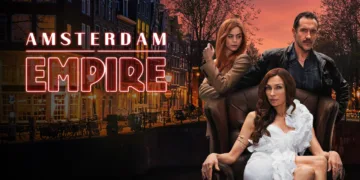




























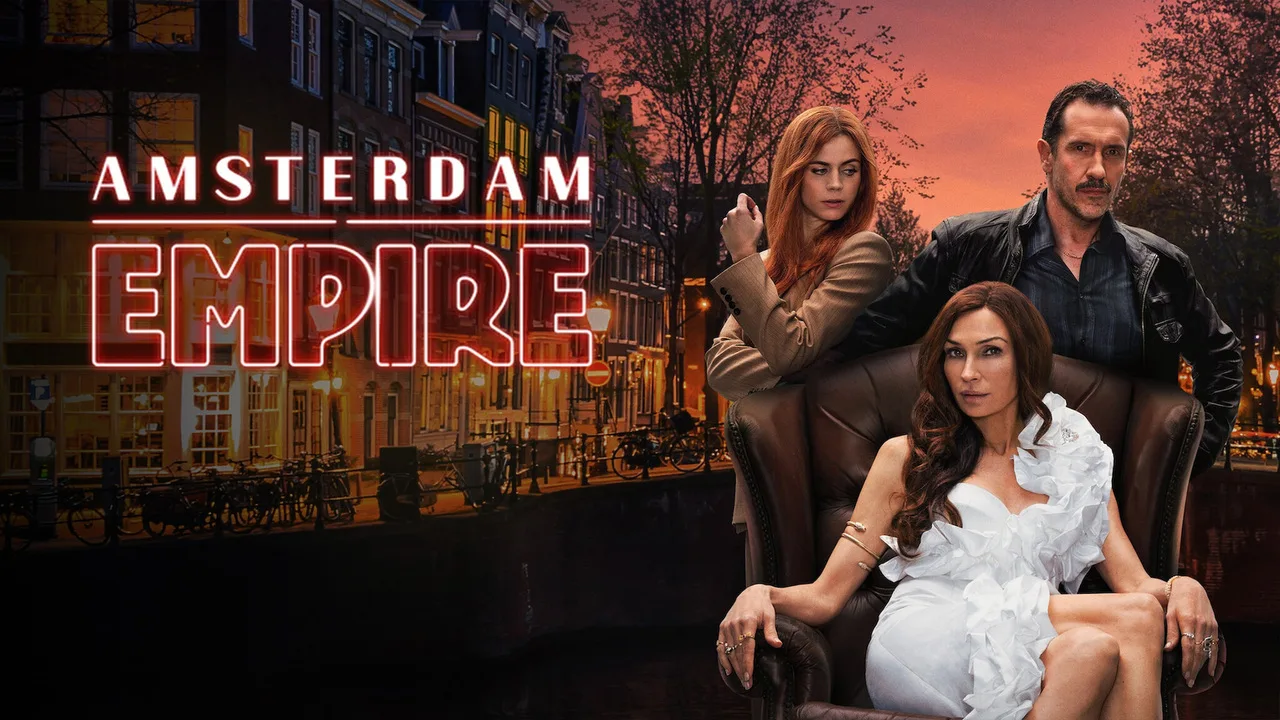

In the opening moments of Amsterdam Empire a celebratory canal cruise ends in sudden violence when a bullet strikes Jack Van Doorn, the reigning figure of the city’s coffee shop circuit. The sequence reads as a blunt announcement of an imminent fall rather than the beginning of an ascent. The series then flips back one month to map the domestic decay that positions Jack as a target. He runs The Jackal empire and built his success through charm and aggressive expansion.
His marriage to Betty Jonkers, a former pop idol, has collapsed. Jack pursues the younger journalist Marjolein Hofman who is now pregnant. Betty refuses a quiet exit and launches a scorched-earth campaign aimed at dismantling Jack’s life and enterprise. The seven episodes that follow stage a high-stakes personal struggle for control against the glossy surface of Amsterdam’s cannabis economy.
The Trope of Retribution Versus Global Storytelling
The core premise hinges on a woman’s calculated retribution, a dramatic engine that feels familiar yet potent. Betty’s leverage comes from intimate knowledge of Jack’s operations which, although presented as outwardly legitimate, depend on large-scale, illegal cultivation. She targets the legal blind spot in Dutch cannabis policy where sales are tolerated but mass growing remains criminal. This arrangement creates an ethical and legal tension about what happens when a lucrative shadow economy operates behind a polite façade.
The series struggles most with its confused tonal identity. It rarely commits to the gritty narcotics thriller it hints at and frequently drifts into heightened domestic melodrama. This tonal mixing mirrors a wider trend in streaming where productions aim for broad international reach and sometimes dilute focus to please many viewers at once. Scenes that should sustain tension, such as Jack’s fear of police infiltration, are quickly deflated by episodes of comic or farcical rivalry.
A moment meant to signal Jack’s precarious position has him clinging to a mechanical bull during a business negotiation. The sequence plays for cringe humor and undercuts the stakes tied to the potential corporate loss. That uneven tonal register keeps the audience at arm’s length, making it difficult to engage fully with the narrative.
The choice to begin with the shooting and then rewind is intended to reframe events and load the past with consequence. In practice the flashback emphasizes the petty three-way bickering that leads to the split, which reduces the killing to an outcome of irritating personal drama instead of a tragic fall from power.
The series offers a sustained observation about greed and ambition but the soap-opera elements often obscure that point. The most revealing material is the show’s portrayal of the cannabis economy as two-faced: the shiny, consumer-facing brand of The Jackal stacked over the dangerous, criminal operation that powers growth. This social tension is genuinely interesting but the narrative rarely pauses long enough to let it push the story forward.
Character Depth and the Failure of Representation
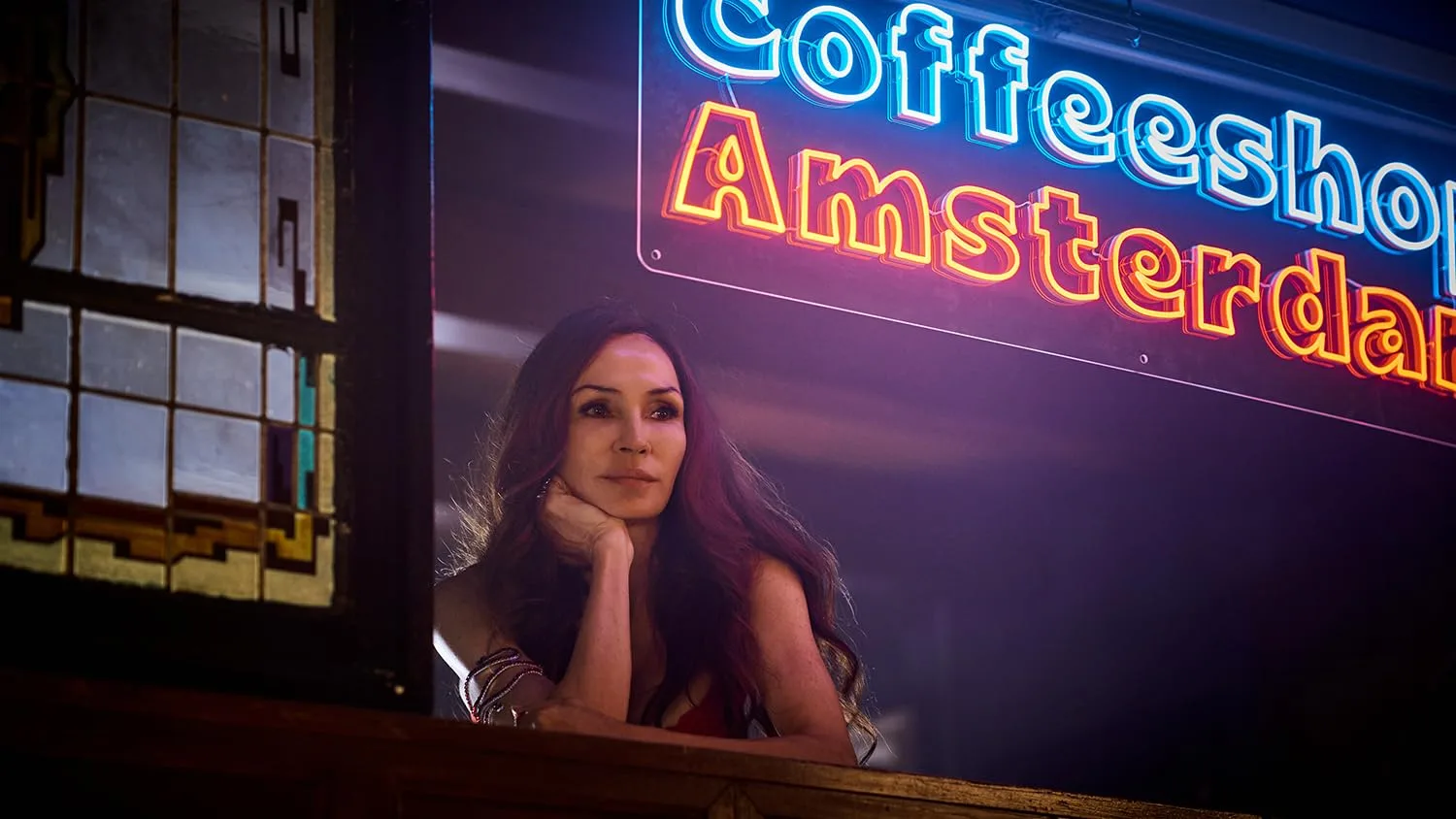
A streaming series frequently depends on a central performance and Famke Janssen supplies a strong anchor. Her return to a Dutch-language role after a lengthy Hollywood career gives the show visible weight and signals the rising profile of international productions. Janssen makes Betty a vivid presence from her first scene, committing to a portrayal that is intensely vengeful and openly dramatic. She brings hardened strength and a clear sense of grievance.

The script, however, does not consistently match that commitment. It reduces Betty to a familiar trope, the scorned woman whose elaborate schemes can read as childish or implausibly easy to execute. That simplification flattens the possibility of portraying a complex fight for economic dignity and replaces nuance with caricature. The series misses opportunities to show female power and anger as layered and contemporary.
Jacob Derwig’s Jack Van Doorn is conceived as an anti-hero but he rarely connects emotionally. Jack functions as a successful liar, an empire builder, and an unapologetic cheater. Derwig captures the surface bluster but the script does not permit access to an inner life that would make his downfall meaningful. He remains emotionally removed, a quietly pitiable figure whose punishment feels deserved, which turns his conflict with Betty into an execution more than an even contest.
The supporting cast fares worse. Elise Schaap’s Marjolein comes across as the endlessly understanding “other woman,” a plot device rather than a developed person. Her role in the triangle lacks the complexity necessary to justify the ensuing war. The potential father-daughter tension between Jack and Katja Van Doorn (Jade Olieberg) is another missed chance. Katja’s moral struggle, between filial loyalty and the corrupt nature of her father’s business, is introduced and then quickly abandoned. Secondary characters often exist solely to advance the central plot and do not emerge as independent actors with fully formed motivations.
Aesthetic Polish and Directorial Distance
Technically the series is the production’s strongest card. With a high budget the show delivers slick, cinematic visuals that hold up on the global stage. Color grading and correction are applied with care and create a contemporary sheen. Amsterdam itself performs as a character; the canals, the nightlife, and the coffee shops supply a backdrop that mirrors Jack’s glamorous disorder. The aesthetic choices signal that major streaming players are willing to invest in the visual quality of regional projects.

That visual refinement, though, does not translate into dramatic intensity. Directorial decisions at key moments often feel procedural and emotionally detached. Crucial scenes lack a sense of committed staging which produces a mismatch between the show’s polished surface and an underwhelming presentation of conflict. The production appears to prioritize a clean, accessible aesthetic over one that would demand emotional or formal risk.
The series also treats action with casual indifference. When action appears, as in a police chase or a cabin sequence, it tends toward the farcical or functions as a brief diversion before returning to domestic quarrel. Camera movement and editing create a measured distance that keeps the viewer from fully inhabiting either the psychological peril or the physical danger. The show looks like an international crime drama at its best on a technical level but its visual language rarely intensifies the emotional stakes it asks the audience to care about.
Pacing, Predictability, and the Future of the Narrative
The seven-episode arc is uneven. Pacing issues are constant; some chapters linger on repetitive arguments between Betty and Jack while other moments that should land heavily flicker past. For example Katja’s fleeting consideration of betrayal passes too quickly for the attendant emotional fallout to register. This inability to control pacing thins the story’s emotional texture.
Fragmentation worsens when secondary plots appear and disappear. A subplot about an associate’s wife undergoing chemotherapy surfaces briefly to raise the stakes and then vanishes. These elements do not build cumulative narrative pressure and instead serve as intermittent distractions. Such writing makes it hard for viewers to form sustained attachments to the characters or the world the show presents.
The series also suffers from predictable plotting and reliance on familiar tropes. Major twists in the divorce and revenge narrative are easy to foresee. The show gestures toward commentary on female agency and corporate corruption but avoids subverting those conventions or probing the characters’ psychology in original ways. Predictability is a liability in a streaming market where audiences often seek narratives that push formal or thematic limits.
A notable disappointment is the relative neglect of the cannabis trade’s internal politics. That thread carries social and historical significance and could have supplied the series with systemic conflict and moral complexity. Instead the writers favor the repetitive domestic warfare. The season ends with Jack’s condition unresolved and a clear path for a second season. The future depends on whether subsequent episodes can correct tonal imbalances, deepen characterization, and pursue the systemic issues the first run gestures toward.
Amsterdam Empire is a Dutch crime drama series that premiered on Netflix, following the intense saga of Jack Van Doorn, the founder of the powerful “The Jackal” coffee shop empire, and his estranged wife, Betty Jonkers, a former pop star. When Jack’s affair with a journalist is exposed, Betty hatches an elaborate plan to strip him of his fortune and business, launching a fierce war of corporate sabotage and personal revenge set against the glamorous and gritty backdrop of Amsterdam’s cannabis scene. The first season, consisting of seven episodes, was released globally on October 30, 2025, and is available to stream exclusively on Netflix.
Full Credits
Title: Amsterdam Empire
Distributor: Netflix
Release date: October 30, 2025
Rating: TV-MA (Implied, typical for Crime/Drama series on this platform with mature themes)
Running time: 45 Minutes per Episode
Director: Jonas Govaerts, Max Porcelijn
Writers: Nico Moolenaar, Piet Matthys, Bart Uytdenhouwen
Producers and Executive Producers: Sander van Meurs (Producer), Famke Janssen (Executive Producer), Nico Moolenaar (Executive Producer), Hendrik Verthe (Co-Producer), Kobe Van Steenberghe (Co-Producer), Yves Van De Paer (Co-Producer)
Cast: Famke Janssen, Jacob Derwig, Elise Schaap, Jade Olieberg, Bart Slegers, Victor Löw, Jesse Mensah, Yannick van de Velde, Romana Vrede, Raymond Thiry, Chris Nietvelt
Director of Photography (Cinematographer): Seppe Van Grieken, Coen Stroeve
The Review
Amsterdam Empire
Amsterdam Empire is a visually slick production anchored by a commanding performance from Famke Janssen. However, the series is fundamentally confused about its identity, failing to commit fully to either its crime thriller framework or its domestic melodrama. It prioritizes surface-level conflict and predictable tropes over nuanced characterization and vital social commentary, ultimately squandering a unique setting and a compelling, modern premise. It serves as frustratingly uneven streaming fare.
PROS
- Famke Janssen brings significant commitment and strength to the central role.
- Excellent cinematography, coloring, and slick aesthetic design.
- Effectively uses the unique atmosphere of Amsterdam’s cannabis-based economy.
- Hints at a relevant critique of the duality of legal and illegal cannabis industries.
CONS
- Fails to balance serious crime thriller elements with farcical domestic melodrama.
- The narrative momentum is frequently lost due to inconsistent episode flow.
- Supporting characters are reduced to one-note tools for the main plot.
- Fails to explore the political and criminal dynamics of the cannabis trade fully.
- Relies too heavily on familiar revenge and cheating tropes without subversion.