
























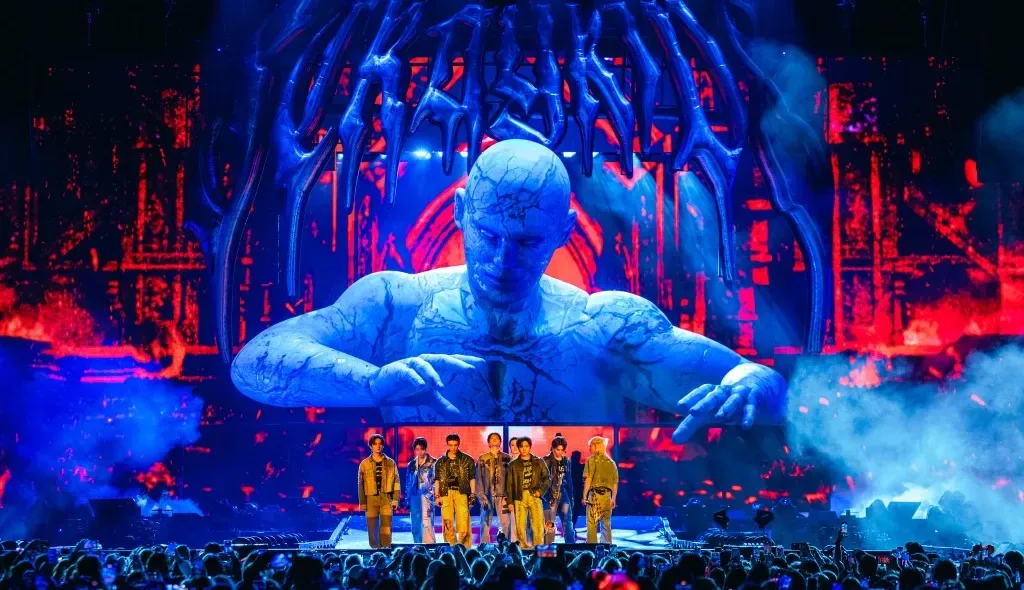

The film opens by treating the jump from a live arena to a cinema screen as its first challenge: how to translate the friction of performance into something that still feels immediate. Set at the start of 2026, it frames this stop on the dominATE tour as a defining point after a massive 2025. SoFi Stadium in Los Angeles becomes the text of the story.
Its size, its geometry, and its crowd density communicate the scale of where this eight-member group sits right now. Directors Paul Dugdale and Farah X split the workload cleanly. Dugdale builds the stadium spectacle. Farah X shapes the interview material into a quieter countercurrent. The result works for viewers who missed the tour dates and for anyone chasing the memory of a sold-out night.
The camera language keeps returning to the feeling of being there, positioning the viewer inside the arena’s architecture and treating this concert as a marker in the group’s timeline. The film resists a conventional concert-movie template and leans on environment, endurance, and sheer momentum to speak for how far the performers have come.
Sensory Overload and Sonic Precision
Endurance drives the performance sections. The setlist runs close to two hours, and the movie repeatedly underlines what that kind of physical demand requires. Each member sustains a high-energy performance from the opening track through the final bow, and the staging keeps testing how much motion the show can hold without losing musical clarity.
“Chk Chk Boom” and “S-Class” set the visual tone with deep reds and blacks that match the sharp aggression of the choreography. These sequences land with a gritty, deliberate texture, built on moving platforms and timed pyrotechnics that lock into the rhythm rather than sitting on top of it. The film treats those effects like tools in a system: each blast, lift, and lighting hit pushes the beat forward and helps the crowd’s roar feel like part of the arrangement.
Pacing shifts become a story beat of their own. After the heavy bass emphasis of “Maniac” and “Hellevator,” the film makes room for slower songs that change the body language of the show. “Lonely St.” and “Cover Me” pull attention toward vocal texture and phrasing, with less complex stage movement competing for focus.
The movie also uses the subunit performances to reset the energy in smaller, more pointed ways. Hyunjin and Bang Chan bring a sleek, stylish approach to “Escape,” and Lee Know and Seungmin pivot into the melodic ballad “Cinema.” During that “Cinema” segment, the production adds a tender detail as fans’ names scroll across the massive screens, a gesture that turns an arena-scale show into something briefly personal.
Mobility becomes another pacing lever. The group uses mobile carts to move across the stadium floor, and the film captures the sense of spur-of-the-moment connection that comes from that shift in staging. It expands the performance space, reaches deeper into the crowd, and keeps the show from feeling locked to one central platform. Across the full set, the technical package stays aligned with the film’s implied narrative: lasers, confetti cannons, platforms, and pyro all point back to the idea of a group operating at the peak of its performance capacity.
Technical Immersion Through the IMAX Format
SoFi’s scale demands camera choices that can read both the macro and the micro, and the movie meets that challenge through a spread of specialized angles. Sweeping drone shots and crane movements map the stadium as a constructed environment, with crowd size and architecture presented as part of the spectacle.
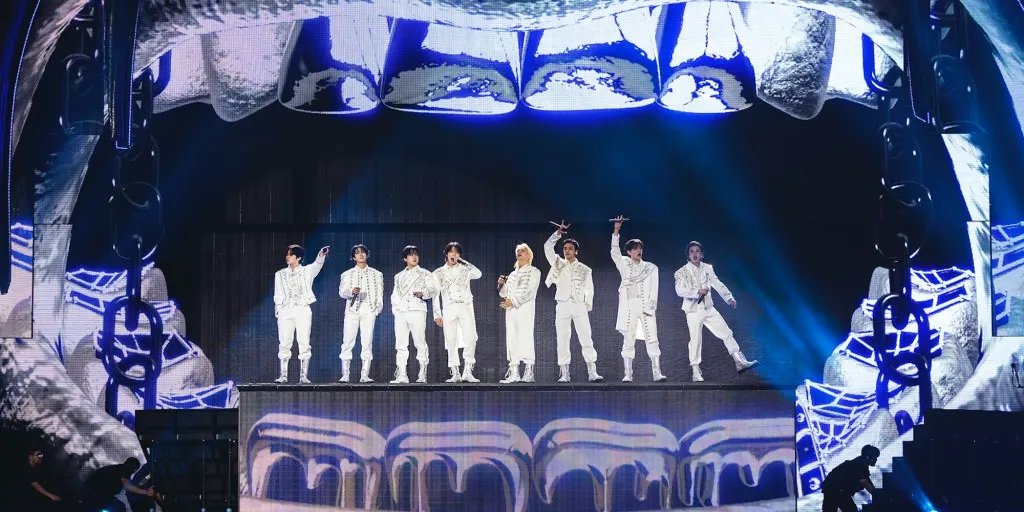
Those wide perspectives cut to extreme close-ups that track exertion in real time: breath, sweat, strain, and facial expression become as important as the choreography lines. That back-and-forth rhythm gives the concert a kind of internal “play loop,” where scale and intimacy trade places to keep the viewer engaged.
Sound is where the IMAX presentation makes its clearest argument. Raps and vocals stay crisp, even with stadium ambience present in the mix. That clarity tightens the emotional distance between viewer and performer, allowing the performance to feel close without shrinking the size of the space. Editing choices reinforce the film’s two-track structure. A glitch-style transition effect marks the handoffs between high-energy concert footage and the quieter documentary segments, giving the movie a consistent visual signal for switching modes.
Small continuity slips show up, and the film’s construction makes their source legible. Costume changes can appear to happen instantly between cuts, and the edit invites attentive fans to spot those seams. Presented as artifacts of building the film from two separate nights of performances, these moments become a kind of detail hunt for viewers who track the show closely. The IMAX framing supports that attention to detail. With 360-degree views and frequent perspective shifts, the movie aims for the “best seat in the house” feeling, offering visual access that a live ticket simply cannot guarantee.
Vulnerability and the Psychology of the Idol
The documentary material pivots away from polish and into the mental weight of global fame. These scenes focus on the demand for perfection and the pressure of a career that leaves very little space for privacy. Felix delivers the most direct emotional grounding, speaking candidly about sacrifices and moments of losing a sense of self along this path. His honesty reframes the stadium spectacle around what it costs to maintain it.
Hyunjin speaks about artistry as protection, shaped through his own metaphor: a wounded blade of grass carrying a sweeter scent. He connects identity to performance, describing the stage as the place where he feels most authentic and asking the audience to understand him through movement. Bang Chan approaches the topic through responsibility, describing what it means to lead the group and a massive fandom.
He admits to frustration and anger that he sometimes manages off-camera, giving the film a rare sense of internal pressure behind the outward control of the show. Seungmin brings a different emotional register, finding joy in the realization of childhood dreams and in the sound of a stadium singing along.
Taken together, the interviews emphasize trust among the eight members and a shared commitment to their supporters. The film uses these quiet conversations as an anchor point, letting sincerity sit beside spectacle without forcing either to compete for attention.
Released globally in theaters and IMAX on February 6, 2026, this cinematic event captures the monumental scale of the group’s “dominATE” world tour. The film focuses on their sold-out, record-breaking performances at SoFi Stadium in Los Angeles, blending high-octane concert footage with intimate, behind-the-scenes documentary interviews. Directed by Emmy winner Paul Dugdale and filmmaker Farah Khalid, the production offers an immersive look at the group’s artistry and the personal stories behind their global success. As of late February 2026, the film is currently showing in cinemas worldwide, providing fans with a front-row experience of the tour’s most electric moments.
Where to Watch Stray Kids: The dominATE Experience (2026) Online






Full Credits
Title: Stray Kids: The dominATE Experience
Distributor: Universal Pictures International, Bleecker Street, Crosswalk, CJ ENM
Release date: February 6, 2026
Rating: 12A
Running time: 2h 26m
Director: Paul Dugdale, Farah Khalid
Writers: None listed
Producers and Executive Producers: Paul Dugdale, Farah Khalid, Ross Putman, Vaughn Trudeau, Cari Waterbury
Cast: Bang Chan, Lee Know, Seo Changbin, Hwang Hyunjin, Han Jisung, Felix Lee, Kim Seungmin, Yang Jeongin, Stray Kids
Director of Photography (Cinematographer): Shana Hagan
Editors: Dean Gonzalez, Stacy Kim
Composer: Stray Kids
The Review
Stray Kids: The dominATE Experience
This film succeeds as a high fidelity translation of a stadium performance to the big screen. It pairs the high energy of the musical sets with a raw look at the members. The technical polish of the IMAX presentation makes the experience feel immediate. Fans will find deep value in the personal interviews that ground the flashy production. It offers a rare window into the pressures of global fame. It serves as a definitive record of a group reaching their peak.
PROS
- High quality IMAX sound and sharp cinematography.
- Unfiltered interview segments that offer real emotional depth.
- Exceptional stamina and performance intensity from the group.
- Creative use of drone and crane shots to capture the scale.
CONS
- Occasional continuity errors with costume changes between camera cuts.
- The fast paced editing can feel jarring during specific sequences.
- A limited theatrical window makes it hard for all fans to see.