





























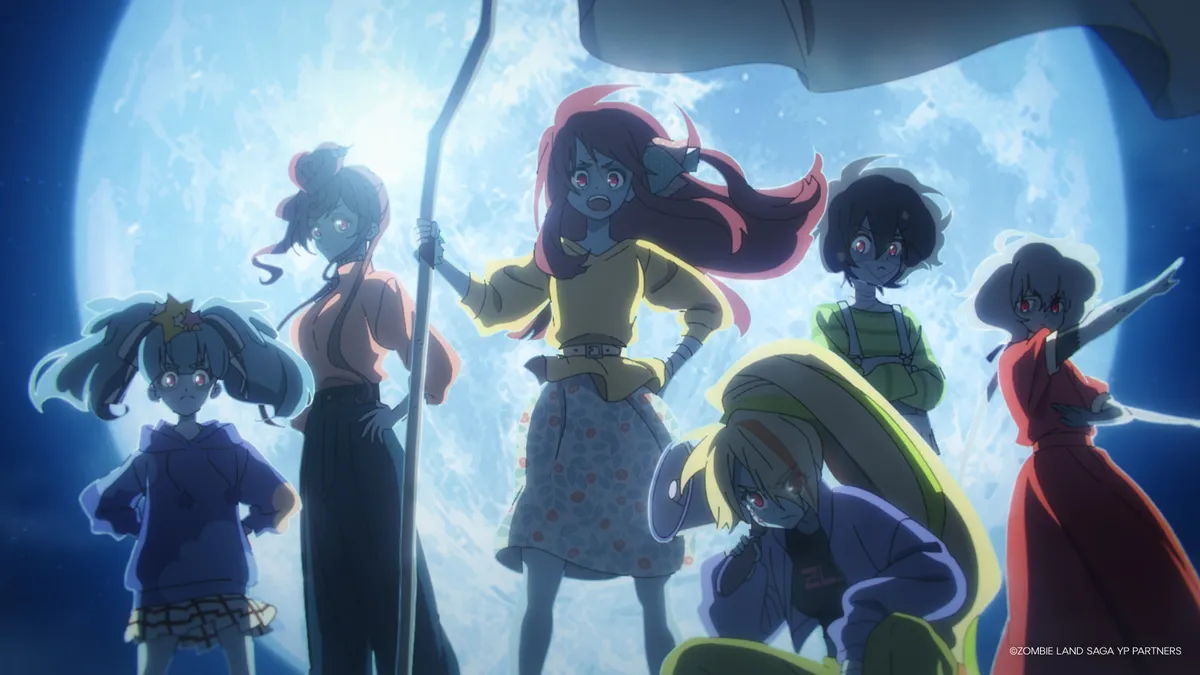

Four years after the “Revenge” concert, the girls of Franchouchou are lining up their biggest moment yet: headlining the Saga Expo. It plays like the natural high point of their local grind, with the familiar rhythms of idol prep and community momentum. Then the film yanks that routine out from under them with a sudden extraterrestrial threat. The mission jumps from saving a prefecture through song to stopping the total destruction of the world.
That spike in scale lands like a sharp genre-swap in an experimental game, where a clean, simple loop suddenly unlocks a much larger ruleset. The opening fifteen minutes function as the handoff. You get the classic, high-energy zombie antics that defined the series, then the story drops into the chaos of a full-scale invasion.
The pacing makes the viewer process two modes at once: the scrappy origin of this group and the reality that they now stand in as global defenders. The pivot feels earned because this series has always used hard turns as part of its identity.
The Awakening of a Legend
Tae Yamada has always been the group’s quiet wild card, a presence that bites through scenes without needing dialogue. This film puts her front and center by triggering an awakening that flips her personality. The physical-comedy Tae falls away, replaced by a stoic figure guided by responsibility. This Tae moves with purpose. Her “legend” status comes through what she does on screen, with the film trusting behavior and choices to carry the weight.
That shift strains the team dynamic fast. Tae’s memories from her time as a mindless idol are gone, and that gap shapes how she reads the other girls. The sense of team that once came automatically now has to be rebuilt in real time. Sakura steps in as the emotional anchor, pushing toward connection and trying to reach the Tae they remember while learning how to stand beside the warrior in front of them. The emotional hit comes from watching identity fracture in motion, with friends working to keep a bond intact as the person inside it changes.
The film keeps Tae’s specific backstory hazy, and that decision pays off. The mystery stays intact, and Tae still gets agency in the present conflict. Determination and current choices define her, which gives her arc a clean throughline even as the plot races into bigger stakes.
Managing High Stakes and Absurdity
The invasion story leans on science fiction tropes to give the chaos a framework. The aliens look strange and unsettling, with designs built around biological oddity that clashes with Saga’s bright, cheerful texture. Their sensitivity to sound sets a pressure point that fits the film’s musical DNA. Songs and noise stop being simple performance tools and start acting like systems the characters must manage, almost like a mechanics shift where the same input produces higher risk.

The middle stretch widens to include the military and government, and that expansion slows the pace. Attention pulls away from Franchouchou to map out the global response, which adds scale while thinning the time spent inside the core cast’s emotional beats. The film corrects its own drift by leaning into the absurdist humor fans expect. Lily piloting a massive robot works as a pressure valve, cutting tension without breaking the scenario’s logic. The local cop joining the fight reinforces the community angle, keeping Saga’s people involved instead of turning the conflict into distant spectacle.
The strongest material shows up when the outside threat presses directly on the group’s internal stress. The story finds momentum when it uses sci-fi devices to test trust, belonging, and the messy work of staying together while the world demands a clean victory.
A Spectacle of Finality
MAPPA brings a slick visual package, blending traditional animation with polished digital effects. The action set pieces and the idol performances both benefit, and the film treats each as part of the same flow instead of separate modes. In game terms, it feels like the production understands its own hybrid design: combat energy and performance energy run on the same fuel.
The final thirty minutes build into a grand gathering for the people of Saga. Side characters from previous seasons return, giving the climax a lived-in texture and making the finale feel tied to the group’s path since their resurrection. The emotional peak hits during the closing concert. Tae’s fight to stay conscious puts a bittersweet edge on the music, and the performance carries the constant threat of loss.
Nostalgia is used with precision. Photographs and planetarium visuals echo the group’s history and push a strong sense of finality for the franchise. New songs and choreography turn the last stretch into a full-on spectacle that rewards long-time viewers. The concert plays as the group’s triumph in uniting their home against an impossible threat, and the ending lands as closure for both the characters and the community they’ve formed.
The theatrical feature Zombie Land Saga: Yumeginga Paradise premiered in Japanese theaters on October 24, 2025, and made its international debut in North America on January 19, 2026. Produced by studio MAPPA, the film serves as the direct sequel to the 2021 television season Zombie Land Saga Revenge. Following the cliffhanger finale of the series, the story depicts the zombie idol group Franchouchou as they transition from local Saga celebrities to the front lines of an extraterrestrial invasion during the Saga World Science and Space Expo. Fans can currently experience the film in select theaters through the “Crunchyroll Anime Nights” screenings, while the preceding two seasons are available for streaming on Crunchyroll.
Full Credits
Title: Zombie Land Saga: Yumeginga Paradise
Distributor: Toei Company, Ltd. (Japan), Crunchyroll, Sony Pictures Releasing International (International)
Release date: October 24, 2025 (Japan), January 19, 2026 (United States and Canada)
Rating: PG (United States), Eiga G (Japan)
Running time: 122 minutes
Director: Kônosuke Uda (Chief Director), Takafumi Ishida, Takeru Satō
Writers: Shigeru Murakoshi
Producers and Executive Producers: Cygames, Avex Pictures, MAPPA, Yuriko Waki (Animation Producer), Z. Charles Bolton (English Dub Producer)
Cast: Mamoru Miyano, Kaede Hondo, Asami Tano, Risa Taneda, Maki Kawase, Rika Kinugawa, Minami Tanaka, Kotono Mitsuishi, Daisuke Ono, Hakuryu
Director of Photography (Cinematographer): Momoko Mifune
Editors: Masato Takemiya
Composer: Yasuharu Takanashi
The Review
Zombie Land Saga: Yumeginga Paradise
This film succeeds by trading its comfortable idol routines for a high-stakes genre collision. While the middle act suffers from pacing issues and a distracted focus on secondary characters, the emotional core remains firmly rooted in the transformation of Tae Yamada. The visual spectacle provided by MAPPA ensures that the transition to the big screen feels justified, culminating in a finale that balances absurdist joy with a genuine sense of bittersweet closure. It is a bold, albeit occasionally messy, love letter to the franchise and the community of Saga.
PROS
- Dynamic character growth for Tae Yamada.
- Exceptional animation and concert visuals.
- Touching emotional resonance and finality.
CONS
- Slow pacing in the middle section.
- Over-reliance on generic sci-fi tropes.
- Disconnect from the main cast during global subplots.







