
























![Kingdom Hearts Collection [I-III] Review](https://gazettely.com/wp-content/uploads/2026/10/Kingdom-Hearts-Collection-I-III-1-360x180.webp "Kingdom Hearts Collection [I-III] Review: KHII Holds Steady as Newer Entries Fluctuate 37")



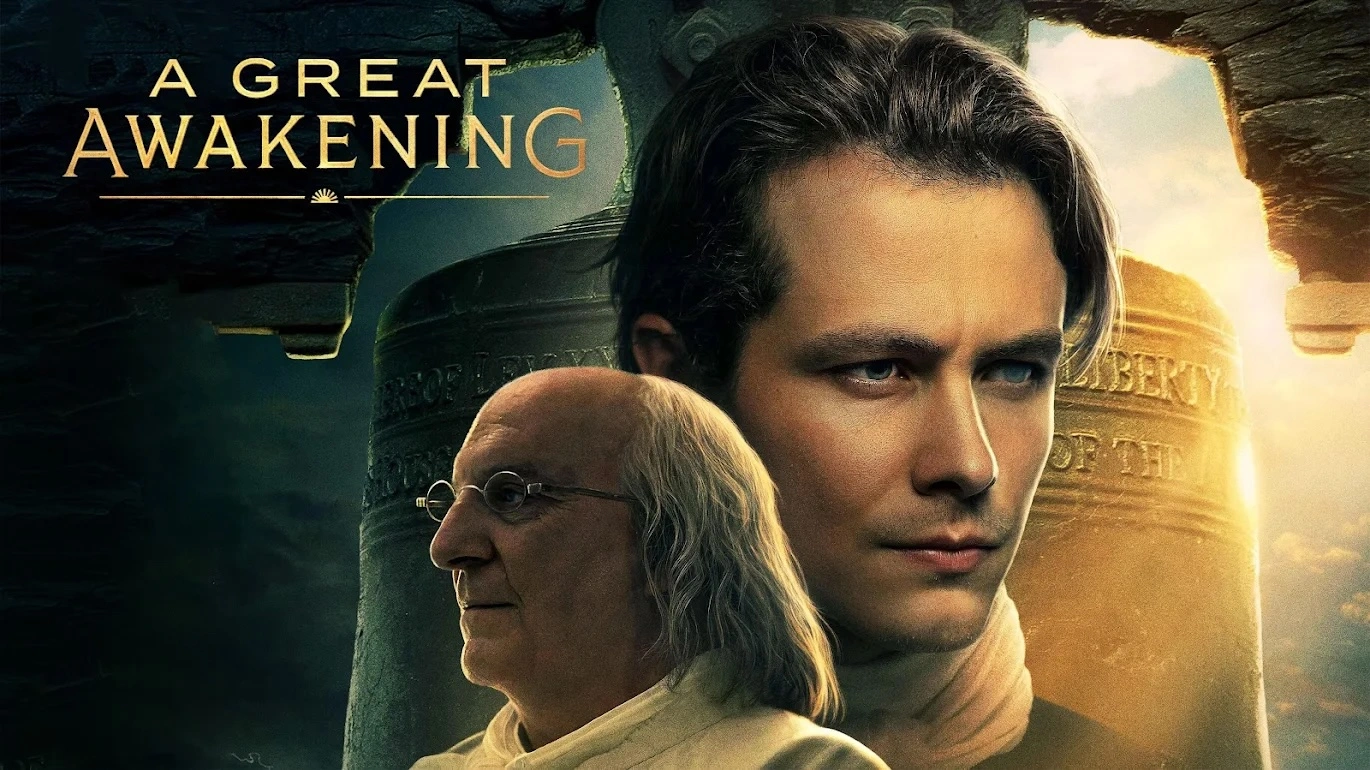

A Great Awakening (2026) arrives as a historical drama built around the mid-18th-century spiritual revival that reshaped the American colonies. Directed by Joshua Enck and produced by Sight & Sound Films, the film follows the relationship between famed evangelist George Whitefield and intellectual polymath Benjamin Franklin. The story begins in the sweltering heat of the 1787 Constitutional Convention.
An elderly Franklin, played by John Paul Sneed, reflects on his life while watching the young nation stumble through political gridlock. He comes across Whitefield’s journals and letters, and those discoveries open the film into memories spanning several decades. These recollections chart Whitefield’s path from a young man drawn to the theater to a commanding orator whose voice could reach thousands.
The film argues that the American Revolution was preceded by a revolution of the soul. It suggests that colonial identity grew through the sermons Whitefield delivered and Franklin printed. The cast includes Jonathan Blair, JT Schaeffer, and Tricia Bridgeman, with thousands of period-accurate costumes used to recreate colonial Philadelphia and the fields of England.
The Narrative Frame: 1787 and the Power of Memory
The film begins in June 1787, inside a suffocating conference hall where the Founding Fathers argue over the fragile shape of the nation. The humidity of a Philadelphia summer presses into the room. Joshua Enck places the story inside a moment of crisis, letting the political tension give the drama its first pulse.
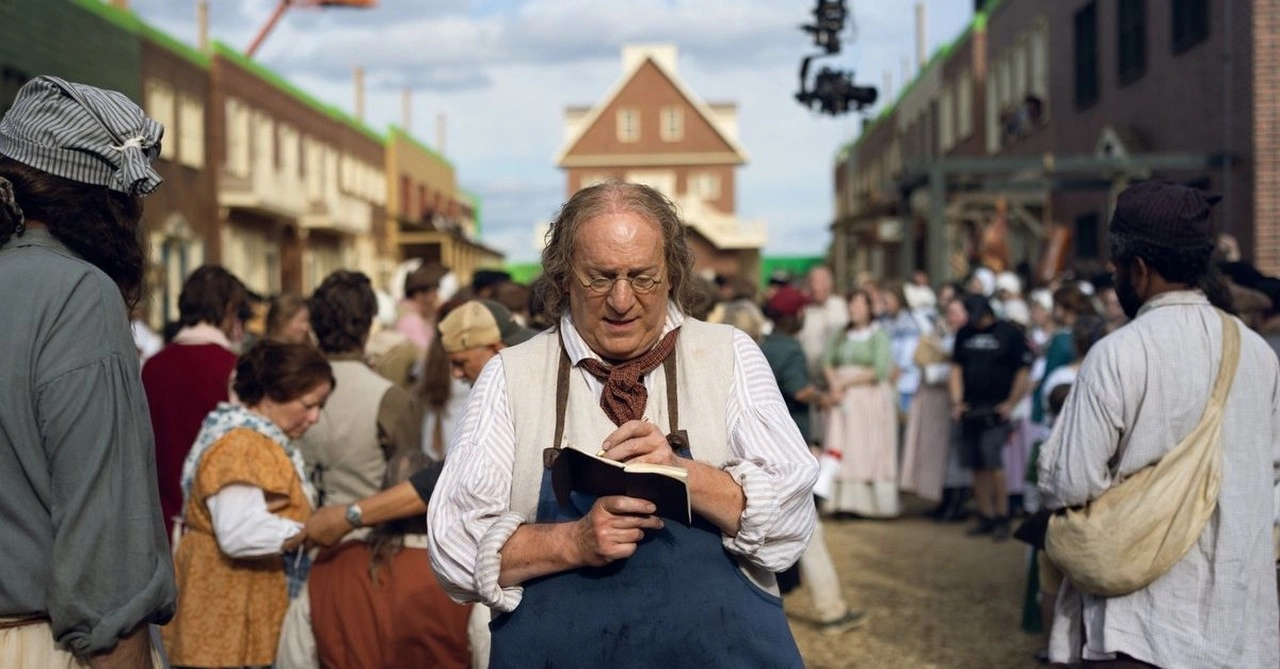
John Paul Sneed plays Benjamin Franklin as aged, observant, and tired of the endless quarrels around him. During a quiet beat, Franklin folds a scrap of paper into a small kite, a graceful visual reminder of his younger years of scientific curiosity. The room feels crowded with discord. The dream of unity hangs by a thread.
That tension sends Franklin back to his print shop, where he speaks with his grandson, Benny Franklin Bache, played by JT Schaeffer. Their exchange gives the film its structural spine. Together, they discover journals and letters belonging to George Whitefield. These artifacts become the film’s passage into the past.
The movie resists a plain chronological march through history. It uses paper, memory, and reflection to pull the audience back to the 1730s. This framing lets the story unfold through the eyes of a man measuring his public legacy against his private recollections.
Franklin makes a striking claim in these scenes. He tells Benny that Whitefield was the revolution. That line shifts the film’s attention away from treaties and battlefield language toward spiritual unity. The Great Awakening is presented as the social glue that helped bind the colonies.
Before the United States existed, colonists shared an experience beneath Whitefield’s preaching. That narrative move reframes the nation’s birth through culture and belief. Memory gives the historical sweep a warmer, human scale, which helps the film keep its grand claims within reach.
Portrait of a Preacher: The Evolution of George Whitefield
George Whitefield enters the story as a humble tavern busboy with dreams of the theater, and the film treats that background as essential. His early life in service gives him a view of ordinary people that shapes his later ministry. His theatrical instincts become a key part of his power.
Jonathan Blair plays Whitefield with a controlled inner flame. At Oxford, Whitefield joins the “Holy Club,” where he works alongside John Wesley, played by Carson Burkett. The film presents the group’s severe discipline and the rigorous self-examination that leads to Whitefield’s spiritual conversion.
Blair’s performance captures the physical strain of 18th-century oratory. Whitefield reached thousands without modern amplification, and Blair uses voice, posture, and stillness to suggest that scale. One of the film’s strongest sequences takes place in Bristol, where Whitefield speaks before a crowd of coal miners.
Dirt marks their faces, and the sincerity of his words cuts through the harshness of the setting. The scene makes the reach of his message easy to feel. He speaks to people often ignored by the established church. Anglican authorities see his style as volatile and push him out of England. That rejection drives his mission into the colonies.
The film presents Whitefield with moral complication. It addresses his history as a slaveholder, creating a difficult tension beside his message of spiritual freedom. The screenplay shows a man who could see people with humanity while still living inside a system of oppression. That tension gives the drama a necessary roughness. History rarely arrives cleanly packaged, and the film respects that messiness. Whitefield also faces church leaders who consider his methods scandalous.
Those conflicts give weight to his rise, since his popularity grows from the same traits that disturb religious authorities. The story follows a man caught between conviction and the social structures around him. His actor’s instincts help him reach common people, and that connection changes the religious life of two continents. Blair keeps the portrayal grounded during the fiercest sermons, steering the preacher away from caricature.
The Franklin Connection: Science Meets Faith
The relationship between Benjamin Franklin and George Whitefield gives the film some of its richest material. Their first meeting in 1739 works as a major dramatic hinge. A crowd of nearly 30,000 people gathers in Philadelphia, an enormous share of the colonial population at that time.
Franklin studies the event like a scientist. He walks to the edges of the crowd to test how far Whitefield’s voice carries. He applies his knowledge of sound to calculate the sermon’s reach. It is a wonderful scene because it lets faith and reason occupy the same physical space.
Their relationship benefits both men. Franklin recognizes the commercial force of Whitefield’s popularity and uses his printing press to turn the preacher’s spoken words into lasting text. That distribution matters. It allows the message to travel far past the reach of a single voice. Franklin gains influence and profit. Whitefield gains access to the colonies through print. One man belongs to the Enlightenment. The other belongs to the spirit. Their respect survives clear differences in how they understand the divine.
The film gives time to their intellectual debates. They discuss light and the unseen forces that shape the world. Franklin changes through the friendship. Brief flashes show his path from a child tithed to God to a printer’s apprentice. He moves from skepticism toward an appreciation for a virtuous populace.
That evolution reaches its peak at the Constitutional Convention, where Franklin suggests that the delegates seek guidance through prayer. The film links that call to Whitefield’s influence. It suggests that Franklin came to see faith as useful in sustaining a free society. Their partnership helps shape a new American identity through the printed word and the spoken sermon. Their collaboration connects different colonial regions and prepares the ground for a new nation.
Visual Language and Technical Production
The film’s visual style draws heavily from cinematographer Steve Buckwalter’s use of light. Light becomes a sign of spiritual clarity. In the Bristol mine scenes, darkness presses down on the frame. Sunlight arriving during the sermon feels almost physical, like relief entering the lungs.
That contrast makes the film’s message easier to grasp. The memory sequences carry vivid, saturated colors, which suggests that Franklin’s recollections remain alive and immediate. The film avoids the washed-out look often attached to historical drama. The 18th century feels present and tactile.
Chris Rose’s production design brings substantial detail to the world. The team recreates large sections of colonial Philadelphia, and Market Street feels like a working space full of texture. I remember visiting Philadelphia’s historic district as a child and being fascinated by the old bricks and tall windows. This film catches that exact architectural feeling. Costume designers Lily Steiner and Andrea McCormick produced 2,000 garments, giving every extra a believable period presence. The fabrics help anchor the film in physical reality.
Chad Marriott’s score shapes the emotional tone with care. It moves between intimate instrumental passages and large choral arrangements. The music supports the scale of the story without overwhelming it. Sound design matters too.
The rumble of storms often appears during the most forceful rhetorical moments, giving the drama a clean punctuation mark. The production carries the mark of Sight & Sound’s stage background. The large crowd scenes have theatrical grandeur, and digital effects expand the physical sets to create a scale that stage space alone could never provide.
The move from live theater to cinema brings a few visible seams. Some blue-screen work is slightly noticeable. These moments do little to weaken the film’s final impact. The actors’ experience with large-audience performance becomes an asset, especially since the story follows historical figures defined by public speech and presence. Jordan Graff’s editing keeps the shifts in time clear. The film moves between 1787 and earlier decades without losing its line of thought. The technical pieces create a unified vision of the past, substantial in craft and careful in design.
A Great Awakening premiered in theaters nationwide on April 3, 2026, coinciding with the Easter weekend and the lead up to the 250th anniversary of the United States. Produced by Sight & Sound Films in partnership with Roadside Attractions, the movie focuses on the intersection of faith and political philosophy during the 18th century. It depicts the evolving relationship between Benjamin Franklin and Reverend George Whitefield as they navigate the shifting social landscape of the American colonies. Audiences can currently view the film on the big screen as it continues its primary theatrical run across North America.
Where to Watch A Great Awakening (2026) Online







Full Credits
Title: A Great Awakening
Distributor: Roadside Attractions, Sight & Sound Films
Release date: April 3, 2026
Rating: PG-13
Running time: 129 minutes
Director: Joshua Enck
Writers: Jeff Bender, Jonathan Blair, Joshua Enck
Producers and Executive Producers: Steve Buckwalter, Troy Thorne
Cast: John Paul Sneed, Jonathan Blair, Josh Bates, Stephen Foster Harris, Zac Johnson, Matt Meyer, Russell Dean Schultz, JT Schaeffer, Alana Gerlach
Director of Photography (Cinematographer): Steve Buckwalter
Editors: Jordan K. Graff
Composer: Chad Marriott
The Review
A Great Awakening
A Great Awakening succeeds as a visually rich exploration of early American identity. It frames the friendship between Franklin and Whitefield as a foundational cultural shift rather than a dry history lesson. Jonathan Blair delivers a powerful performance that anchors the spiritual intensity of the narrative. While some production elements betray a stage-focused background, the film provides a thoughtful look at how shared ideals once bound a fragmented populace. It provides an engaging perspective for those interested in the intersections of faith and reason.
PROS
- Jonathan Blair delivers a commanding vocal performance.
- The period costumes and production design feel authentic.
- The narrative structure uses history as a living memory.
- The film explores the technical aspects of 18th-century communication.
CONS
- The framing device creates occasional momentum breaks.
- Some digital backgrounds look flat on the big screen.
- The musical score stays at a high intensity for too long.
- Historical complexities regarding slavery remain somewhat surface level.