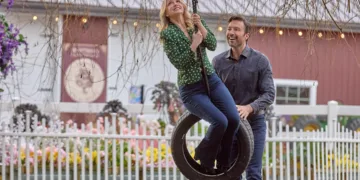





























In A Season to Blossom, Elise Everett reaches a turning point between the security of corporate work and the quieter pull of her literary ambitions. After years spent drifting, she commits to a permanent position in Chicago. That plan is interrupted when she returns to her hometown of Driftless to oversee the sale of her late grandmother’s bookstore.
Her visit lines up with the local Apple Blossom Festival, a season tied to renewal for the town. There she reconnects with Max Whitman, a childhood friend who is trying to guide his family orchard into the craft cider business. Their reunion leads to a practical partnership.
Elise writes vivid copy for his drinks, and Max helps her keep the store running. As the festival draws closer and a violent storm threatens the local economy, their connection deepens. The film tracks Elise as she works through her identity as a writer and the weight of her grandmother’s legacy. Her arc rests on a difficult choice between a dependable career and a life shaped by creativity.
Written Wisdom and Personal Friction
Elise moves through the story with the pressure of a long creative block hanging over her, and her unfinished manuscript feels like evidence of a life she has left suspended. Her sharp response to the bestseller The Plus-One Problem makes that frustration visible. It exposes envy, doubt, and the fear that time has moved on without her. The film gives her a form of guidance through her grandmother’s lingering presence.

Gram has left calligraphic notes throughout the bookstore, each one offering advice that feels personal and immediate. Because these messages appear visually on screen, the audience is drawn right into Elise’s emotional progress. The device works like a cinematic version of inner narration, turning private hesitation into something tactile.
Max Whitman has his own struggle, rooted in the orchard and in his relationship with his father. He wants to build a future through herbal infused ciders, and that choice places him in direct conflict with Earl, who stays committed to traditional crop management. Their disagreement gives the film a second thread about inheritance, expectation, and the cost of trying to reshape family work into something new. Max’s goal has commercial stakes, though it also carries personal meaning, since his push for change reflects a desire to define himself within a legacy that already feels mapped out.
The arrangement between Elise and Max begins as a clean exchange of skills, and that structure gives the romance a useful narrative engine. He brings the labor the bookstore needs. She gives his ciders language, personality, and a way to reach buyers on an emotional level. Her descriptive writing becomes a form of authorship that extends beyond the manuscript she cannot finish.
The copy she creates for his flavors helps him compete for a national vendor, so her talent starts affecting the world around her in concrete ways. That detail ties the film’s emotional and practical threads together. Writing is not treated as an abstract dream. It becomes action. Their partnership grows because each person supplies something the other lacks, and that mutual faith helps them question the lives they have settled into.
The Aesthetic Logic of Driftless
The Driftless Bookstore anchors the film’s visual design in warmth and familiarity. It feels lived in, protective, and deeply tied to memory. Antique lamps, plush couches, and decorative objects fill the rooms, giving the store the texture of a place shaped through years of care. Even the “Business” section carries that sensibility, with old law books on the shelves in place of current manuals. The space tells its own story before anyone speaks. It reflects Gram’s influence and explains why Elise finds it hard to treat the store as a simple asset to be sold.
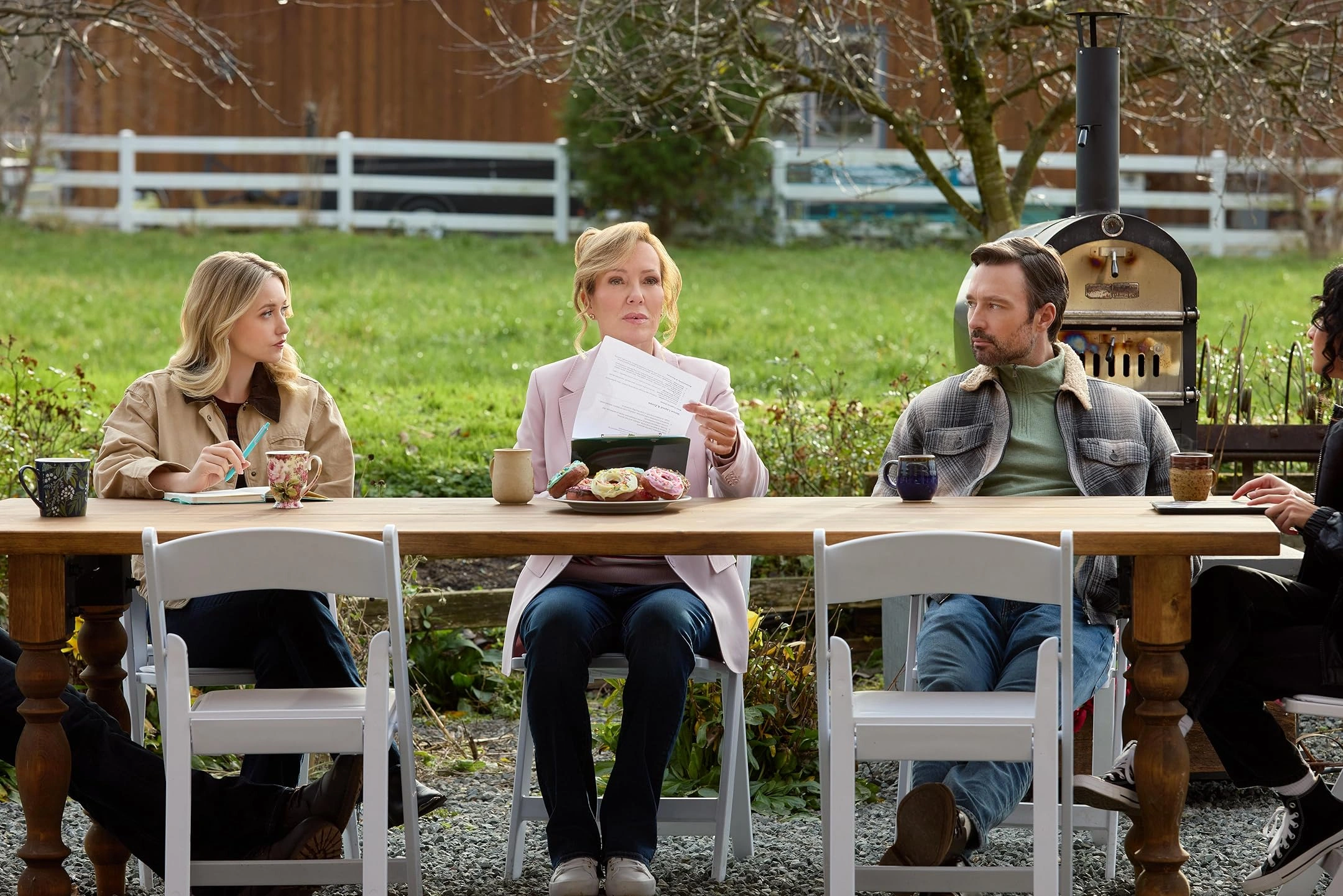
The production also carries a visual contradiction that becomes hard to miss. The title points toward spring, yet the world on screen often looks like late autumn. Dead leaves cover the ground, and the characters dress in heavy layers suited to colder weather. The cider motif strengthens that feeling.
Spring arrives more clearly near the end, when Elise’s wardrobe shifts and the image finally catches up with the promise in the title. That gap between premise and appearance creates an unusual rhythm. It gives the town a suspended feeling, as though renewal has been delayed until Elise is ready to claim it.
The thunderstorm serves as the story’s point of highest pressure. It threatens the fragile apple blossoms and causes a mechanical failure in the cider tanks, forcing the characters to protect either their safety or the results of their work. For a quiet town, those stakes land with real force.
Driftless itself is presented as an idealized refuge, full of neighbors who offer steady kindness and a local market that supports the people around it. That atmosphere gives the film a gentle confidence. The town feels like a place where purpose can still be rediscovered through shared effort and care.
Subplots and Supporting Soul
Emily Tennant plays Elise with a clear sense of hesitation, and that quality gives the character emotional credibility. She captures the feeling of someone attached to a future that no longer fits cleanly. Carlo Marks gives Max a strong sense of professional drive, which helps the romance unfold at an unhurried pace. Their connection develops patiently, and that measured pacing makes the payoff feel honest.
Earl and Winnie bring a stronger emotional current to the film’s secondary romance. Their bookstore poetry reading lands as one of its most affecting scenes. The younger leads helping them get ready for a first date adds a playful look at love across generations, and it broadens the film’s sense of companionship beyond the central couple. Molly, the bookstore manager, gives the shop a grounded stability. Her subplot involving baking adds a domestic softness to the space, and her presence reflects the kind of steadiness Elise has been missing.
Clover the cat also carries quiet narrative weight. The animal suggests an ongoing connection to Gram, and the stray’s determination to remain with Elise feels like a small push toward the life waiting for her. One production choice stands out in a less effective way.
The makeup for the female leads is strikingly heavy for such a rustic setting. Elise often appears with full evening tones early in the morning. That choice can pull the viewer out of the town’s natural texture, yet it still belongs to the heightened reality the film embraces. Taken together, these details shape a world where second chances feel real, tender, and close at hand.
A Season to Blossom premiered on the Hallmark Channel on April 4, 2026, as a featured title in the annual Spring Into Love programming event. The story follows an aspiring novelist who returns to her roots to manage her late grandmother’s bookstore, discovering a renewed sense of purpose and a blossoming romance in the process. You can currently watch the film during its encore presentations on the Hallmark Channel or stream it on demand via the Hallmark+ platform.
Where to Watch to A Season to Blossom (2026) Online






Full Credits
Title: A Season to Blossom
Distributor: Hallmark Channel
Release date: April 4, 2026
Rating: TV-G
Running time: 84 minutes
Director: Terry Ingram
Writers: Jennifer Wolfgram
Producers and Executive Producers: Jordan Smysnuik, Gary King, Gemma Martini, Trevor McWhinney
Cast: Emily Tennant, Carlo Marks, EaeMya Thyngi, Laura Soltis, Mark Humphrey, Devon Kenzo, Laura Londoño
Director of Photography (Cinematographer): Courtney Julien
Editors: Richard Schwadel
Composer: Tommy Fields
The Review
A Season to Blossom
A Season to Blossom succeeds as a comfort watch by leaning into the familiarity of its genre. The film finds its strength in the mechanical exchange of skills between its leads and the grounded emotional stakes of the secondary romance. While the visual inconsistencies and reliance on standard tropes make it feel predictable, the sincere performances and the cozy bookstore setting provide a satisfying experience for fans. It represents a solid example of small-town storytelling that prioritizes heart over innovation.
PROS
- Natural chemistry between the lead actors.
- Strong emotional weight in the secondary romance subplot.
- Detailed and inviting production design for the bookstore.
- Creative visual integration of the grandmother's notes.
CONS
- Heavy reliance on established genre cliches.
- Visual mismatch between the seasonal theme and the actual setting.
- Slow narrative pacing in the first half.
- Stylistic choices like makeup feel out of place for the environment.