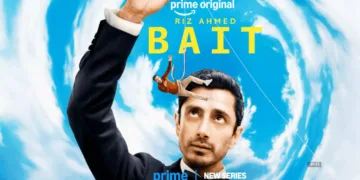




























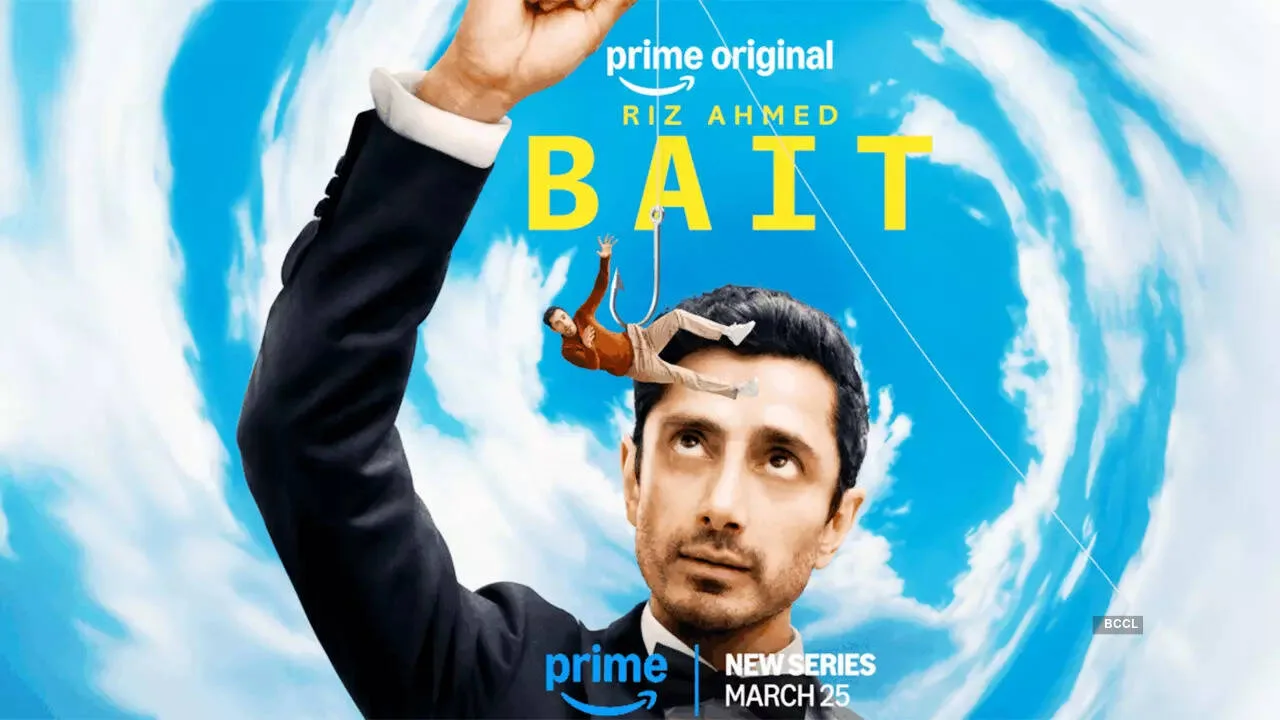

James Bond has always been a mirror held up to Britain’s idea of itself: suave, unflappable, sovereign. Every few years, when the question of who should next inhabit that tuxedo resurfaces, the conversation quietly becomes something else. It becomes a question about belonging. About which bodies the nation is prepared to project its fantasies onto. Riz Ahmed’s six-part Amazon Prime Video series Bait plants itself inside that question and refuses to make it comfortable.
Ahmed creates and stars as Shah Latif, a British-Pakistani actor a decade into a career of near-misses, who auditions disastrously for Bond and then, in a single impulsive act, ensures the world finds out anyway. The autobiographical parallels are hard to ignore: Ahmed shares Shah’s Pakistani heritage, Wembley upbringing, Oxford education, rap background and indie-film roots. What he doesn’t share, thankfully, is Shah’s trajectory. Co-showrunner Ben Karlin, directors Bassam Tariq and Tom George, and a cast including Guz Khan, Sheeba Chaddha, Ritu Arya and Weruche Opia complete the picture.
It begins as one kind of show and becomes several others. That is both the point and the challenge.
A Man Who Can’t Remember His Lines
Shah is introduced mid-audition, blanking on dialogue in front of a director who has run out of patience. He has been fasting for Ramadan, he explains. Except he hasn’t. The lie is telling.
This is a man caught between identities he hasn’t fully inhabited. When a hot microphone catches him calling himself a “stupid Paki” in a dressing room, it captures something the show examines with real honesty: racism absorbed over a lifetime doesn’t stay external. It moves inward. It starts sounding like your own voice.
His career’s ledger is grim. He hawks a “2015 Rising Star” festival award online. Strangers mistake him for Dev Patel and then note he’s neither tall nor handsome enough to actually be Dev Patel. His father watches television all day and has never seen Shah on it. When the Bond rumor breaks, his family’s pride arrives so suddenly that it illuminates, without commentary, exactly how invisible he had felt before.
The Bond debate frames the show, but the question underneath is older. Who gets to be considered sufficiently British? The progression from “who will play Bond?” to “who is British?” is one the series makes without fanfare, letting the logic surface through Shah’s daily experience. His cousin Q never once registers that she shares a name with a beloved 007 character. The show doesn’t underline the joke. It leaves it there, which is exactly the right instinct.
The grief surrounding Q and Zulfi’s late mother exists at the edges of scenes, never given the space it deserves. It remains the one thread Bait doesn’t fully trust itself to pull.
A Genre in Freefall (On Purpose)
Pinning a genre label to Bait is a small act of futility. The show opens as domestic sitcom and arrives, by episode five, at post-9/11 Bourne thriller. These are not the same show. That’s the intention.
The Eid episode belongs to Sheeba Chaddha, whose comedic timing grounds the series before it tips into the strange. A backyard gathering pivots into a faux-Bollywood musical number that arrives without apology. Then comes the near-continuous-take episode as Shah tracks down his ex’s bag across East London into a rave, with Ahmed and Ritu Arya playing it as a rom-com both characters are too self-aware to surrender to.
The Patrick Stewart element requires its own paragraph.
A pig’s head thrown through the window of Shah’s family home in episode one is a visceral hate crime that should shut a story down into grief. Instead, Shah begins having full conversations with it, the severed head speaking in Patrick Stewart’s voice and dispensing worldly cynicism in equal measure. It is a Lord of the Flies allusion rendered as podcast format. Deeply odd. It works.
The pig’s head externalizes Shah’s internal monologue: the part of him that suspects everyone wants him to fail, or only wants him to succeed for reasons that have nothing to do with him. As a dramatization of paranoia, it is far more interesting than a therapy scene would have been.
The finale resolves its threads at a speed that feels slightly defensive, as though the show became uncertain, in its final half-hour, of how much weight its architecture could bear.
How to Film a Man Coming Apart
Bassam Tariq brings a visual sensibility that treats domestic spaces as contested terrain. Wide lenses push the walls of Shah’s parents’ house outward even as family dynamics press inward. The handheld camera follows characters with the restless proximity of someone not quite welcome, which turns out to be exactly the right register for Shah’s experience of his own life.

Tom George’s episodes replace intimacy with distance. Long lenses observe Shah from across train platforms, from angles that imply surveillance. The contrast between the two directors’ approaches externalizes Shah’s disintegrating sense of reality more effectively than the script alone could manage.
The Urdu-English code-switching in the dialogue, characters talking over each other in both languages, creates an atmosphere of density and warmth that feels genuinely specific. The soundtrack earns equal trust. A Urdu cover of “Sweet Dreams” opens the series as a thesis statement: aspirations and cultural inheritance existing in the same breath. Pakistani classics from Tafo Brothers and Nermin Niazi sit alongside the score without being curated into nostalgia. They simply belong there.
Where craft falters is at the seams. Some psychological threads are introduced with audacity and folded away before paying off. Bait is formally ambitious enough that its limits feel avoidable rather than structural.
The Eyes Have It
Riz Ahmed has always operated at the edge of stillness. In Sound of Metal, the stillness was the subject. In Bait, Shah Latif is a man in constant motion, and Ahmed’s greatest feat is making the panic visible without making it cartoonish.
The key is the eyes. Large and expressive, registering micro-shifts in hope, calculation and terror, they do the work Shah’s mouth is too guarded to do. His comedic range here is a genuine rediscovery. Since Four Lions, Ahmed has leaned toward dramatic gravity, and justified it. Bait gives him back a talent for bumbling that is specific and endearing: Shah self-sabotages with the commitment of someone who has rehearsed it, and Ahmed plays the destruction as both funny and quietly devastating. Episode five, essentially a two-hander with Patrick Stewart’s disembodied voice, is where the show stakes its boldest claim on his range.
Guz Khan as Zulfi is the best supporting performance in the series. The entrepreneurial bravado of his Muslim rideshare scheme sits atop genuine anger that Khan releases in controlled bursts. His scenes with Ahmed generate the show’s most organic comedy. Sheeba Chaddha’s Tahira is a doting mother played with enough specificity to avoid the archetype. Ritu Arya’s Yasmin is the series’ most intellectually honest presence, and the East London episode built around the two of them is the emotional high point of the run.
Bait is at its most alive when these people are in a room together, talking over each other in two languages, and the camera can barely keep up.
Bait is a sharp British comedy-drama series created by and starring Academy Award winner Riz Ahmed. The show premiered globally on Amazon Prime Video on March 25, 2026, and follows the chaotic life of Shah Latif, a struggling actor who suddenly finds himself in the media spotlight when he is shortlisted to become the next James Bond. Spanning six episodes, the series explores themes of identity, fame, and the pressures of representation within the Pakistani Muslim community in West London. You can currently stream the entire first season exclusively on Prime Video.
Where to Watch Bait Online


Full Credits
Title: Bait
Distributor: Amazon Prime Video
Release date: March 25, 2026
Rating: TV-MA
Running time: 23–27 minutes
Director: Bassam Tariq, Tom George
Writers: Riz Ahmed, Ben Karlin, Dipika Guha, Prashanth Venkataramanujam, Karen Joseph Adcock, Azam Mahmood
Producers and Executive Producers: Riz Ahmed, Ben Karlin, Allie Moore, Jake Fuller, Roopesh Parekh, Tony Hernandez, Brooke Posch, Molly Seymour, Chris Sheriff, Karen Joseph Adcock, Dipika Guha, Prashanth Venkataramanujam, Azam Mahmood
Cast: Riz Ahmed, Guz Khan, Aasiya Shah, Sheeba Chaddha, Sajid Hasan, Ritu Arya, Weruche Opia, Maxine Peake, Rafe Spall, Soni Razdan, Himesh Patel, Sian Clifford
Director of Photography (Cinematographer): Frank Lamm
Editors: Ant Boys, Gary Dollner
Composer: Shruti Kumar
The Review
Bait
Bait is a formally daring, frequently funny and occasionally brilliant piece of television that doesn't quite fulfill everything it promises. Riz Ahmed's performance anchors a show genuinely willing to take risks with genre, identity and structure. The finale retreats too quickly from its own boldest ideas, and some emotional threads deserved more room. What survives those limitations is sharp, specific and unlike anything else streaming right now.
PROS
- Riz Ahmed's layered, funny and physically precise central performance
- Formal ambition: each episode shifts register and visual grammar deliberately
- Authentic cultural specificity in dialogue, soundtrack and family dynamics
- Patrick Stewart's pig's head is genuinely inspired absurdist storytelling
- Strong supporting cast, particularly Guz Khan and Ritu Arya
CONS
- Finale resolves complex threads too hastily
- Shah's family trauma is underdeveloped given its emotional potential
- Some psychological complexity introduced and abandoned mid-series
- Supporting characters occasionally feel more like concepts than people