



























Deep Water positions the modern traveler inside a pressurized metal tube at thirty thousand feet, a fragile ecosystem of convenience. This intercontinental flight from Los Angeles to Shanghai serves as a microcosm of globalism. First Officer Aaron Eckhart and Captain Ben Kingsley manage a cargo of human hopes and unstable electronics.
The procedural routine of a commercial flight acts as a thin veneer over the primal chaos waiting in the dark. A passenger’s trivial negligence sparks a fire that destroys the technical sanctity of the cabin. This mid-air crisis necessitates a landing in the vast Pacific, turning a high-tech vessel into floating debris. The transition from a disaster epic to a claustrophobic horror piece happens as the survivors face an ancient predator.
It is a cinematic study of the “unsinkable” myth revisited for the lithium-ion age. Sophisticated navigation systems prove useless when the floor disappears into the brine. The film examines the vulnerability of our artificial heavens. Nature remains a cold accountant. The flight path ends in a dark struggle for existence, with the promised lights of Shanghai abandoned behind the horizon. Modern miracles are only as safe as the smallest battery.
The Kinetic Anatomy of Collapse
Angus Sampson portrays Dan, a character whose social friction is as combustible as the battery pack in his luggage. He is the personification of the “unregulated individual,” a figure who ignores safety protocols for a cigarette and dooms a hundred strangers. The fire in the cargo pod provides a visceral representation of tech-anxiety.
When the fuselage breaches, the direction captures a terrifying loss of agency. Bodies and luxury items become shrapnel in a depressurized void. The plane ripping apart feels like a rejection of our artificial habitats. The shrapnel dancing in the cabin is a visual poem of destruction. The luxury of the first-class cabin gets shredded by the physics of the cargo bay. This is the end of the sky-age.
This sequence provides the strongest visceral reaction in the film. It highlights our total dependence on machines that are, in the end, just metal and wires. Harlin manages a sense of “crash-entropy” that feels dangerously real. The sound of failing engines creates a rhythmic dread that mimics a dying heartbeat.
The pilot’s struggle to land on the water is a masterclass in “kinetic hopelessness.” When the aircraft finally hits the surface, the impact is a jarring return to the physical world. It is a moment where the digital age meets the unforgiving physics of the ocean.
The visual spectacle of the plane faceplanting into the sea serves as a peak of technical execution. The cinematography emphasizes the absolute chaos of the moment. The metal buckles and the sea rushes in to reclaim the space. This is a moment of pure technical prowess. The screen fills with the debris of a broken civilization. The fragility of our wings is laid bare.
Geography of the Floating Graveyard
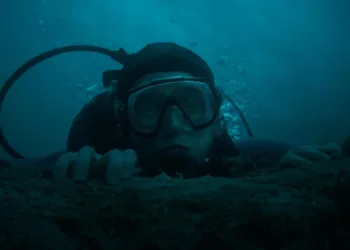
The Pacific transforms into a floating graveyard, divided into three islands of wreckage. Survivors are isolated on the cockpit, the fuselage, and yellow rafts, creating a geography of separation. The audience experiences a sense of “wreckage-vertigo” as the film jumps between these segments. Mako sharks appear as the ultimate opportunists, drawn to the acoustic signature of the crash. They are biological machines of consumption. The film abandons psychological restraint for “viscera-porn.”
Shark attacks are sudden and graphic, stepping past fear of the unseen into the realm of the “splatter-aquatic.” Limbs are lost and bodies bisected with a clinical coldness. This shift to gore over suspense transforms the film into a ritual of culling. The mako sharks are biological machines designed for the singular purpose of caloric intake. They represent a nature that remains indifferent to human morality. The feeding frenzy is rendered with a clarity that strips the mystery from the deep.
The sharks are persistent hunters, embodying a biological nihilism. The film moves into a space where the sharks act as the janitors of the disaster site. Scenes of “chum-ification” reflect the brutality of the 1945 USS Indianapolis disaster. The ocean is a hostile environment where social statuses are irrelevant.
The wreckage serves as a fragile lifeboat in a vast, dark expanse. Each section of the wreckage becomes a tiny, desperate stage for a different drama. The sharks circle with a cold, mechanical precision. They are the ocean’s answer to our lithium batteries, forces of nature beyond our control. Nature is a cold accountant.
Social Darwinism on the Pacific Stage
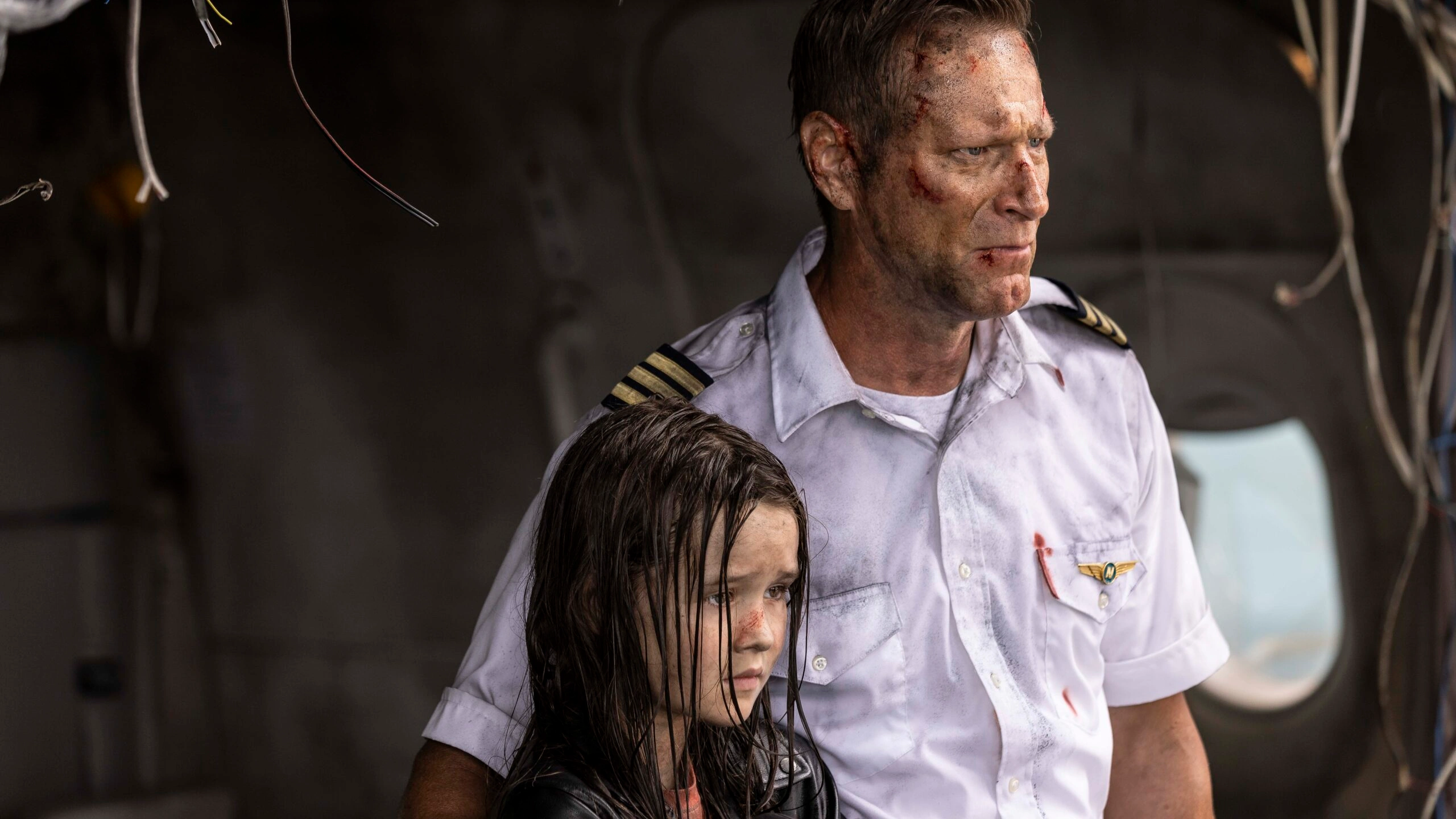
Aaron Eckhart plays the First Officer with a “stoic-sadness” common to characters seeking penance through professional duty. His motivation is anchored in a sick child, a sentimental weight that serves as his moral compass. The survivors are a collection of social archetypes.
E-sports players and rowdy athletes provide a commentary on modern tribalism. They must trade their digital or physical egos for collective survival. The e-sports players discover their reflexes carry a different utility here. The athletes find that their muscles are no match for the predatory efficiency of the deep. This is a lesson in humility.
Ben Kingsley begins as a steady mentor and shifts as the situation degrades, reflecting the collapse of authority. Then there is the “orphan-anchor” of the plot, the young Cora. Her bond with Eckhart creates a “surrogate-lineage” amidst the carnage. This emotional scaffolding is necessary for the film’s survival as a story. The friction between the survivors highlights the frailty of our social contracts. It is a “survival-theater” performed on a sinking stage.
The characters are reduced to their most basic impulses. Some find heroism, while others fall into self-serving cowardice. The script examines how crisis strips away the masks of civility. The film uses these dynamics to reflect our own fractured society. This drama is the human cost of the mechanical failure. The social Darwinism of the raft exposes who we are when the grocery stores disappear.
The Genre-Fracture and Sinking Logic
The film is a study in “narrative-bipolarity,” split between a technical disaster and a monster movie. This division creates a jarring shift in energy. The first half is grounded in mechanical reality; the second half enters a space of “aquatic-absurdity.” Logic gaps become apparent, particularly with the characters’ survival in cold water for extended periods. One might question the biological realism of characters remaining mobile in the cold Pacific for so long, yet the film prioritizes “kinetic-logic” over medical accuracy.
The sharks behave with a “scripted-malice” that feels inconsistent with animal biology. One moment they are tactical geniuses, the next they are meandering props. The atmosphere remains thick with a sense of “imminent-extinction.” The increasing focus on individual arcs during the final act attempts to ground the violence. Some emotional payoffs feel earned. Others are lost in the rapid culling of the cast.
The film manages to keep its energy even when the physical logic fails. It is a messy, blood-soaked exploration of the “survivor-impulse.” The transition between the aircraft crisis and the shark attacks highlights the unpredictability of disaster. The story questions our place in the natural order.
Harlin’s history with the genre informs every frame. He knows the geography of fear on a sinking vessel. The pacing keeps the audience in a state of constant anxiety. The finale leans into the emotional weight of the survivors’ bonds. This return to the shark genre is a loud, chaotic reminder of our mortality. The ocean always gets the final word.
Deep Water premiered at the Sarasota Film Festival on April 10, 2026, and it is scheduled for a wide theatrical release on May 1, 2026. Distributed by Magenta Light Studios, this survival thriller will be available in theaters starting this Friday. The film marks a return to the shark-infested genre for director Renny Harlin as he blends the intensity of an aviation disaster with the primal horror of deep-sea predators.
Full Credits
Title: Deep Water
Distributor: Magenta Light Studios, Arclight Films
Release date: May 1, 2026
Rating: R
Running time: 107 minutes
Director: Renny Harlin
Writers: Pete Bridges, Shayne Armstrong, S.P. Krause, John Kim, Damien Power
Producers and Executive Producers: Gene Simmons, Gary Hamilton, Bob Yari, Ying Ye, Neal Kingston, Grant Bradley, Dale Bradley, Adrián Guerra, Xavier Parache, Robert Van Norden, Ryan Hamilton, Brian Beckmann, Vladimir Artemenko, Mike Gabrawy, Amanda Harvey, C.J. Vranca, Michael O’Loughlin, Perry Doc DePasquale-Alleva, Patrick Josten, Walter Josten, Pete Bridges
Cast: Aaron Eckhart, Ben Kingsley, Molly Belle Wright, Angus Sampson, Kelly Gale, Li Wenhan, Lucy Barrett, Madeline West, Pryanka Bose
Director of Photography (Cinematographer): D.J. Stipsen
Editors: Geoff Lamb
Composer: Fernando Velázquez
The Review
Deep Water
The film functions as a visceral meditation on the fragility of our technological heavens. It delivers a harrowing first act that captures the mechanical terror of a failing civilization. The transition into a shark-centric survival piece introduces logic gaps and tonal inconsistencies. The raw energy remains effective. It is a blood-soaked exercise in kinetic nihilism that succeeds as a dark spectacle of survival.
PROS
- A technically precise and terrifying mid-air disaster sequence.
- Visceral and unflinching portrayal of predatory biology.
- Grounded lead performance by Aaron Eckhart.
CONS
- Inconsistent pacing during the shift from sky to sea.
- Narrative logic gaps regarding survival in cold oceanic water.
- Heavy reliance on graphic gore instead of psychological tension.