




























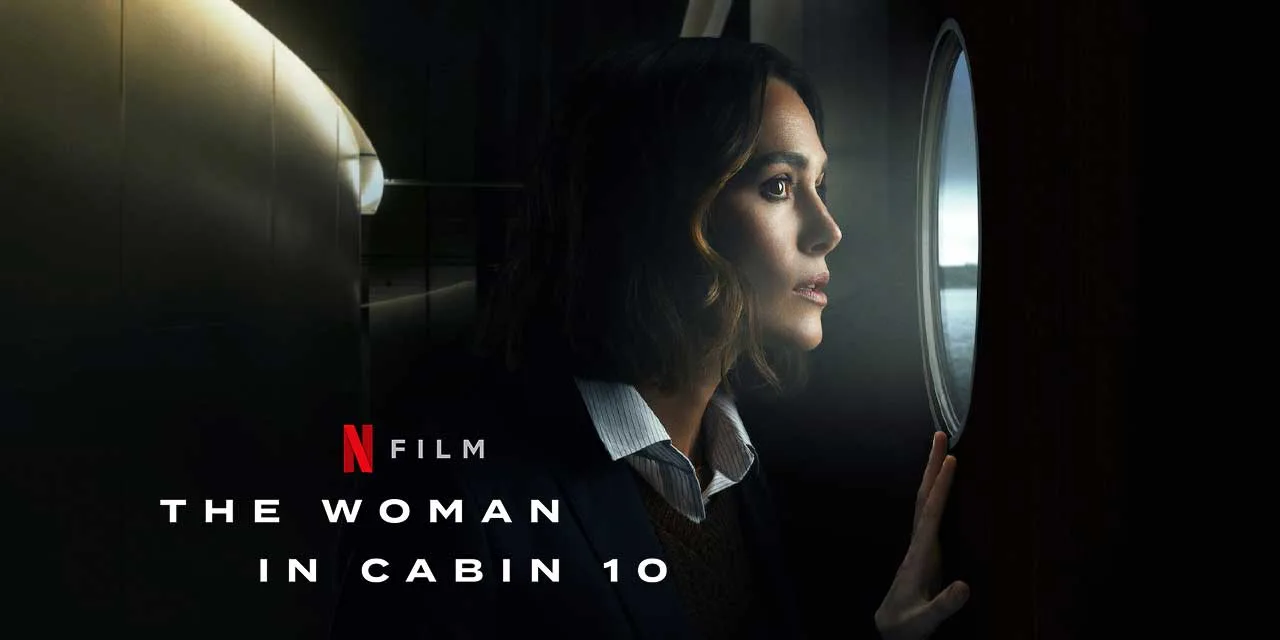

The cabin window holds a clean, almost surgical reflection: Laura “Lo” Blacklock’s drawn face floats over the cold sweep of the Norwegian fjord, an image that insists on itself before a single line of dialogue. That mirrored moment sets the frame for The Woman in Cabin 10, a psychological thriller adapted from Ruth Ware’s bestselling novel.
The film places Lo, an investigative journalist portrayed with brittle force by Keira Knightley, into an assignment that breaks down quickly. She boards the superyacht Aurora Borealis to cover a philanthropic gathering of the global elite. On the first night she sees, in the dark, a woman thrown from the adjacent Cabin 10, which the manifest lists as empty.
Her alarm meets systematic dismissal from crew and passengers. The plot then shifts from identifying a perpetrator to a study of isolation: Lo must test the stability of her recollection against a powerful, coordinated denial.
Atmosphere, Setting, and The Chilly Grip of Luxury
Simon Stone frames the ship not as backdrop but as an instrument of menace. The Aurora Borealis is all glass, steel, and seamless surfaces, an object lesson in contemporary design and pristine taste. That look registers as modern luxury. The ship’s interior becomes a sealed environment where privilege reads as impenetrability. The vessel closes in on its occupants and isolates Lo within a glittering cage that sails across anything but friendly seas.
The film sets striking visual oppositions. Sleek, climate-controlled lounges filled with guests in evening wear and flawless makeup stand against the primeval sweep of the Norwegian fjords. The sea appears as a vast black plane, cliffs loom, fog gathers and the natural world exerts a mute, oppressive presence. Lo’s search for proof occurs inside that small, bright bubble while the ocean promises no route to safety. The environment functions as a dramatic device, sharpening the stakes of her predicament. The passengers’ wealth registers as an aesthetic detail that means little against the scale of the elements.
Stone favors mood and steady escalation of tension over playful subversion. The film borrows from classical suspense grammar, drawing on techniques that foreground slow dread. The familiar set-up of a witness who is systematically disbelieved echoes older psychological thrillers such as Gaslight. The sound design contributes to the pressure. Water sounds, empty corridor silence, and an insistent score create a steady background pressure that nudges the viewer toward discomfort. A vessel meant to protect its occupants instead appears to be leaking moral rot into its immaculate interiors.
The film’s polished look proves a double-edged instrument. The cinematography is exacting and the editing keeps the pace taut; the inciting incident arrives early and propels the narrative. That visual polish grants the thriller a persuasive sheen and a sense of craft. At times, that surface dominates. The focus on refined appearance reduces access to cruder, more chaotic emotional turbulence. The film often privileges compositional beauty over the ragged, raw textures that deepen psychological collapse. The aesthetic coolness filters into the emotional register so the narrative’s heat seldom matches its visual chill. Technical rigor sits beside an emotional reserve the story needs more of.
Narrative Mechanics and The Weaponization of Doubt
The film stages its conflict around doubt used as an instrument of power. Lo’s claims are dismissed at every turn: from the cabin steward up to the billionaire host. The script uses elements of her past against her. She carries the visible damage of a recent traumatic investigative assignment and a set of failed personal ties. Others on board readily point to that history and label her unstable, which makes the absence of corroboration appear plausible. The mystery then moves into an existential fight. The problem is not only to find a culprit; Lo has to establish that any crime occurred at all.

The screenplay, credited to Stone, Joe Shrapnel, and Anna Waterhouse, keeps the camera and the narrative closely aligned with Lo’s fraying perspective. That alignment produces urgency and places the viewer inside the strain of her disbelief. The isolation of the setting makes peril immediate. Yet the plot sometimes depends on manufactured obstacles. Convenient camera failures, missing security footage, and characters acting against obvious self-interest feel designed to serve the plot rather than spring naturally from character logic. Those moments make the machinery of the story visible and interrupt the accumulation of dread.
The architecture of the plot arrives at a final sequence that asks for a particular kind of credulity. A satisfying thriller resolution must pay off its tension with clear, earned logic. The film seeks a shocking resolution, but the combinational complexity required to resolve the central puzzle presses the audience toward strained acceptance. The elaborate means by which the truth is pieced together demand a large suspension of disbelief. The intricacy of the scheme and the convoluted route to clarity risk turning the payoff into melodrama or simplification because so many moving parts must line up for the reveal to work.
A persistent, though sometimes implicit, theme concerns privilege and disbelief. The film depicts ultra-wealthy passengers who combine uniform disdain with accumulated power, forming a tacit alliance. Their social standing shields them from ordinary consequences. Lo appears as an exposed investigator who is quickly sidelined and discredited by this consolidated authority. The narrative implies that reality within this microcosm bends to consensus among the powerful.
The Burden of the Lead and the Problem of Archetypes
The film depends on the central performance to hold the structure together. Keira Knightley’s portrayal of Lo Blacklock functions as the film’s emotional anchor, carrying substantial dramatic weight. Knightley shapes the material into something sharper than simple melodrama. Her work balances acute vulnerability with the single-mindedness of a journalist. She avoids playing hysterical and offers a contained intelligence that remains credible as panic mounts. The film works because the actor keeps the audience invested in her fight.

That anchored performance exposes the supporting cast’s limitations. The ship is populated with capable actors whose roles rarely rise above schematic outlines. Guy Pearce plays the billionaire Richard Bullmer with an appropriate smoothness and ambiguous threat, but the screenplay often describes his influence rather than allowing scenes to demonstrate it fully. Hannah Waddingham registers powerfully in a few scenes as a haughty presence who projects upper-class contempt. Her moments are memorable yet too few to change the texture of the ensemble.
A larger group of passengers, including Art Malik, David Morrissey, Kaya Scodelario, and Daniel Ings, form an array of wealthy figures who remain largely thin sketches. They are defined by status and attitude and by their quick refusal to credit Lo. They serve as obstacles and atmospheric detail more than as rounded individuals with plausible motives. Lo’s ex-boyfriend, played by David Ajala, contributes a small, predictable source of personal friction but little dramatic ballast.
This archetypal casting reduces the mystery’s emotional effectiveness. When emphasis stays on mood and plot momentum, the story trades away the interior complexity required for a fully credible whodunit. The guests are too thin to act as convincing suspects or manipulators. The sense of gaslighting risks feeling like a mechanical device to delay resolution rather than a terrifying social condition. The emotional impact of the final uncovering diminishes because the surrounding players lack the depth needed to conceal or enact deception on a large scale.
A Serviceable Voyage and Final Judgment
The Woman in Cabin 10 finds its strengths in polished direction, dense atmosphere, and disciplined pacing. Those elements combine with Knightley’s central turn to give the film forward motion and emotional weight. She supplies intensity and a register of reality that the narrative sometimes lacks.

The film’s weaknesses are evident. Contrivances used to advance the plot interrupt immersion. The final reveal asks the audience to accept complex constructions whose plausibility strains under scrutiny. The supporting characters’ thinness prevents the mystery from becoming a richly layered ensemble piece.
Placed within its genre, the film does not attempt radical reinvention or a biting satire on class. It functions as an accomplished thriller. The experience will satisfy viewers who value mood, style, and a steady, slow-burn tempo anchored by a persuasive lead. The film operates as a classy, atmospheric mystery that fulfills expectations and stops short of deeper reinvention. It is best suited to audiences seeking a taut, deliberate suspense piece centered on a strong central performance.
The Woman in Cabin 10, based on the bestselling novel by Ruth Ware, was released on October 10, 2025. Directed by Simon Stone and starring Keira Knightley as a journalist who witnesses a suspected murder on a luxury yacht, the film explores themes of gaslighting and class privilege. It is available to watch exclusively on the streaming platform Netflix.
Full Credits
Director: Simon Stone
Writers: Joe Shrapnel, Anna Waterhouse, Simon Stone, Ruth Ware (based on the novel)
Producers and Executive Producers: Debra Hayward, Ilda Diffley, Cindy Holland, Richard Hewitt
Cast: Keira Knightley, Guy Pearce, Hannah Waddingham, David Ajala, Art Malik, Gugu Mbatha-Raw, Kaya Scodelario, David Morrissey, Daniel Ings, Lisa Loven Kongsli
Director of Photography (Cinematographer): Ben Davis
Editors: Katie Weiland, Mark Day
Composer: Benjamin Wallfisch
The Review
The Woman in Cabin 10
The Woman in Cabin 10 is a stylish, atmospheric thriller anchored by Keira Knightley's commanding central performance. While its aesthetic polish and tight pacing deliver consistent suspense, the narrative often relies too heavily on contrivance. The supporting cast remains underdeveloped, limiting the complexity of the mystery. It is a highly watchable, glossy piece of entertainment that works as a serviceable psychological mystery, but ultimately falls short of transcending its predictable structure.
PROS
- Keira Knightley's magnetic, grounded central performance.
- Stylish direction and high-end aesthetic presentation.
- Effective creation of claustrophobic, paranoid atmosphere.
- Smart, tight pacing that establishes tension quickly.
CONS
- Reliance on excessive contrivance and plot mechanics.
- The underdeveloped nature of the supporting cast and suspects.
- The final reveal strains believability and feels melodramatic.
- Atmosphere often takes precedence over genuine emotional depth.