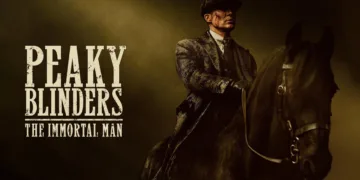















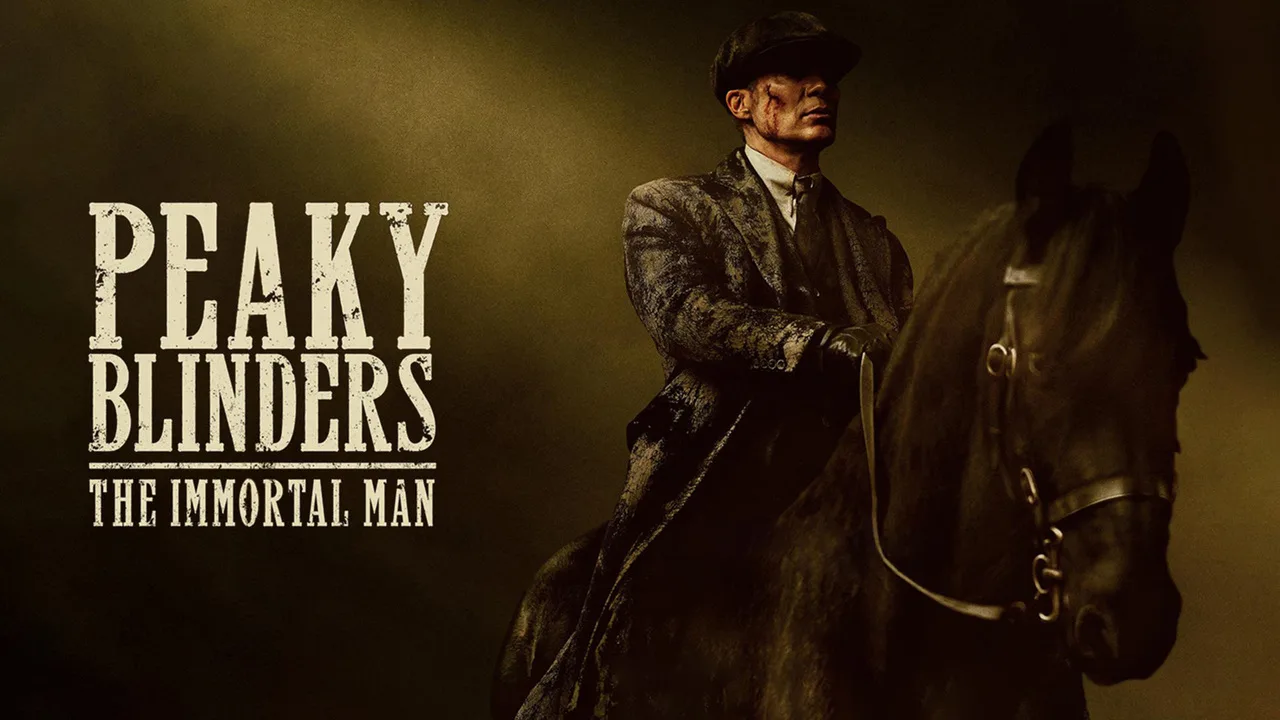

Thirteen years is a long time to carry a flat cap. Tommy Shelby first rode into frame in 2013, a figure of studied menace against the smoke and soot of post-WWI Birmingham, and the world took to him with a ferocity that surprised even his creators. Now, four years after the television series closed its final chapter, Steven Knight and director Tom Harper have brought him to cinema. Peaky Blinders: The Immortal Man is set in 1940, with Nazi bombs remaking Birmingham from above while its most famous son hides in the countryside below.
Cillian Murphy returns, grayer and hollowed, to a role that earned him an Oscar between seasons and now calls him back one final time. The film arrives as both an ending and a threshold: a farewell to Tommy’s reign and a bridge to a 1950s-set Netflix spin-off already commissioned. What Knight has fashioned is a story about grief so deep it starts to look like erasure, and the terrifying persistence of a man’s myth long after the man himself has given up.
A Man Writing His Own Epitaph
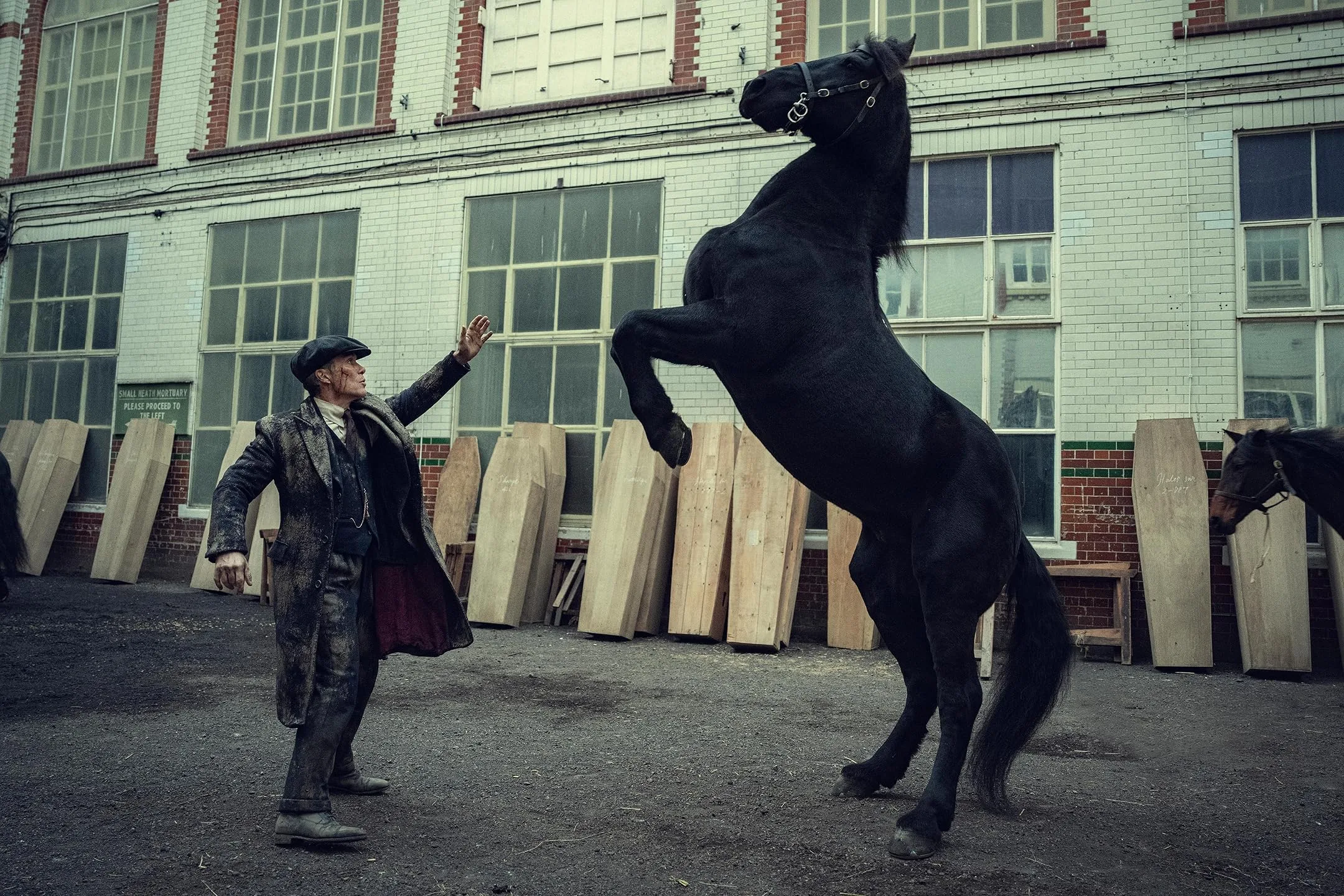
Tommy Shelby, at the film’s opening, has made himself a ghost. Sequestered in a remote country mansion with the loyal Johnny Dogs (Packy Lee) as his only company, he is writing his autobiography, a manuscript titled “The Immortal Man” with what reads as equal parts irony and desperation. The therapy is failing. The dead keep visiting. His daughter Ruby appears to him. A more devastating revelation, held back by the film with careful restraint, exposes another grief he carries, one the audience is not fully prepared for. These are not hauntings in any supernatural sense. They are the accumulated weight of a life that has consumed everyone it touched.
His detachment from the war raging above Birmingham is itself a kind of philosophy. Bombs fall. Fires light the horizon. Tommy sits and writes. “I was never a father, Ada,” he tells his sister. “I was a form of government. I no longer believe in government of any kind.” The line lands with the flatness of a man who has reasoned his way out of caring about anything.
The film grounds its plot in Operation Bernhard, the real Nazi scheme to destabilise Britain by flooding it with counterfeit currency. That this historical mechanism is used to animate the personal drama between a father and son speaks to Knight’s instinct for finding the private within the catastrophic. Duke Shelby (Barry Keoghan), Tommy’s illegitimate son raised among the Romani after his mother’s death, has been running the Peaky Blinders in Tommy’s absence and has agreed to distribute the forged notes. He sees it as opportunity. He sees most things as opportunity, because opportunity is what fills the space left by a father who was never there.
The film’s themes circle each other with quiet insistence: inheritance, abandonment, the myth of the self-made man, and the way grief, left unprocessed, transmits itself through blood. The monetisation of loss during wartime gives Knight’s script its sharpest edge.
Fathers, Sons, and the Weight of a Name
Murphy has always understood Tommy Shelby as a philosophical project as much as a dramatic one. The graying temples and the stiffness in his body are not mere aging; they are the physical record of what this man has survived and lost. In close-up, which Harper and cinematographer George Steel deploy with precision, Murphy’s face becomes a kind of landscape: the far-off gaze that sees something the camera cannot reach, the sorrow held so tightly it has calcified into something resembling calm. His Tommy is a man who has passed through fury and arrived somewhere quieter and more frightening.
The Garrison Tavern scene, in which Tommy re-enters society by producing a grenade in response to a soldier’s provocation, earns its crowd-pleasing energy because Murphy plays it with such dead-eyed economy. The suit-up montage preceding his return to Birmingham functions as callback and character statement: this is what Tommy becomes when he has a reason to become it again.
Barry Keoghan, stepping into the role of Duke from Conrad Khan, brings something the character needed: genuine instability. Duke is a young man abandoned twice by his father who has built a self from whatever material was available, which happened to be violence and distrust. The vulnerability behind his placid, dangerous exterior surfaces in unexpected moments, and his scenes with Murphy carry the film’s heaviest emotional freight. Their pig-sty confrontation, physically brutal and emotionally raw, is the kind of scene that stays lodged in the mind. The one limitation is that Duke, as written, sits comfortably within the range of roles Keoghan has made his signature. The performance is excellent; the territory is familiar.
Tim Roth’s Beckett, the Nazi collaborator at the centre of the counterfeiting scheme, is chilling in proportion to his ease. His relaxed cruelty and subtle positioning of himself as a surrogate father to Duke produce a more disturbing antagonist than theatrical villainy would allow. Rebecca Ferguson’s Kaulo channels mysticism with authority, though the role asks her primarily to catalyse rather than exist independently. Sophie Rundle’s Ada remains the franchise’s moral spine. The absence of Paul Anderson as Arthur Shelby, addressed through a flashback subplot that never quite finds its footing, leaves a gap the film cannot fully paper over.
Beauty in the Rubble
Tom Harper shoots wartime Birmingham with the understanding that devastation has its own aesthetic grammar. George Steel’s cinematography operates with a confidence that reads as genuinely cinematic rather than scaled-up television. The bombed-out streets, the cold interior of Tommy’s self-imposed exile, the fog through which he periodically strides in slow motion: each environment is lit and framed as a psychological state as much as a physical one. The manor is hollow and dark because its inhabitant is hollow and dark. Birmingham, crumbling under Nazi assault, mirrors the moral disintegration the characters inhabit.
Harper’s action sequences benefit from widescreen staging that the small screen could never fully accommodate. The film’s climax, set among Liverpool’s canal docks and involving exploding boats, Nazi confrontations, and a final showdown between Tommy, Duke, and Beckett, is technically and emotionally the film’s peak. Steel’s use of light in these sequences deserves particular attention: darkness here is a presence with weight, a thing that presses against the characters as much as the violence does.
The soundtrack remains one of Peaky Blinders’ most distinctive signatures. Antony Genn and Martin Slattery’s score is supplemented by original contributions from Fontaines DC’s Grian Chatten and Amyl and the Sniffers’ Amy Taylor, alongside Massive Attack needle drops that land with practiced precision. Nick Cave and the Bad Seeds’ “Red Right Hand” returns in a slowed arrangement at a key moment, and the choice feels earned rather than nostalgic. Anachronism in period drama is a gamble that requires confidence to pay off; here, it does.
Knight and Harper also manage the difficult balance between rewarding dedicated viewers and keeping the film accessible to those less steeped in six seasons of Shelby history. Callbacks and symbolic references reward those who know where to look without making the uninitiated feel shut out from the film’s emotional logic.
The Gaps Between the Bricks
A film compressing six seasons of accumulated character into 112 minutes will always show the seams. Duke’s arc and Kaulo’s role both feel truncated in ways that reveal how much space the story actually needed. Kaulo arrives, channels the dead, sends Tommy back into the world. Ferguson invests her with presence, but the character’s interiority remains largely opaque.
The film is also too self-conscious about its own absences. Substitute characters are positioned to fill the structural roles of beloved originals, but the framing draws attention to the substitution rather than letting new figures breathe. The Arthur Shelby problem is the most acute: the flashback subplot meant to acknowledge his absence neither honours it adequately nor moves the story forward with purpose.
Knight’s screenplay, characteristically, is most alive in dialogue and thematic conception, and most strained when the plot requires precise mechanical execution. A recurring silliness occasionally tips the film’s Shakespearean ambitions toward bathos, a tonal instability that Murphy and Keoghan work hard to steady. The film functions well as a bridge between what the Peaky Blinders was and what it is becoming. It satisfies on its own terms. The trouble is that the terms could have been larger.
After years of fans waiting to see how the Shelby saga would wrap up, Peaky Blinders: The Immortal Man finally landed on Netflix on March 20, 2026. If you missed the limited theatrical run that started on March 6, you can stream the full movie globally on Netflix right now.
Where to Watch Peaky Blinders: The Immortal Man (2026) Online


Full Credits
Title: Peaky Blinders: The Immortal Man
Distributor: Netflix
Release date: March 20, 2026
Rating: R
Running time: 112 minutes
Director: Tom Harper
Writers: Steven Knight
Producers and Executive Producers: Steven Knight, Cillian Murphy, Guy Heeley, Caryn Mandabach, Jimmy Tandel, Patrick Holland, Tom Harper, David Kosse, Jamie Glazebrook, Andrew Warren, David Mason
Cast: Cillian Murphy, Rebecca Ferguson, Tim Roth, Stephen Graham, Sophie Rundle, Barry Keoghan, Ned Dennehy, Packy Lee, Ian Peck, Jay Lycurgo, Kasper Hilton-Hille, Ava Hupperdine-Perrin, Alfie Thomas Bland
Director of Photography (Cinematographer): George Steel
Editors: Mark Eckersley
Composer: Antony Genn, Martin Slattery
The Review
Peaky Blinders: The Immortal Man
Peaky Blinders: The Immortal Man delivers a visually striking and emotionally heavy farewell to Tommy Shelby's reign. Cillian Murphy provides a masterful, quiet performance grounded in grief, and Barry Keoghan injects a volatile energy into the narrative. The cinematography and signature soundtrack remain excellent. The film struggles with truncated character arcs and awkwardly handled absences, particularly regarding Arthur Shelby. It functions effectively as a bridge to future stories. It satisfies on its own terms, leaving a desire for tighter mechanical execution.
PROS
- Cillian Murphy provides a phenomenal, emotionally grounded performance.
- Barry Keoghan delivers an excellent, volatile portrayal of Duke.
- Tim Roth offers a chilling performance as a relaxed antagonist.
- The visually confident cinematography uses wartime devastation effectively.
- The signature soundtrack and musical selections are utilized perfectly.
CONS
- Character arcs feel truncated, specifically for Duke and Kaulo.
- Substitute characters and missing originals are handled awkwardly.
- The flashback subplot concerning Arthur Shelby falls flat.
- Certain scenes suffer from tonal instability and recurring silliness.