























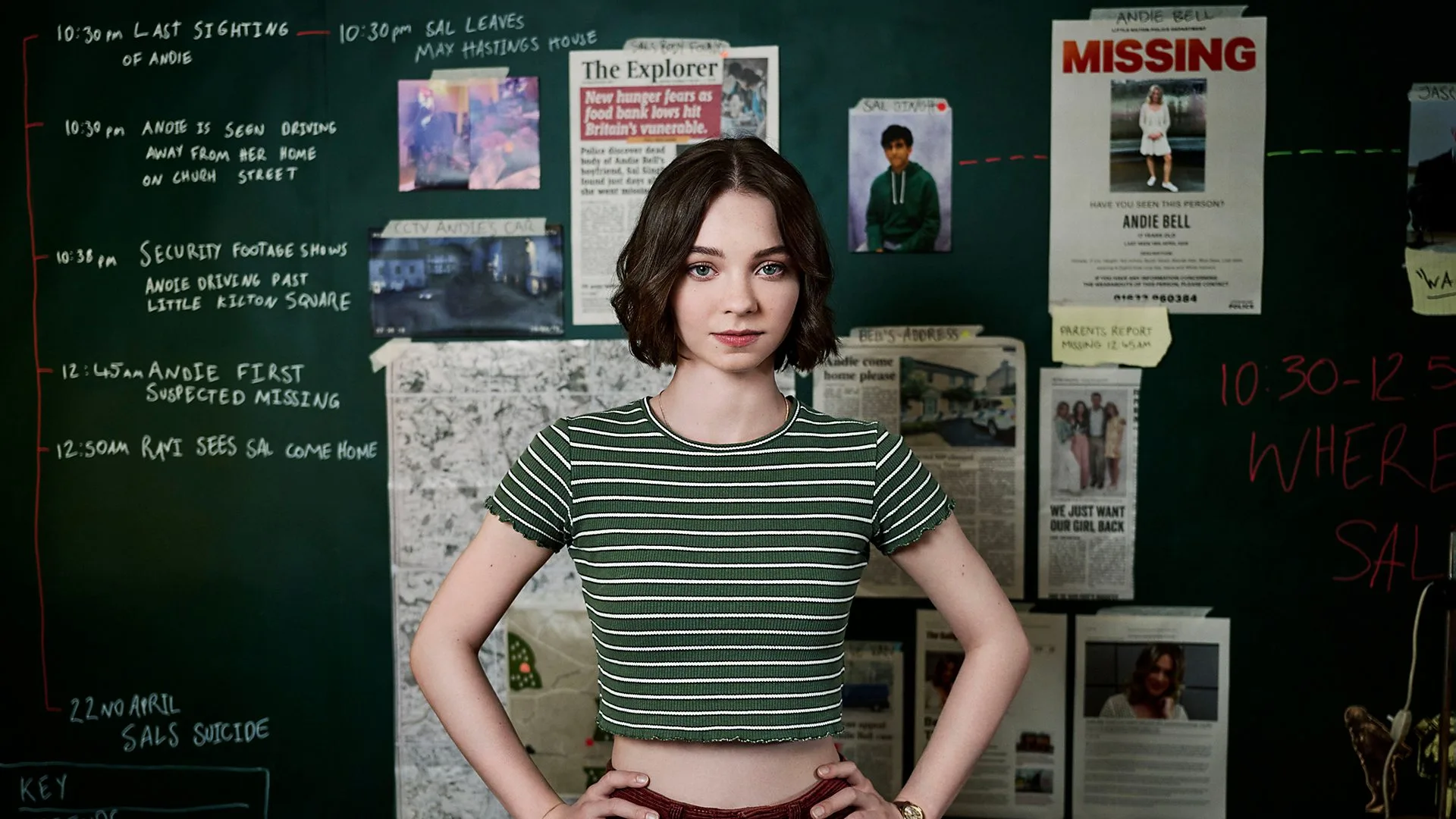

A Good Girl’s Guide to Murder Season 2 begins in the uneasy aftermath of triumph. Pip Fitz-Amobi has exposed the truth behind Andie Bell’s death, cleared Sal Singh’s name, and turned the wreckage of Little Kilton into a true-crime podcast. That sounds like closure, the sort of neat civic service television detectives often provide before they move on to a new corpse and a fresh corkboard.
Pip wants out. Fair enough.
The trouble is that Little Kilton has no interest in letting her retire. Max Hastings is facing trial for drugging and assaulting women, and Jamie Reynolds, a key witness tied to the case, disappears just as the legal machinery begins to grind forward. Season 2, adapting Good Girl, Bad Blood, keeps the YA frame of the series, with clue walls, secret messages, strained friendships, and the familiar thrill of teenage investigation. Yet the tone is heavier now. The show has become less fascinated by solving a mystery than by studying the bruises left after the truth comes out.
Pip Fitz-Amobi and the Morality Hangover
The smartest shift this season is that Pip is no longer treated as a clean instrument of justice. In Season 1, her curiosity had an almost storybook charge: a sharp teenager could look where adults had failed to look, ask what adults had failed to ask, and drag buried truth into daylight. Season 2 keeps her intelligence intact, then places a question mark beside it. What happens when being right does not make the damage disappear?
Pip has always had the temperament of a reformer trapped in a teenager’s body. She believes patterns can be read, lies can be untangled, and justice can be forced into motion through enough nerve and enough color-coded evidence. That belief has now been badly dented. Cara’s family has been shattered. Little Kilton still carries the stains of the Andie Bell case. Pip’s success has made her visible, admired, blamed, and feared. A podcast may give her control over the story, yet it also turns private grief into public property. That is the true-crime paradox in miniature: everyone wants the truth, preferably with episode titles.
Emma Myers makes this psychological shift the season’s main event. Her Pip remains bright, persuasive, and socially agile, but Myers lets panic flicker under the surface. She plays Pip as someone learning that moral certainty can become addictive. There is a tremor in her determination now, a sense that every clue is also a test of identity. If she cannot solve Jamie’s disappearance, what was all the suffering for? If Max walks free, did any of her previous courage matter?
That is a brutal place to put a young protagonist, and the show is at its best when it refuses to make her obsession look tidy. Pip’s darker turn is persuasive because it grows from virtues the audience already admires. Her loyalty becomes fixation. Her courage becomes recklessness. Her hunger for justice becomes a private doctrine, a little courtroom she carries in her head. Call it detective’s vertigo: she has stared into wrongdoing long enough that the ground beneath her own ethics begins to tilt.
Myers sells that tilt without turning Pip into a melodramatic antihero. She is still vulnerable, still funny in flashes, still young enough to make terrible choices with the confidence of someone who has read three articles and built a spreadsheet. The performance gives the season emotional force whenever the plotting threatens to sprint past the human cost.
Jamie, Max, and the Fragile Machinery of Justice
Season 2 runs on two linked engines: Jamie Reynolds’ disappearance and Max Hastings’ trial. The first gives the season its chase. The second gives it its bite.
Jamie’s vanishing matters because he is Connor’s older brother, a witness in Max’s trial, and connected to the anonymous Woman A. On paper, this gives Pip a clear mission. Find Jamie, protect the case, help Connor, keep Max from slipping through the cracks. The mystery sends her through Little Kilton’s familiar maze of screenshots, secrets, catfishing, evasions, and half-confessions. The machinery is often entertaining, and some twists land with real charge.
Yet the missing-person plot sometimes struggles to carry the same emotional weight as the trial. Jamie is important to the structure, but the show’s deepest anger belongs to Max. That imbalance is revealing. The season seems most alive when it leaves the mechanics of disappearance behind and looks at the social architecture around male impunity: wealth, family protection, intimidation, legal doubt, and the ancient ritual of making survivors prove pain to people trained to mistrust them.
Max Hastings is the season’s most disturbing figure because he is not written as a supernatural monster. Henry Ashton plays him with entitlement, fear, and an oily charm that makes the character feel grimly recognizable. His menace comes from the fact that he expects systems to bend for him. That expectation is political, social, and historical. From aristocratic scandals to modern courtroom spectacles, the powerful have long understood that truth and consequence are separate countries, with lawyers guarding the border.
The scenes involving Max and his mother Rosie sharpen that idea. They suggest a private world where status is treated as oxygen and accountability as social death. Max is frightening because he is pathetic, which may be the least comforting kind of villainy. He is a predator who also fears losing maternal approval. The show never lets that fear excuse him. It does something more useful: it shows how monstrous behavior can live inside ordinary dependency, family loyalty, and class panic.
The season’s trial material gives the show a wider charge. It asks what truth is worth when institutions move slowly, evidence is contested, and victims are pushed into public exposure. Pip can uncover facts, but she cannot force society to value them. That friction gives Season 2 its philosophical spine. Justice here is no shining statue. It is paperwork, testimony, money, pressure, memory, and timing. Very glamorous stuff. Someone call the merch department.
Love, Friendship, and Little Kilton’s Thin Edges
Ravi Singh remains the show’s warmest counterweight to Pip’s intensity. As her boyfriend and investigative partner, he gives Season 2 a needed steadiness. He sees Pip’s brilliance, and he also sees the cost of it. Zain Iqbal brings a soft patience to Ravi, creating a character who understands that love often means noticing someone’s self-destruction before they do.
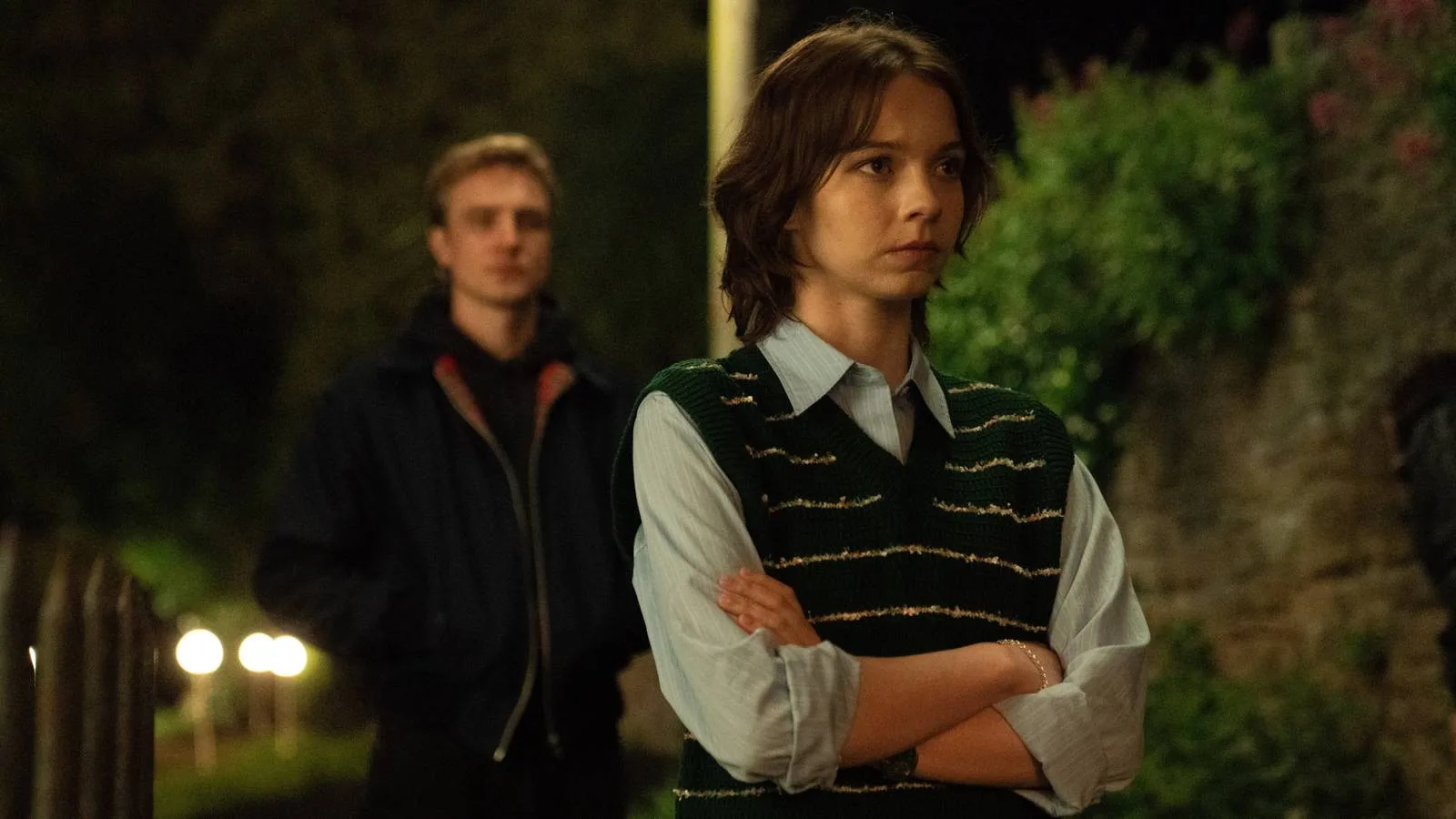
Still, the romance is oddly muted. Pip and Ravi’s bond is sincere, but the official-couple phase lacks some of the spark that made their earlier dynamic feel alive. Part of this is structural: Pip is too consumed by the case to give the relationship much room. Part of it lies in how forgiving Ravi can be. His patience is admirable, then slightly suspicious, then almost saintly. A little sharper friction between them would have helped. Even saints need boundaries, or at least a strongly worded text.
Cara Ward represents one of the season’s most promising emotional threads. Her friendship with Pip has been damaged by the revelations of Season 1, and her resentment makes complete sense. Pip uncovered the truth, but the truth wrecked Cara’s family. That contradiction could fill an entire episode. Instead, the show gives Cara moments of pain without fully developing the conflict. Asha Banks suggests a deeper wound than the script allows her to explore.
Connor Reynolds faces a similar problem. His brother is missing, which should place him under tremendous emotional strain. The show often keeps him near comic relief, a choice that can feel tonally awkward. His loyalty and anxiety still matter, but his role points to a larger issue: Season 2 is so committed to Pip’s spiral and Max’s trial that several supporting characters become emotional signposts rather than full people.
Little Kilton, meanwhile, remains effective as a pressure cooker. Its small-town intimacy makes every secret feel contagious. Bedrooms, school spaces, fields, grey skies, and clue boards create a soft British gloom that suits the season’s moral weather. Yet the town is richer as atmosphere than as a social body. It feels haunted by the first case, but some of its residents are written with thin outlines. The setting has power. It could use more lived-in mess.
The Darker YA Machine
Season 2 is darker, more anxious, and more psychologically loaded than its predecessor. The shift suits the material. The first season carried the clean appeal of a teen detective correcting adult failure. This season lives in the aftershock. It understands that solving a crime can become its own trauma, especially for someone still forming a sense of self.
The pacing benefits from the six-episode structure. There is little dead air, and the story moves quickly from podcast fallout to missing-person thriller to courtroom dread. That speed keeps the season bingeable, though it also creates strain. Some late twists feel hurried. Some emotional beats arrive, register, and vanish before they can leave deeper marks. The show sometimes behaves like it is afraid stillness will kill momentum, when stillness is often where its best ideas breathe.
The handling of sexual assault, survivor testimony, public judgment, and legal intimidation is stronger than expected from a YA thriller with a fondness for dramatic clue boards. The season treats these subjects with seriousness, giving Max’s trial a social weight that reaches beyond Pip’s personal mission. It does not turn trauma into decorative grit. That restraint matters.
The craft is uneven in familiar ways. The visual mood works: grey skies, sleepy streets, teenage rooms, and evidence walls create an atmosphere of adolescent dread, as if GCSE stress wandered into a crime archive and never came back. The soundtrack is less disciplined. Some pop needle drops underline emotions with the subtlety of a highlighter pen on fire. A few choices land, especially around Max’s menace or Pip’s panic, but the music often tells us what the actors have already made clear.
Still, Season 2 finds a sharper identity. Its central question is no longer “Who did it?” The question is what a young person becomes after learning how much evil can hide in ordinary places. Pip’s investigation turns into a symbolic descent through the culture of exposure: podcasts, public testimony, online attention, legal spectacle, and private guilt. The season speaks to an age obsessed with amateur detection, where everyone has a theory, a thread, a recording, a moral position. It understands the seduction of that role and the danger of confusing attention with repair.
A Good Girl’s Guide to Murder Season 2 has flaws: a crowded final stretch, underused supporting characters, and a mystery that sometimes feels less powerful than the ideas surrounding it. Yet its emotional core is strong. Myers gives Pip a restless, damaged intelligence, and the season turns teen sleuthing into a study of consequence. The result is a follow-up with bite, melancholy, and enough ethical discomfort to make its detective board feel like a mirror.
The second season of the hit mystery-thriller series A Good Girl’s Guide to Murder officially premiered on Wednesday, May 27, 2026. Fans can stream all six episodes of the new season on Netflix in the United States and various international territories, while viewers in the United Kingdom can watch it for free on BBC iPlayer. The new season adapts Holly Jackson’s second book, Good Girl, Bad Blood, following Pip Fitz-Amobi as she steps back into amateur sleuthing to find a missing friend while navigating a tense local trial and hosting her own true-crime podcast.
Where to Watch A Good Girl’s Guide To Murder Season 2






Full Credits
Title: A Good Girl’s Guide to Murder Season 2
Distributor: BBC, Netflix
Release date: May 27, 2026
Rating: TV-MA
Running time: 40–49 minutes per episode
Director: Asim Abbasi, Jill Robertson
Writers: Holly Jackson, Poppy Cogan
Producers and Executive Producers: Matthew Read, Matthew Bouch, Frith Tiplady, Holly Jackson, Poppy Cogan, Dolly Wells, Simon Crawford Collins, Asim Abbasi, Florence Walker, Sophie Klein, Sophie MacClancy
Cast: Emma Myers, Zain Iqbal, Asha Banks, Jude Morgan-Collie, Yali Topol Margalith, Henry Ashton, Carla Woodcock, Misia Butler, Jack Rowan
Director of Photography (Cinematographer): Benjamin Gerhun, Spike Morris
Editors: Ella Newton, Hazel Baillie
Composer: Heather Christian
The Review
A Good Girl’s Guide to Murder Season 2
A Good Girl’s Guide to Murder Season 2 is a sharper, darker follow-up that turns Pip’s detective instincts into a source of tension rather than easy heroism. The Jamie Reynolds mystery has uneven spots, and some supporting characters feel underfed, yet Emma Myers gives the season a tense emotional center. The Max Hastings trial brings the strongest material, giving the story moral weight and social bite. It is flawed, hurried in places, and still very bingeable.
PROS
- Emma Myers gives Pip greater psychological depth.
- Darker tone adds weight to the mystery.
- Max Hastings’ trial creates strong dramatic tension.
- The season handles heavy subject matter with care.
- Little Kilton remains an effective small-town pressure cooker.
CONS
- Jamie’s disappearance is weaker than the trial storyline.
- Some late twists feel rushed.
- Supporting characters need richer development.
- Pip and Ravi’s romance feels muted.
- The soundtrack can be too obvious.