



























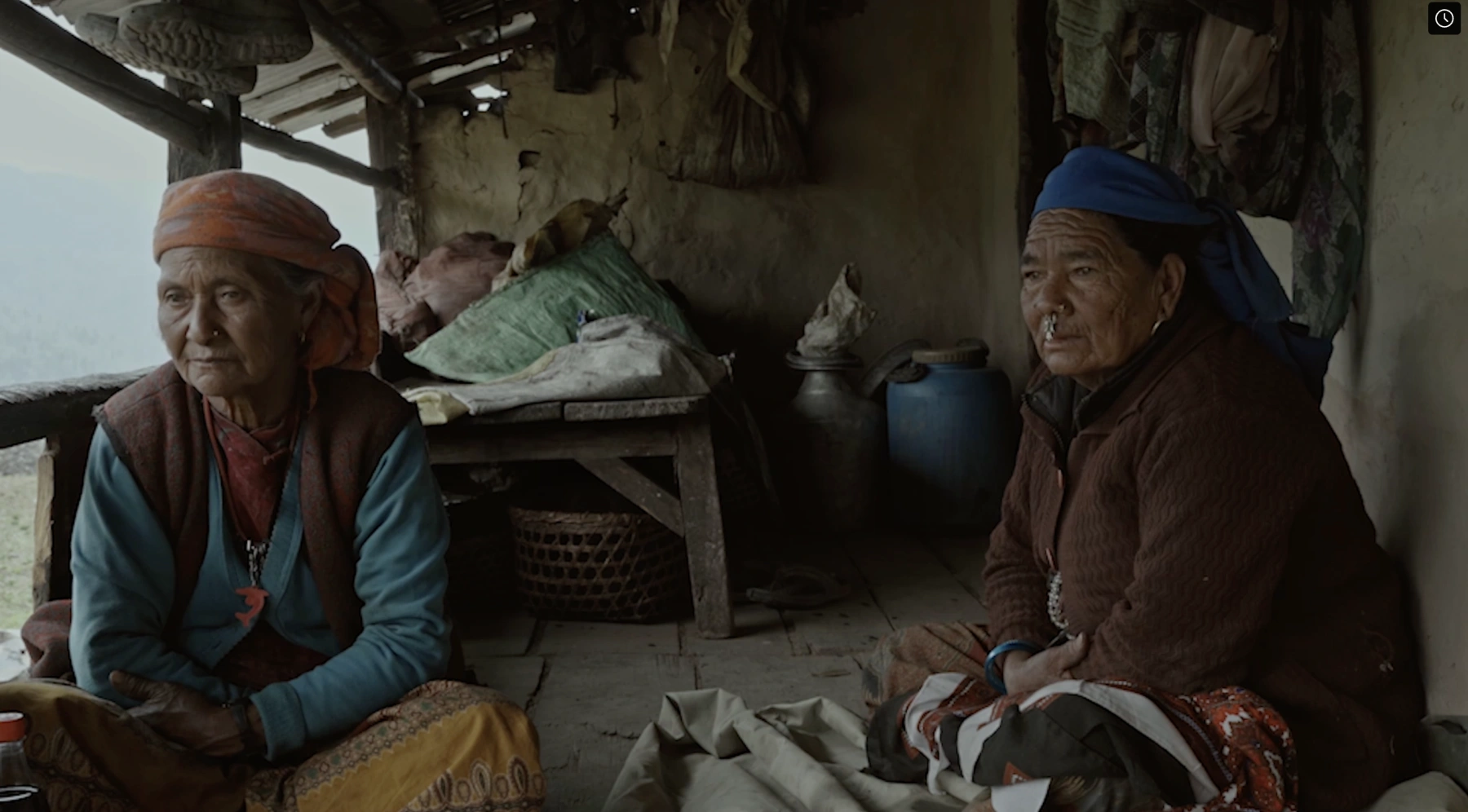

High-altitude isolation carries a bodily pressure, a fact announced in the opening images of Rajan Kathet and Sunir Pandey’s feature-length documentary debut. Originally known as Dhorpatan, the film places viewers in the bare terrain of western Nepal in October, as the local population heads south before a seasonal crisis arrives. Ratima and Kalima remain in this trembling emptiness, two elderly women who accept the role of village caretakers under severe conditions.
They are sautas, co-wives who shared a marriage to the same deceased man. That social bond gives the film its quiet charge. The exposition avoids a conventional historical briefing or structural preview, giving itself fully to the physical world. Locked wooden doors, vacant fields, and rolling mist turn the settlement into a remote outpost near the edge of human contact. Survival requires dependence on a domestic rival, and the psychological premise emerges through geography, weather, and abandonment.
Domestic Friction in a Frozen Void
The film’s psychological force comes from the opposing temperaments of the two women and the forced companionship that binds them through winter. Ratima carries a jaded, inward withdrawal from the present. Taciturn and physically unwell, she passes the freezing days with cigarettes and alcohol, dulling her grief through habits that feel both weary and ritualistic. Her mournful songs give voice to bodily anxiety and deep regret. Her mind remains tied to the past, most vividly through her dreams, where her late husband returns in different stages of youth and old age.
Kalima brings a sharper, more animated energy into the bleak domestic room. Vigorous and practical, she seeks contact wherever she can find it. She speaks with her dog, her cow, and her goats, giving each animal the status of a companion capable of grasping her jokes and remarks. Her dreams move in a different direction, filled with flowers, helicopters, and snakes, images that suggest motion, surprise, and a stubborn appetite for life.
Their shared life in a single room turns ordinary tasks into emotional weather. Meals prepared by the fire carry flashes of tenderness and resentment, with each shift shaped by the pressure outside the door. A sudden blizzard or a quarrel over laundry left in the snow can ignite bitter argument, exposing decades of buried rivalry.
Ratima even mutters threats of physical retaliation from her corner, a small, acid detail that gives the room the feeling of a pressure vessel. Then Ratima’s health weakens, and Kalima sits beside her in the dark, gives her medicine, and offers shelter with a fidelity that feels practical, intimate, and unsentimental.
This relationship resists the easy social stereotype that reduces co-wives to fixed enemies. Through chores such as foraging for greens, securing roofs, and tracking stray animals, the film observes a bond reshaped by the demands of a punishing landscape. Their interaction becomes a daily negotiation. Safety and comfort have disappeared, and survival produces a raw intimacy that leaves little space for prolonged hatred.
The Visual and Auditory Language of Isolation
Babin Dulal’s cinematography drives the film’s atmospheric design through strict, hushed attention. The camera favors lingering wide shots and long takes, often placing the two women as tiny, exposed figures against the mountain ranges. The vast contours of the Dhor Valley create a sense of desolation that feels almost geological.
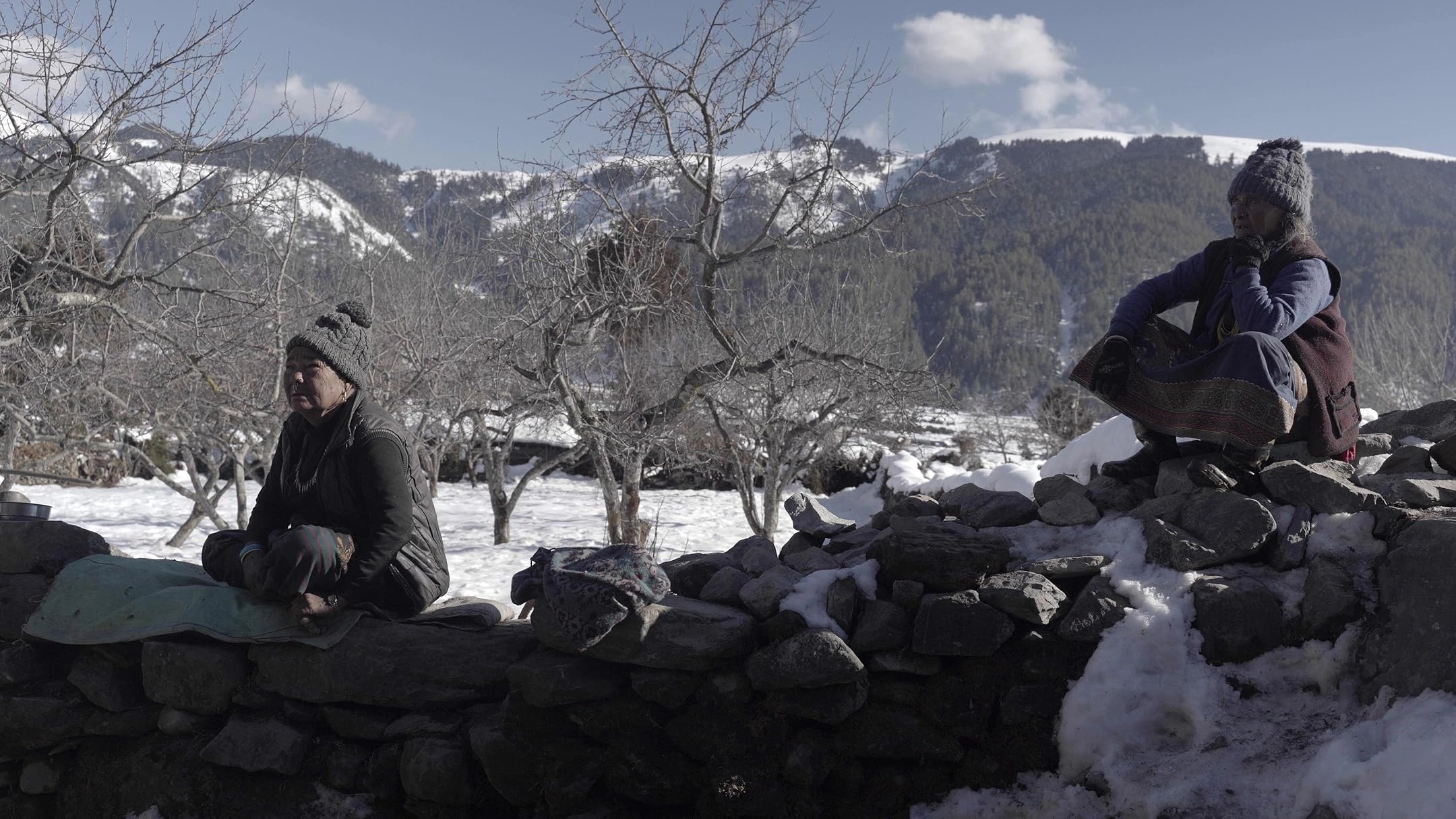
Frozen sleep, drifting fog, and immense fields of snow give the village an eerie stillness, as if human history has receded from the frame. The slow pacing asks the viewer to inhabit the monotony and heavy rhythm that define Ratima and Kalima’s daily existence.
Rajan Shrestha’s background score deepens that emptiness, working like an unseen pressure across the winter cycle. In the first half, the music leans on heavy, ominous tones that recall the sonic grammar of psychological thrillers and horror films. The sound builds tension through atmosphere, suggesting that the cold itself has become a hostile presence around two aging bodies. The lonesome setting feels dangerous because the score treats landscape and age as twin forces closing in from every side.
The break of winter changes the film’s entire sensory field. Spring brings the local community back to the valley, and the screen fills with motion: children running through pathways, women gathering near water sources, men moving through the village on bicycles.
The score leaves its earlier gloom and rises into a hopeful crescendo, matching the visible transformation in Ratima and Kalima’s faces. Their contact with the returning locals clarifies their social place. They are respected elders whose lonely winter vigil has protected the community’s foundation.
Limits of the Observational Lens
Kathet and Pandey work firmly within fly-on-the-wall documentary practice, favoring environmental mood and anthropological observation over a conventional, conflict-led plot. This choice creates an immersive atmosphere with a strong sense of authenticity, and it also keeps emotional distance between the camera and its subjects. The film avoids direct interviews and voiceover commentary for much of its running time, leaving a chill reserve in place.
The viewer watches the external patterns of the women’s lives: their trudging through snowstorms, their cooking routines, their labor, their waiting. Their deeper anxieties, personal histories, and particular fears remain largely unexplored. The camera stays close to the surface of action, leaving questions about past choices, individual identity, and inner life unanswered.
That detached method is occasionally interrupted by editorial decisions that prick the film’s passive surface. Clever cuts and off-screen dialogue create sudden pockets of humor or unease, keeping the slow rhythm from hardening into stasis.
The boldest formal interruption arrives midway through the film, when the invisible wall of documentary observation breaks. For the first time, a director’s voice comes from behind the camera and asks the women a direct question. Their brief, whispered answers immediately disturb the illusion of untouched observation.
That rupture changes the viewing experience. Ratima and Kalima become visibly aware of the filming process, and the audience must recognize their acceptance of being watched. The documentary becomes a self-aware study of behavior under scrutiny, a record of human presence shaped by camera, weather, memory, and social survival. The women appear as active participants who choose what to reveal, allowing their frustrations, eccentricities, and resilience to exist within a cinematic frame that balances stillness with the latent tension of psychological drama.
No Winter Holidays is a poignant feature-length documentary co-directed by Rajan Kathet and Sunir Pandey that made its world premiere at the Sheffield DocFest in June 2023. The film chronicles the raw, unembellished lives of Ratima and Kalima, two elderly widows of the same man who must navigate an uneasy companionship while staying behind to guard a remote Himalayan village during a brutal winter. Viewers tracking its availability can stream it on specialized digital platforms like True Story, or access it via independent documentary networks and subscriptions such as Video StoreAge, which showcases distinct international ethnographic projects.
Full Credits
Title: No Winter Holidays (Original Title: Dhorpatan)
Distributor: Salpa Films, True Story, NoCut Film Collective, Video StoreAge
Release date: June 10, 2023 (World Premiere at Sheffield DocFest)
Running time: 79 minutes
Director: Rajan Kathet, Sunir Pandey
Writers: Rajan Kathet, Sunir Pandey
Producers and Executive Producers: Rajan Kathet, Sunir Pandey, Gary Byung-Seok Kam, Cristina Hanes, Isabella Rinaldi
Cast: Ratima Bishwakarma, Kalima Bishwakarma
Director of Photography (Cinematographer): Babin Dulal, Shishir Bishankhe
Editors: Kiran Shrestha
Composer: Rajan Shrestha (Phatcowlee)
The Review
No Winter Holidays
No Winter Holidays succeeds as a patient, atmospheric study of survival, capturing the raw realities of aging and isolation through a striking Himalayan lens. While its strict adherence to a detached, fly-on-the-wall format creates an unfortunate emotional distance that leaves the inner lives of its subjects unexamined, the film remains a visually arresting and aurally haunting piece of ethnographic cinema. It rewards patient viewers with a subtle, unembellished portrait of human companionship born from sheer geographic necessity.
PROS
- Exquisite, watchful cinematography that captures the formidable scale of the Dhor Valley.
- An ominous, thriller-like background score that brilliantly heightens the psychological weight of isolation.
- A nuanced, realistic subversion of traditional cultural stereotypes surrounding co-wives.
- Authentic, unscripted moments of humor and tension arising from the subjects' contrasting personalities.
CONS
- A detached observational style that leaves the deeper inner lives and personal histories of the women unexplored.
- Slow, repetitive pacing that occasionally prioritizes environmental world-building over narrative momentum.
- A lack of direct engagement that can make the runtime feel somewhat dry and emotionally distant.