























In Sender, the doorstep becomes a confession booth, a wound, and a trap. Russell Goldman expands his short film Return to Sender into a feature debut that treats online shopping with the moral gravity of a haunting. The monster is not hiding in the basement. It comes with tracking updates, bright branding, and a customer-service voice trained to sound harmless.
Britt Lower plays Julia, a newly sober woman who has lost her job and moved into a rental home that feels less like shelter than temporary containment. Her attempt at renewal is interrupted by unsolicited packages from Smirk, an Amazon-like delivery empire that seems to know her tastes, habits, humiliations, and buried memories. What first appears to be a corporate glitch becomes an invasion of the self.
Goldman builds the film as psychological thriller, corporate satire, and tech-horror fable. Rhea Seehorn, Anna Baryshnikov, David Dastmalchian, and Jamie Lee Curtis circle Julia’s unraveling life, each one carrying a different kind of threat, pity, or tenderness.
The Algorithm Remembers Everything
Julia is three weeks sober, three weeks unemployed, and already exhausted by the idea of becoming a better person. At Alcoholics Anonymous, she sits apart from the group, present in body yet sealed off from the ritual of confession. Sobriety, as the film understands it, is not peace. It is exposure. The anesthesia has been removed, and every nerve now has a voice.
Her fixation on Whitney, played by Rhea Seehorn, feels both needy and aggressive. Whitney does not want to be Julia’s sponsor, which makes Julia’s attachment to her feel almost ritualistic. She needs a witness, preferably one who resists the role. Julia’s sister Tatiana brings a different pressure: soft-spoken concern wrapped in religious certainty, the kind of help that can feel like surveillance with a gentler vocabulary.
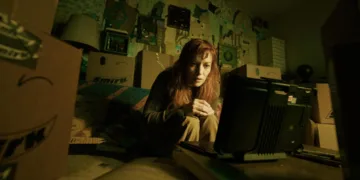
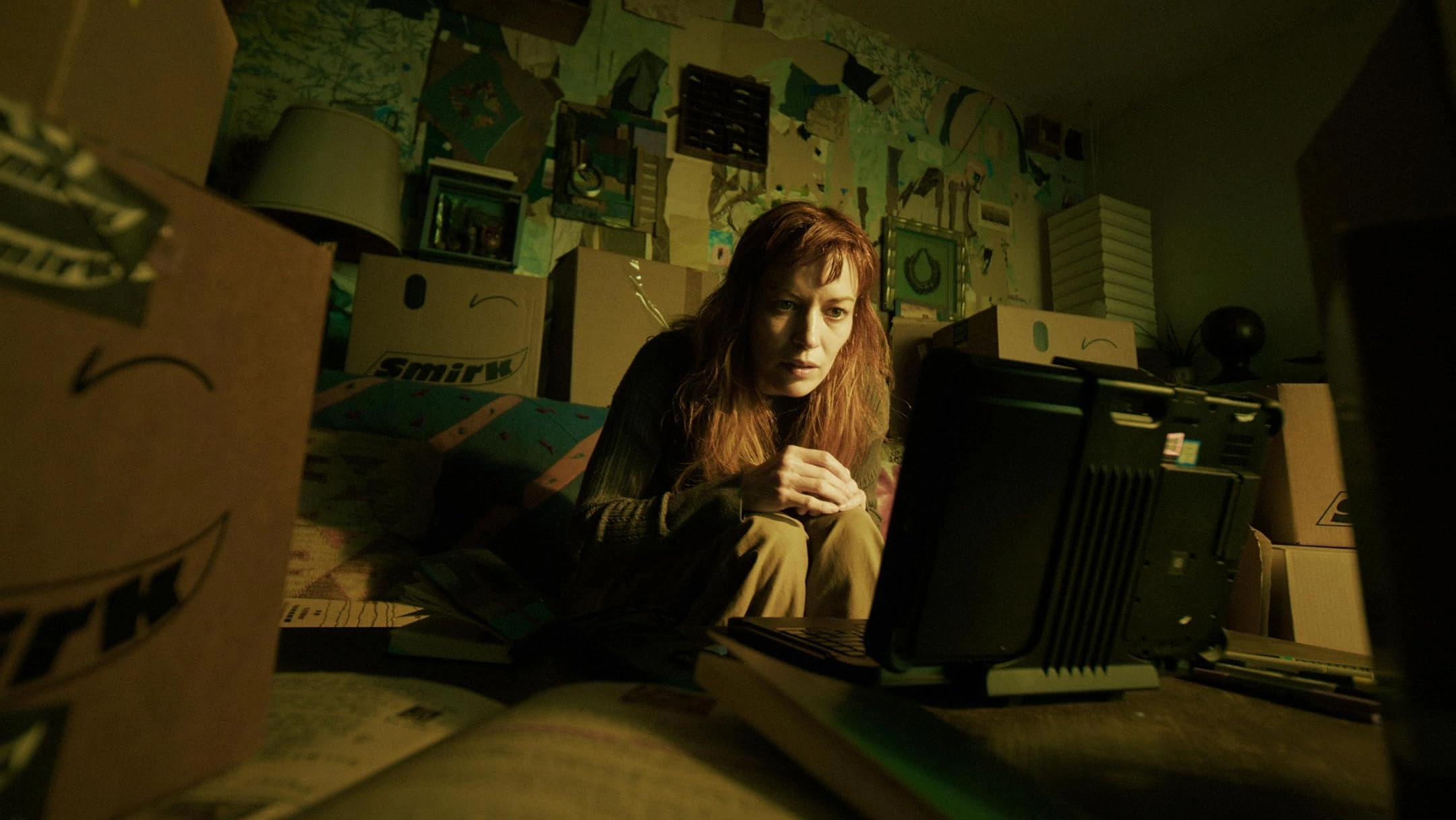
Then the packages arrive. Lipstick in Julia’s preferred shade. Condoms. Protein powder connected to a former co-worker. Drum-related objects. Strange masks. Each item drags a fragment of Julia’s past into the sterile present of her rental home. Smirk does not simply send products. It sends evidence.
The mystery works best as a fever inside Julia’s mind. Someone may be targeting her. Her psyche may be staging a revolt. Both possibilities feel plausible because the film places her in a world where the difference between being watched and being predicted has nearly vanished. Her decision to work inside Smirk plays like a descent into the system that has already colonized her life.
Britt Lower and the Human Cost of Being Seen
Britt Lower gives Julia a raw, splintered physicality. She paces like a trapped animal, opens boxes with an almost violent urgency, and turns ordinary rooms into battlegrounds through sheer nervous motion. Her face often seems caught between defiance and collapse. Julia can be abrasive, even cruel, yet Lower never lets her become a simple victim. She is damaged, selfish, frightened, funny in sour flashes, and painfully human.
Seehorn’s Whitney cuts through the film with dry impatience. The role is brief, yet her presence gives the recovery scenes a brittle charge. Whitney’s anger feels lived-in, which makes her an uneasy mirror for Julia rather than a comforting guide. Baryshnikov’s Tatiana adds another form of unease. Her care for Julia is real, but it arrives with judgment tucked beneath it. Their sisterly bond is made of guilt, fatigue, love, and old bruises.
David Dastmalchian brings the film its rare softness as Charlie, the Smirk driver whose awkward gentleness makes him feel out of place inside this corporate nightmare. His scenes with Lower carry a strange, bruised sweetness. Charlie is part of the machine, yet he seems lonely enough to resent it from within.
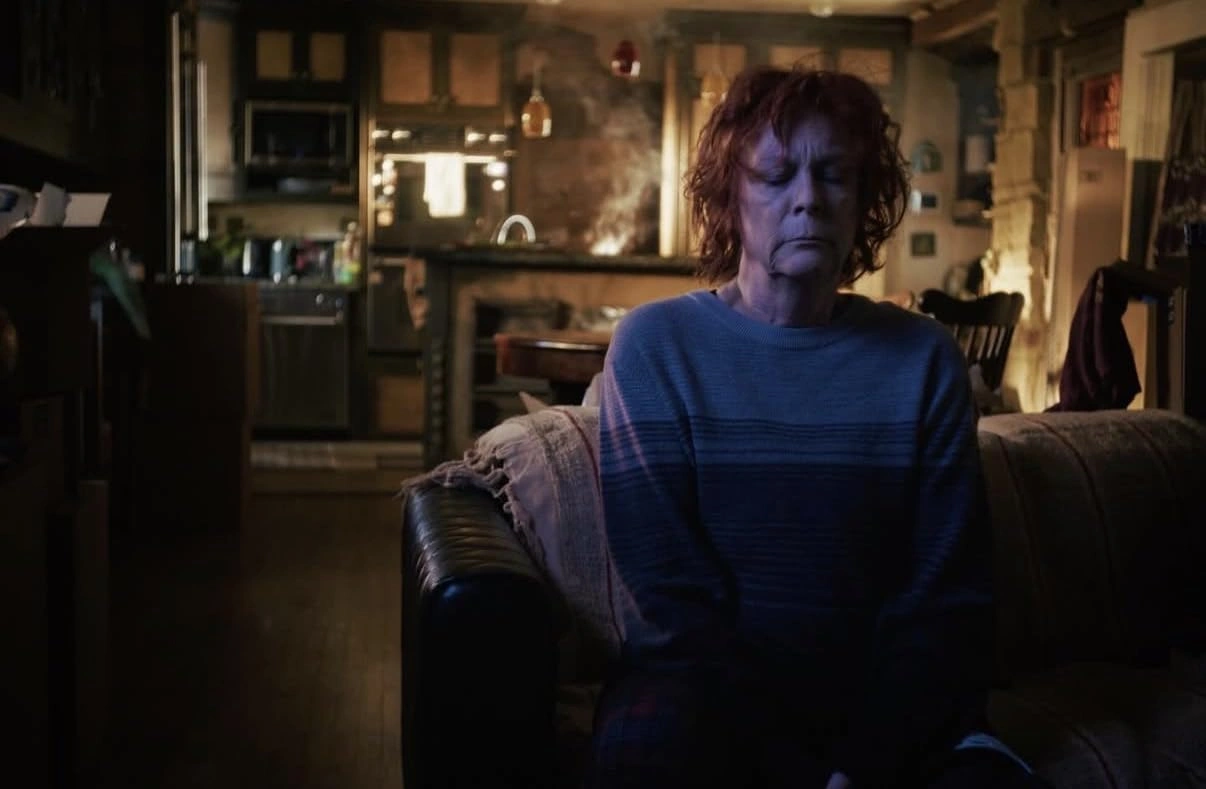
Jamie Lee Curtis, nearly spectral in the prologue, gives the story a wider chill. Her appearance suggests that Julia’s terror is not isolated. The packages have other addresses.
A Machine Made of Sound, Color, and Shame
Sender is most persuasive as a sensory assault. Marco Rosas’s editing snaps the film into anxious fragments, cutting across time and space with the harsh rhythm of a mind losing sequence. Scenes seem to arrive too quickly or linger a breath too long, creating a constant unease. The film often feels edited by panic itself.
Gavin Brivik’s score grinds and pulses with metallic force, turning Julia’s world into a warehouse of invisible mechanisms. Nathan Ruyle’s sound design is even sharper: cardboard tearing, cymbals clashing, static buzzing, appliances roaring to life, delivery alerts stabbing the air. These noises become extensions of Julia’s nervous system. Nothing sounds neutral. Every object has teeth.
Gemma Doll-Grossman’s cinematography gives the film a sickly glow, with greens and blurred edges that make domestic space feel contaminated. Cold daylight exposes Julia rather than comforting her. Her rental home, aided by precise production design, becomes a tidy prison slowly overtaken by boxes. The neatness is important. Chaos does not always look messy. Sometimes it is stacked cleanly by the door.
Goldman’s film fits beside paranoid works such as Unsane, Pi, Safe, Videodrome, and Pulse, yet its fear belongs firmly to the age of algorithmic intimacy. Smirk knows Julia because Julia lives inside systems built to learn her. The film’s lean dialogue and familiar late-stage revelations may blunt some of its force, and a few supporting characters could use richer inner lives. Still, Sender understands a modern terror with painful clarity: the self can be cataloged, sold back, and delivered overnight.
Sender is an American psychological horror-thriller film that made its official world premiere in the Narrative Feature Competition at the South by Southwest (SXSW) Film Festival on March 14, 2026, followed by a prominent screening at the San Francisco International Film Festival. Written and directed by Russell Goldman as his feature length directorial debut, the tense narrative tracks a newly sober young woman who falls into an extreme state of paranoia after constantly receiving unsolicited e-commerce packages filled with unnervingly personal items. Film enthusiasts can check out the independent thriller at seasonal festival screenings, while its widespread commercial theatrical and streaming platform release plans continue to be negotiated through its production agencies.
Full Credits
Title: Sender
Distributor: Comet Pictures, Paris Films
Release date: March 14, 2026
Running time: 94 minutes
Director: Russell Goldman
Writers: Russell Goldman
Producers and Executive Producers: Jamie Lee Curtis, Molly Hallam, Jake Katofsky, Thomas Grabinski, Akshay Shah, Britt Lower, Russell Goldman
Cast: Britt Lower, Rhea Seehorn, Jamie Lee Curtis, Anna Baryshnikov, David Dastmalchian, Utkarsh Ambudkar, Mike Mitchell, Ken Jeong, Edward Torres, Alyssa Limperis, Inger Stratton
Director of Photography (Cinematographer): Gemma Doll-Grossman
Editors: Marco Rosas
Composer: Gavin Brivik
The Review
Sender
Sender is a tense, stylish psychological thriller that turns consumer convenience into a private nightmare. Britt Lower gives the film its frayed pulse, while Russell Goldman’s direction creates a world where every package feels like an accusation. Some supporting roles feel thin, and the reveal may not satisfy every viewer, but the film’s sound, editing, and existential unease leave a sharp mark.
PROS
- Britt Lower’s intense lead performance
- Strong sound design and editing
- Smart use of consumer paranoia
- Distinct visual mood
- David Dastmalchian brings warmth
CONS
- Some supporting characters feel underused
- Lean dialogue may frustrate
- Mystery reveal feels familiar
- Pacing can feel abrasive