


























Louise Andersen has already survived the hardest part of amnesia by the time The Secret Woman catches up with her. She has built a life. She runs a café on the Norwegian island of Hidra, loves crime writer Joachim, and has accepted that whatever existed before she was found badly injured aboard a ship may never return. Then a stranger calls her Helene, and the stability she created begins collapsing almost immediately.
Barbara Topsøe-Rothenborg’s Danish Netflix thriller gets its best idea from that collision. A DNA test reveals Louise is really Helene Söderberg, a missing heiress tied to a powerful Danish shipping company. She has a husband, Edmund, and a young son, Alexander. The discovery gives her legal facts without restoring emotional memory, which creates a much stranger problem than simply solving her disappearance. She knows who Helene was on paper. She still has no idea what being Helene felt like.
That tension separates the premise from the familiar amnesia mechanics of The Bourne Identity or Memento. Louise has spent two years becoming somebody through daily choices, relationships, and routines. Now people she cannot remember insist that another version of her carries greater authority. The film understands the discomfort of that situation immediately. It just has trouble staying interested in it.
Motherhood Makes the Mystery Personal
The strongest reason for Louise to return to Denmark is Alexander. Her connection with him arrives before any recovered memory can explain it, and Natalie Madueño plays their reunion with a useful mixture of tenderness and alarm. Louise is drawn toward this child while simultaneously facing the terrifying fact that she has missed years of his life.
Her promise that she will not abandon him again gives the story stakes that no corporate conspiracy could manufacture. Leaving Denmark would mean returning to the person she consciously chose to become, yet it would also mean walking away from a son who has already lost his mother once.
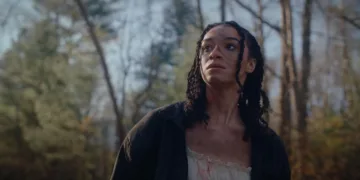
Madueño is very good at holding both identities in the same performance. The Louise we see at the Norwegian café appears settled inside her surroundings. Once she enters the Söderberg estate, her body language tightens. She watches people before answering them. Familiar objects produce flashes that she cannot properly interpret. A damaged compact mirror triggers one such memory, turning an ordinary possession into evidence from a life she does not trust.
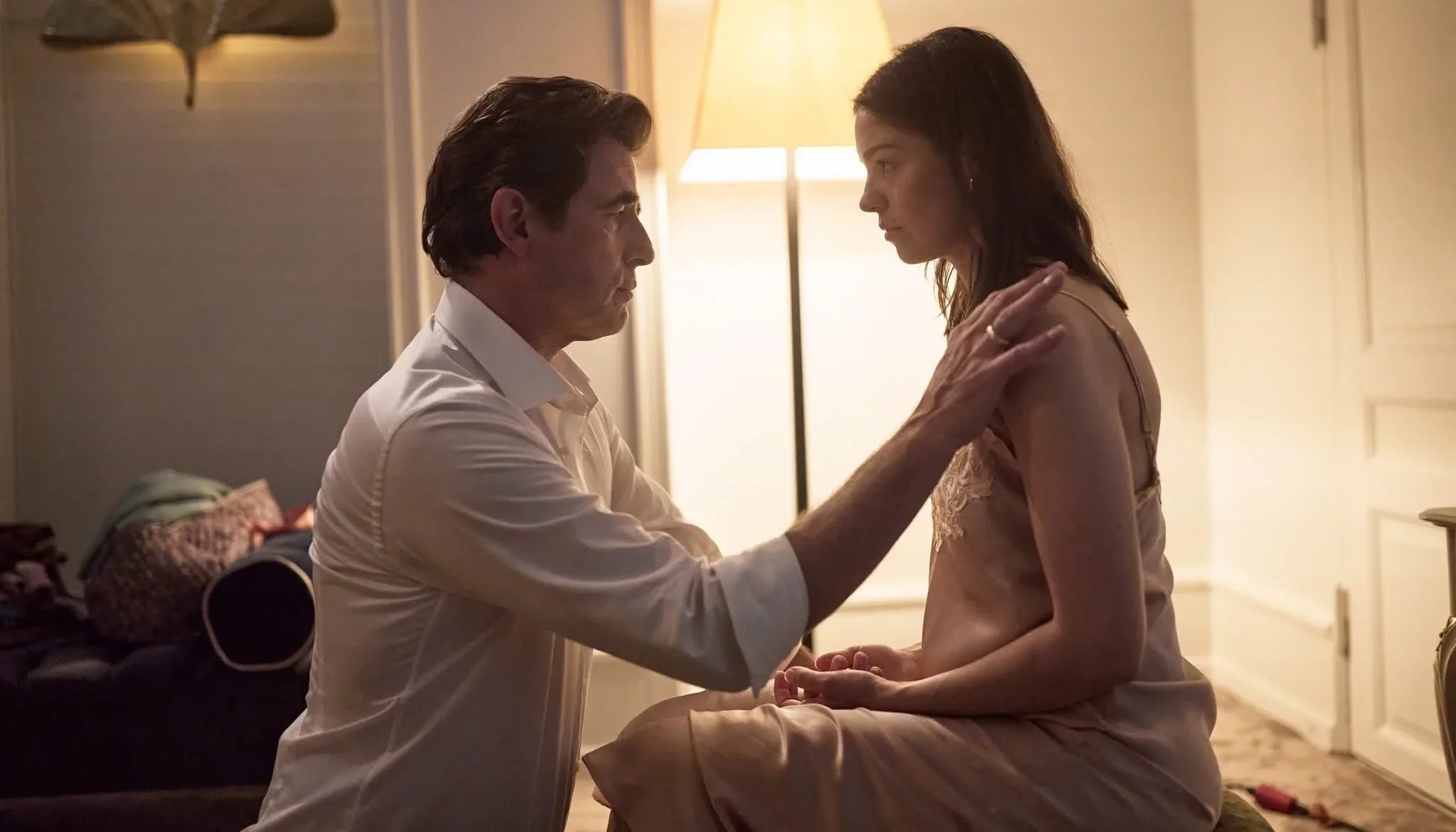
Edmund makes that uncertainty dangerous. Claes Bang initially plays him with careful restraint. He presents photographs, recounts milestones, and behaves like a husband hoping his wife will remember him. The problem is that Louise cannot independently confirm any of it. Every affectionate story is also information Edmund controls.
Those early scenes give Bang room to make politeness threatening. His soft delivery carries far greater force than the open hostility that arrives later. Once Edmund begins displaying obvious possessiveness, anger, and violence, the film loses some of its psychological ambiguity. We stop asking if Louise’s discomfort might be the reaction of a woman returning to an unfamiliar marriage. The answer has already started flashing in red.
Joachim offers the opposite relationship. Pål Sverre Hagen gives him an easy warmth, and his investigation into the Söderbergs turns concern into action while Louise remains trapped inside their version of events. He is the person attached to who she became after losing her memory. Edmund is attached to who she was before losing it. There is an entire psychological drama sitting inside that triangle. The thriller keeps checking its watch.
Clues Arrive Right on Schedule
The first half handles the mystery with enough confidence to keep curiosity alive. Louise searches through old belongings after being recognized. The compact mirror sparks a fragment of memory. Rooms inside the Danish estate trigger further flashes, shot with a colder visual texture that separates remembered fragments from the present.

Joachim’s research runs alongside Louise’s discoveries, letting information reach us from outside the Söderberg household. The pacing is efficient. New clues arrive before scenes have time to grow stale, and the film rarely gets stuck repeating information. Efficiency starts becoming convenience once the investigation deepens.
Louise’s memories frequently return at exactly the moment a missing piece is needed. A yearbook with torn pages sits around waiting to become evidence. Information that a wealthy and apparently powerful family has concealed elsewhere survives in strangely accessible places. Instead of making Louise fight for fragments of her past, the screenplay often places the next fragment directly in her path.
That matters because memory should be the film’s most unstable element. Louise has no reliable internal record of what happened. Every recovered image could have been frightening, misleading, incomplete, or emotionally distorted. The film uses flashbacks mainly as an information-delivery system.
Its suspense suffers from a similar issue. One alley sequence has Louise fleeing an unknown pursuer and hiding while danger closes in. The ingredients are there, yet the camera often stays too far from her to create the claustrophobia the scene needs. The score tells us to tense up, while the framing keeps giving us room to breathe.
I kept noticing this gap between what a scene was trying to communicate and what the filmmaking actually made me feel. The music frequently arrives first, announcing suspicion before the image has created it. Inside the Söderberg home, tilted compositions and gothic hallways make the household look unstable long before the story leaves much doubt about Edmund. The movie keeps pointing toward danger. Eventually, pointing is all it has left to do.
The Performances Keep the Puzzle Human
Madueño carries a difficult role because Louise and Helene cannot simply register as separate personalities. One woman has two biographies competing for ownership of her life. Her best scenes are the quieter ones. Watch how she reacts to Alexander compared with Edmund.
The child produces an emotional pull she cannot explain. Edmund produces hesitation before she can explain that either. Madueño gives those reactions different textures, which allows instinct to become part of the mystery without turning Louise into a supernatural lie detector.
Bang works from the opposite direction. Edmund is most unnerving while he is still controlled. His mildness suggests a man who knows exactly how much pressure to apply. Later scenes ask him to become a clearer villain, and the performance loses some of its unpredictability because the script has already made the destination obvious.
The supporting players help establish the Söderberg home as a place where everybody seems to possess information Louise lacks. Stina Ekblad’s presence as Edmund’s mother works especially well when she is positioned around stairways and corridors, watching rather than explaining. Topsøe-Rothenborg leans into manor-house gothic imagery here, using the architecture to make Louise look like a guest inside her own history.
The Norwegian material feels brighter and more open. Denmark gradually becomes enclosed by rooms, corridors, family expectations, and corporate secrets. It is a simple visual division, but it gives Louise’s two identities distinct physical spaces.
That clarity also exposes what happens when the screenplay becomes overloaded. The final confrontation should compress all of this pressure into immediate danger. Instead, characters begin explaining the machinery behind the conspiracy while Louise is supposedly facing people capable of terrible violence. Nothing drains menace like a villain deciding this is the perfect time for a briefing.
The Bigger Story Gets Less Care
The final stretch expands the mystery far beyond a damaged marriage. Corporate corruption, murder, exploitation, and human trafficking enter the story, reframing Helene’s disappearance as part of something much larger. The scale increases. The emotional focus shrinks.
Human trafficking carries consequences the film barely has time to examine. Victims outside Helene’s immediate story remain peripheral once their suffering has supplied the conspiracy with sufficient horror. The screenplay wants the revelation to raise the stakes, then races toward resolving Helene’s personal crisis before the implications can settle.
That choice is frustrating because the earlier identity material gives the film a sharper question. What makes Louise responsible for Helene’s life if she cannot remember living it? A name can be restored through DNA. Money can be returned. A marriage can be legally recognized. None of those things can manufacture emotional continuity.
Alexander complicates the question beautifully because he cannot be treated like another artifact from Helene’s old life. Louise may have no memory of becoming his mother, yet his need for her exists in the present. Her past has consequences that memory loss cannot erase.
Edmund exploits the opposite side of that vulnerability. He repeatedly defines Helene for Louise because she lacks the memories required to challenge his account. Whoever controls the story of her past gains enormous influence over her present.
The film has something genuinely sharp there about identity becoming a contested narrative. Then another clue appears, somebody explains another secret, and the machinery starts moving again.
The Secret Woman works best during the moments when Louise is forced to ask which parts of a life can actually be recovered. Its mystery keeps offering answers. The person living inside those answers remains far harder to reconstruct.
The Secret Woman premiered globally on Netflix on August 28, 2026. A woman living a peaceful life on a remote island discovers she is actually someone else who vanished three years prior, prompting her to unravel a dangerous web of buried truths.
Where to Watch The Secret Woman (2026) Online


Full Credits
Title: The Secret Woman
Distributor: Netflix
Release date: August 28, 2026
Rating: TV-MA
Running time: 1 hour 44 minutes
Director: Barbara Topsøe-Rothenborg
Writers: Anders Rønnow Klarlund, Jacob Weinreich, Anna Ekberg
Producers and Executive Producers: Marcella Linstad Dichmann
Cast: Natalie Madueño, Pål Sverre Hagen, Claes Bang, Stina Ekblad, Ingrid Bolsø Berdal, Rasmus Hammerich, Thomas Voss
Director of Photography (Cinematographer): Lars Reinholdt
Editors: Lars Wissing
Composer: Elvin Matz, Aramis Silvereke, Alexander Westlund
The Review
The Secret Woman
The Secret Woman has a terrific identity crisis buried inside a shakier mystery. Natalie Madueño gives Louise/Helene genuine emotional weight, especially when Alexander turns an abstract past into something painfully immediate. Barbara Topsøe-Rothenborg keeps the clues moving, yet convenient memories, obvious suspicions, and exposition-heavy confrontations gradually drain the suspense. The film is easiest to enjoy as a brisk Netflix thriller, because its ideas about memory, motherhood, coercion, and privilege deserve considerably deeper treatment than the screenplay gives them.
PROS
- Natalie Madueño’s layered lead performance
- Strong identity and memory premise
- Effective early mystery construction
- Claes Bang’s controlled early menace
- Steady pacing through the investigation
CONS
- Convenient memory recoveries
- Edmund becomes obvious too early
- Underpowered suspense filmmaking
- Overloaded final revelations
- Trafficking storyline lacks needed depth