

















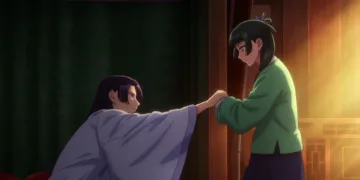













A hand holds a pencil, poised over a blank page. “Scene 1, Summer, Seaside,” the screenwriter Li writes, and with these few words, a world is summoned into existence. Sho Miyake’s Two Seasons, Two Strangers begins with this quiet act of creation, immediately placing us inside the mind of its protagonist. Li, a Korean writer living in Japan, is experiencing a profound creative and emotional stasis.
Her inner monologue, spoken in her native Korean, reveals a struggle with the very tools of her trade; she feels trapped in a “cage of words.” The film patiently observes her stillness, establishing a contemplative atmosphere that presents an inquiry into the porous divide between the life one lives and the stories one tells. It is a film about the deep solitude of the artist and the unexpected ways connection can be found in the quiet spaces between words.
Summer by the Sea
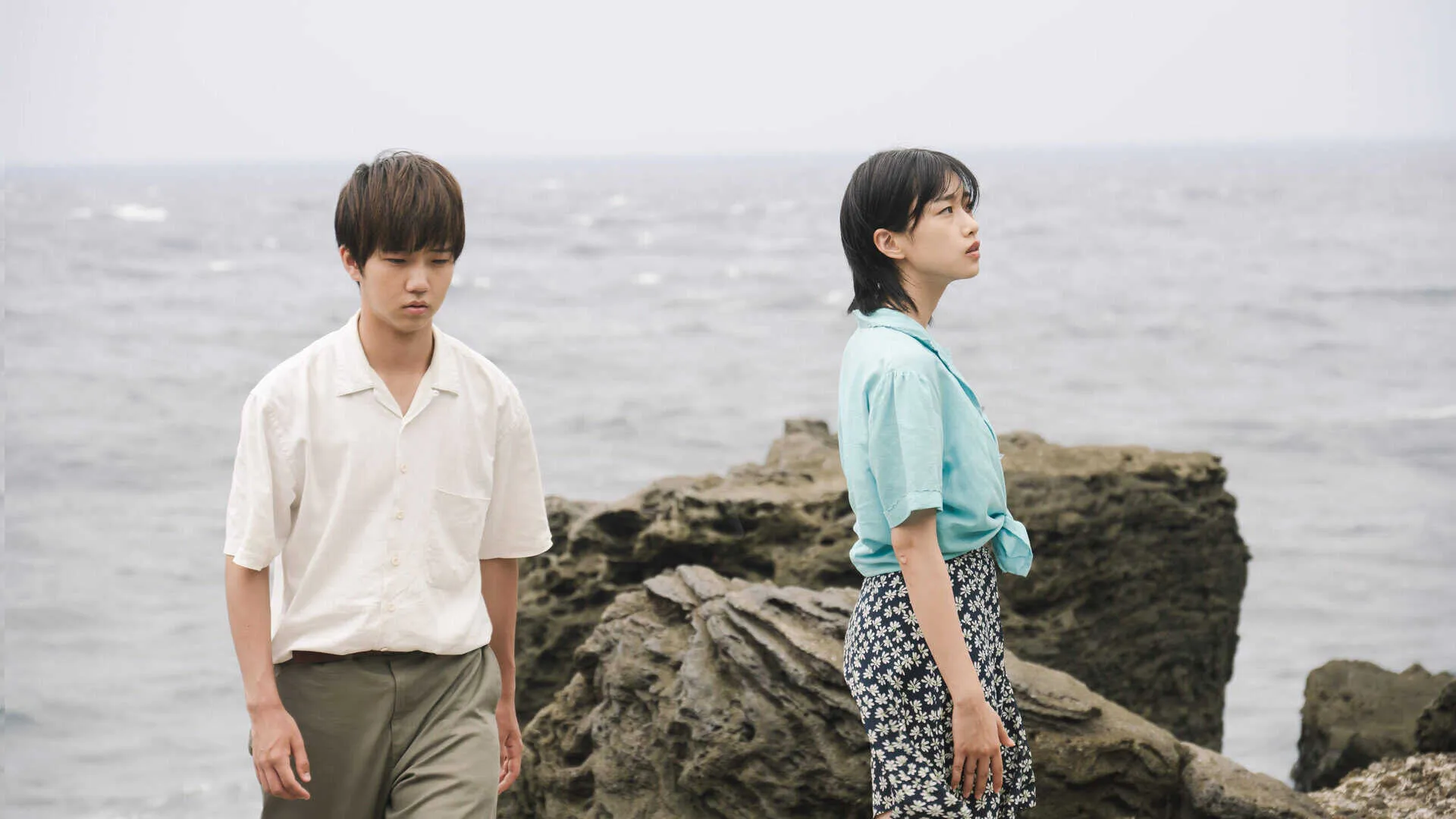
The story Li writes unfolds in a sun-drenched coastal town, a setting ripe for a fleeting holiday romance. Here, a young woman named Nagisa and a young man named Natsuo meet by chance. Both are adrift; she is disappointed that a change of scenery has failed to change her mood, while he glumly believes himself to be profoundly unlucky.
Theirs is a tentative, fleeting friendship born of a shared, unspoken loneliness. They walk, talk, and read paperbacks by the shore, their interactions carrying the gentle, observational cadence of an Éric Rohmer film. On the surface, their connection is simple and sweet, culminating in a plan to meet again.
The visual palette is dominated by the blues of the ocean and sky, with Yuta Tsukinaga’s cinematography capturing the elemental fluidity of water with a graceful touch. Yet, a strange melancholy permeates this idyllic setting. A tourist’s camera makes Natsuo deeply uncomfortable, and he later recounts a grim childhood memory of seeing the bodies of drowning victims washed ashore.
Their climactic swim together happens not under a clear sky but during a torrential downpour, the camera buffeted by waves. This undercurrent of foreboding suggests that the fiction is a direct reflection of its creator’s despaired mind, a beautifully crafted story colored by an unseen sadness.
Winter in the Mountains
The film then pivots from the imagined summer to a lived winter, leaving the azure coast for sullen, earthy browns and stark whites. We follow Li herself, years after she wrote the seaside story. At a public screening, she is a twitchy, tentative presence, fumbling for answers when questioned about her work.
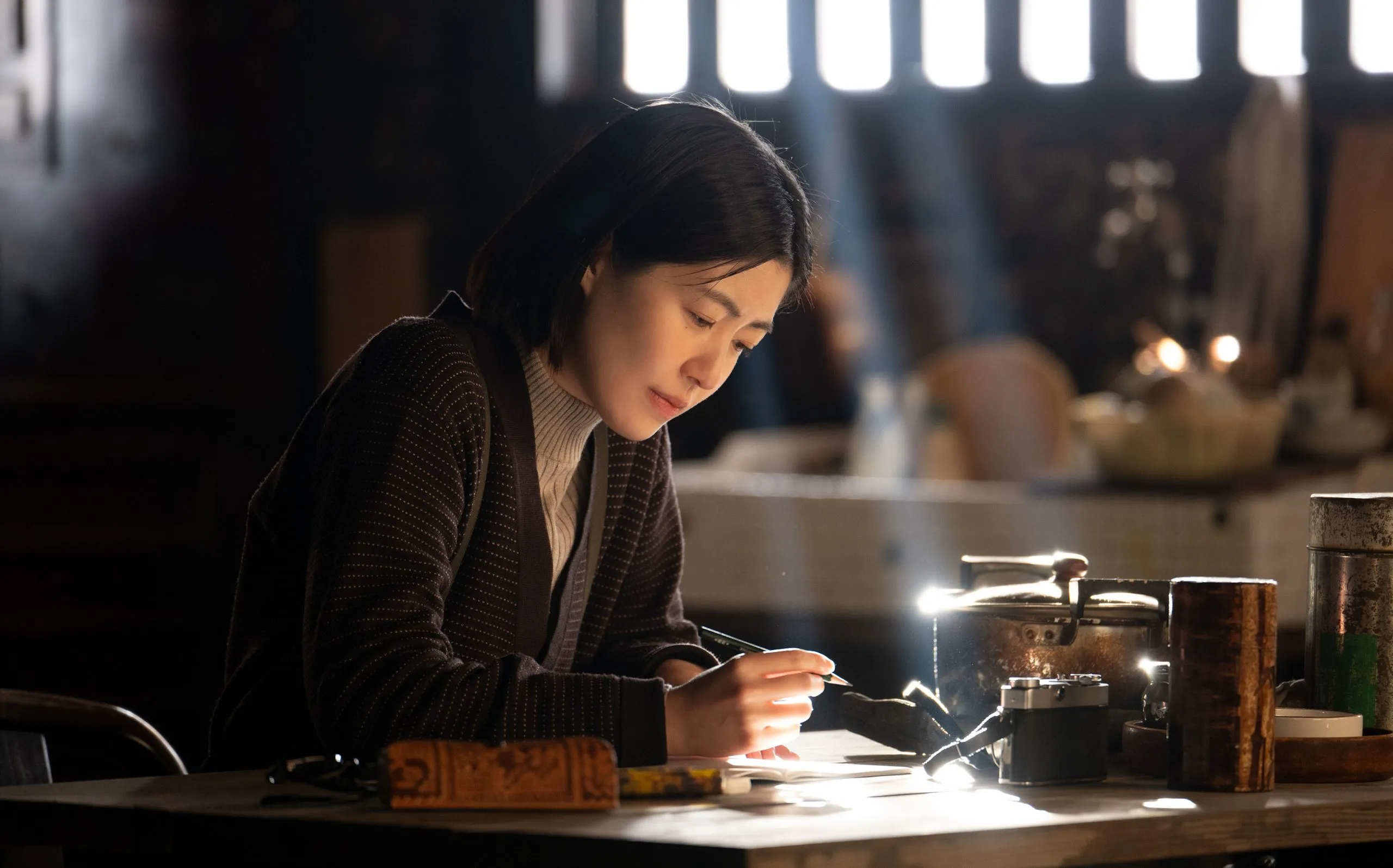
Prompted by her creative paralysis and the sudden death of a former professor, she escapes the city without a plan. A train plunges through a dark tunnel and emerges into a world of dazzling, untouched snow. This stark visual transition marks the move from her controlled fiction to an unpredictable reality.
In this remote, snow-blanketed village, she finds the only available lodging at a dilapidated inn literally off the map. It is run by Benzo, a cynical and curmudgeonly man separated from his family. Their initial interactions are stiff and awkward, defined by the visible cold that seeps into the building and the emotional distance between them.
Slowly, a shared sense of isolation builds a bridge. Their conversations turn to the nature of storytelling, with Benzo asserting that a good work is defined by how well it depicts human sadness. Their bond solidifies through a strange, almost comedic misadventure involving stealing a prized fish from his ex-wife’s pond.
The performance by Shim Eun-kyung as Li is a study in quiet restraint. She conveys a universe of thought and feeling in the way her glasses fog over a bowl of hot ramen, her character’s attempt to exist beyond language made palpable.
Life Inscribed
Two Seasons, Two Strangers is built upon a reflexive, story-within-a-story framework. The film explicitly draws attention to its own artifice, cutting from the seaside story to show an audience watching it, with one viewer remarking, “Honestly, I didn’t get it.” Li is both the author of the first narrative and the subject of a second.
Her own winter encounter with Benzo becomes a real-life echo, a messier and more authentic version of the fictional summer connection she created. The film expertly parallels these two meetings, showing how the raw material of life, with all its humor and tragedy, is channeled into art.
The second half of the film feels more stimulating, as Li’s lived experience gains a texture and spontaneity that her crafted fiction lacks. The structure suggests that to break free from creative paralysis, one must step away from the page and engage with the world’s unscripted moments.
It is a quiet meditation on the artistic process, proposing that true inspiration is found not in grand events but in the spontaneous, unwritten grace of a chance meeting. The film understands that the most profound connections often descend upon us when we are lost, offering muted consolation from the most unusual corners.
“Two Seasons, Two Strangers” is a 2025 Japanese drama film based on the manga “Mr. Ben and His Igloo, A View of the Seaside” by Yoshiharu Tsuge. It premiered at the 78th Locarno Film Festival on August 15, 2025, where it won the Golden Leopard. The film follows Li, a screenwriter grappling with a creative slump, who embarks on a journey that leads her to a remote inn during winter. It is slated for a theatrical release in Japan on November 7, 2025.
Full Credits
Director: Sho Miyake
Writers: Sho Miyake, Yoshiharu Tsuge
Producers: Masayoshi Johnai
Cast: Shim Eun-kyung, Yuumi Kawai, Mansaku Takada, Shiro Sano, Shinichi Tsutsumi
Director of Photography (Cinematographer): Yuta Tsukinaga
Editors: Keiko Okawa
Composer: Hi’Spec
The Review
Two Seasons, Two Strangers
Two Seasons, Two Strangers is a work of profound, quiet beauty. Its reflexive structure, which nests a story within a story, is a brilliant device for examining the interplay between art and lived experience. With exquisite cinematography and a deeply felt lead performance, the film presents a moving meditation on loneliness, creativity, and the grace of unexpected human connection. It is a patient, poetic, and deeply rewarding piece of filmmaking that finds immense feeling in the smallest of gestures.
PROS
- An intelligent story-within-a-story structure that enriches its themes.
- Beautifully contrasting cinematography that captures the distinct moods of summer and winter.
- A masterful lead performance from Shim Eun-kyung, full of nuance and quiet depth.
- A subtle, sensitive handling of loneliness and the search for connection.
CONS
- The deliberately slow, contemplative pace may not suit all viewers.
- Its narrative is emotionally subdued, lacking conventional dramatic conflict.
- The purpose of the initial story segment may feel unclear until later in the film.