
























Harry Lagoussis’s sci-fi-infused drama Novak explores the treacherous line between a scientific visionary and a manipulative charlatan. This theme of the charismatic guru is a familiar one in global cinema, from Hollywood cult thrillers to the complex ‘godman’ narratives of Indian film. We first meet Dr. Novak, a disgraced Croatian neuroscientist, living in a squalid Athens apartment.
He is a forgotten figure, burnt-out from past controversies. His quiet exile is interrupted by Petros, a young devotee who believes Novak’s abandoned research on electromagnetic pollution can save humanity. The arrival presents an immediate question: is this a chance for the fallen scientist to redeem his work, or will he simply repeat his destructive patterns on a new generation of followers?
An Ashram of Wires and Faith
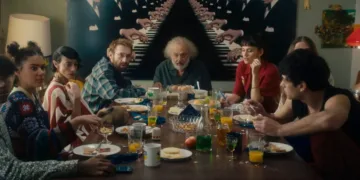
Novak accepts the offer and is ushered into the world of “New Atlantis,” a commune of anti-technology activists. The rambling, atmospheric house serves as a modern-day ashram, a secluded space where followers disconnect from the outside world to devote themselves to a singular, unorthodox philosophy.

The cluttered interiors, filled with modernist art and shadowy corners, create a powerful sense of a community that has turned inward. Its members are a collection of disillusioned souls: Maria, the stern, Lotte Lenya-like host who organizes their lives; Max, who takes direct action by damaging cellphone towers; the vulnerable, self-harming Daphne; and Louise, a filmmaker documenting their cause.
This environment, detached from societal norms, becomes the perfect laboratory for Novak. His scientific equipment, far from the sleek futurism of mainstream sci-fi, consists of old computers and tape recorders, giving his work a grounded, almost Frankenstein-like quality.
This lo-fi aesthetic recalls the gritty realism found in India’s Parallel Cinema, which often used practical effects to explore profound ideas. With his ego bolstered by their admiration, Novak begins his experiments, clipping electrodes to the heads of his willing subjects. He aims to induce a “pure and transcendent mental state,” but as his methods grow more extreme and his authority becomes absolute, deep ethical lines are crossed, causing the community to fracture under the weight of its own faith.
A Towering Performance in a Hazy Crowd
The film is anchored by Zlatko Buric’s commanding and layered performance as Dr. Novak. His weighty, bearlike physical presence makes the character’s charisma completely believable; he exudes an intellectual arrogance mixed with a paternal warmth that makes it easy to see why people would follow him.
Buric’s portrayal has the quiet authority of veteran Indian actors like Naseeruddin Shah or Om Puri, who could carry an entire film through their nuanced depiction of morally ambiguous men. He remains a compelling figure even when delivering clichéd dialogue that sounds like it was pulled from a self-help manual, bringing conviction to lines that might otherwise fall flat. This strong central performance is unfortunately contrasted by the thinly drawn acolytes who surround him.
The supporting characters, from the wide-eyed idealist Petros to the filmmaker Louise, lack psychological depth. Their immediate, unwavering belief in Novak’s questionable science feels unconvincing and stretches credulity.
Their gullibility is a central plot device, yet it is never fully explored, making them feel more like thematic props than realized individuals. This imbalance weakens the film’s emotional core. It presents a fascinating premise about the modern search for leadership but misses the chance to explore the complex motivations of those who are so desperate to follow.
A Vision Muted by Its Own Rhythm
Novak is a film of frustrating contradictions, where ambitious ideas are hampered by their uneven execution. The narrative moves at a plodding, glacial pace that struggles to build and maintain momentum. The early scenes take a long time to establish the situation, and this deliberate rhythm frequently undermines the story’s high-stakes premise, making it difficult for the viewer to feel a sense of urgency or danger.
Scenes often feel overstretched or end abruptly, creating a disjointed viewing experience. Visually, the film is far more successful. The director, a former cartoonist, displays a strong aesthetic sense through striking uses of perspective and careful composition. The cluttered, shadowy art design of the commune creates a potent atmosphere of both sanctuary and prison.
A darkly humorous animated sequence, created by the character Louise to explain the dangers of technology, stands out as a high point of creativity. The soundscape is also effective, using its design to create an unsettling mood.
The soundtrack’s use of indie pop from bands like The Seeds and The Fiery Furnaces injects a welcome energy, a technique common in global independent films. The film contains a potent concept and a powerful lead performance, yet it is let down by a sluggish narrative and underdeveloped characters, failing to translate its interesting ideas into a consistently engaging cinematic experience.
“Novak” is a drama and science fiction film that explores the blurred line between genius and madness. It is directed by Harry Lagoussis and was released in 2025. The film’s runtime is 1 hour and 50 minutes. It was presented in the Edinburgh competition on August 17, 2025. The film is a co-production between Greece and Switzerland.
Full Credits
Director: Harry Lagoussis
Writers: Harry Lagoussis
Producers: Giorgos Karnavas, Michael Graf, Sara Bonakdar, Kaarthekeyen Santhanam
Cast: Zlatko Burić, Ella Rumpf, Yiannis Papadopoulos, Elena Topalidou, Korina-Anna Gougouli, Nikos Manesis
Director of Photography (Cinematographer): Yorgos Koutsaliaris
Editors: Dimitris Polyzos
Composer: Harid Neilas
The Review
Novak
Novak is a conceptually ambitious film anchored by a magnetic lead performance from Zlatko Buric. His portrayal of a modern-day scientific guru is captivating. The film's strong visual style and atmospheric design create a compelling world. These strengths are unfortunately undermined by an extremely slow pace, underdeveloped supporting characters, and a narrative that fails to generate the tension its premise requires. It is a film with fascinating ideas that it cannot quite bring to life, resulting in a watch that is more intellectually interesting than emotionally engaging.
PROS
- A powerful and charismatic central performance by Zlatko Buric.
- Impressive visual direction and atmospheric art design.
- An interesting, high-concept premise exploring themes of faith and technology.
- An effective indie pop soundtrack that adds energy.
CONS
- The narrative pacing is exceptionally slow and often plodding.
- Supporting characters are thinly written and their motivations are unconvincing.
- The dialogue can be flat and clichéd.
- Fails to build sufficient dramatic tension, undermining its own plot.