





















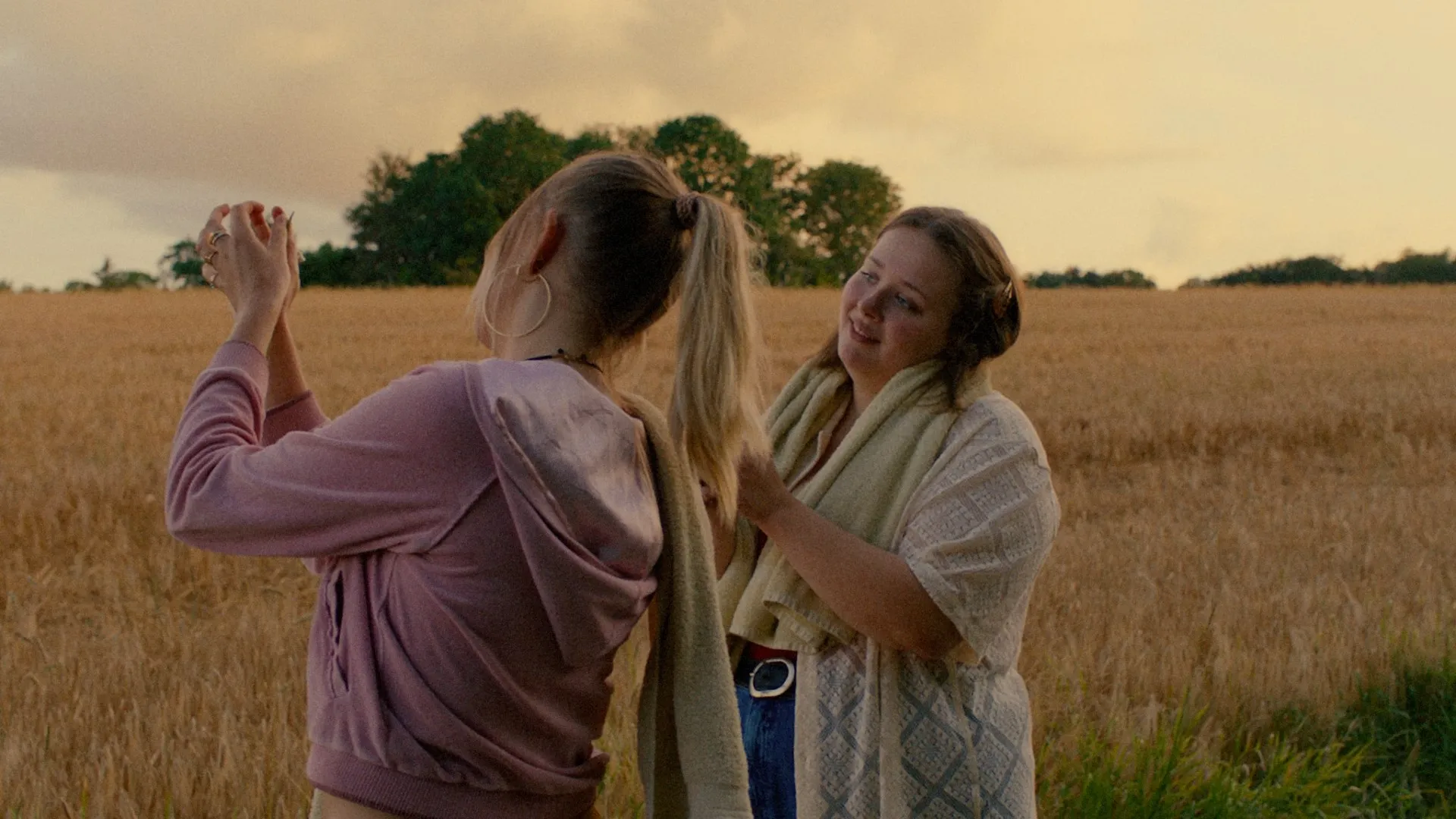

Emilie Thalund’s debut feature “Weightless” (Vægtløs) announces itself quietly, without fanfare, much like its protagonist moves through the world. Fifteen-year-old Lea, played with disarming vulnerability by Marie Helweg Augustsen, arrives at a Danish summer health retreat carrying invisible burdens heavier than any scale could measure.
The film, which claimed top honors in San Sebastian’s New Directors competition, positions itself as a coming-of-age story. Yet what unfolds feels closer to an excavation of adolescent consciousness trapped inside a body that society has already judged and found wanting.
Lea’s weeks at this camp trace two parallel trajectories: the expected physical transformation through restricted meals and mandated exercise, and a far more turbulent psychological awakening. Thalund handles her subject with clinical precision softened by genuine empathy, examining how a teenage girl navigates desire when she has been taught her body is the wrong vessel for it.
Sasha, her thin and fearless roommate (Ella Paaske), and Rune, a camp instructor in his thirties (Joachim Fjelstrup), complete this triangle of need and misrecognition. This is a film about wanting to be wanted, about the particular cruelty of adolescence when your flesh becomes evidence against your right to participate in the rituals of attraction and touch that your peers claim so easily.
Bodies as Battlefields
Lea exists in perpetual tension with herself. Her self-worth calculates itself through a brutal mathematics of appearance, each glance in a mirror another data point confirming her inadequacy. She internalizes cruelty with frightening efficiency, building an architecture of shame that supports her every interaction. Yet beneath this self-negation, anger simmers.
She does not explode or rebel in obvious ways. Her resistance takes subtler forms, a slow accumulation of moments where she refuses to disappear entirely into the role of grateful project, the fat girl who should be thankful anyone notices her at all.
Also Read






Sasha arrives at camp for different reasons. Too wild, too sexually precocious, too much trouble for her parents to manage. She moves through space as if she owns it, slim and confident, already fluent in the language of desire that Lea is only beginning to stammer. Their friendship develops along fault lines of envy and genuine affection. Sasha can be caring, even loving, yet her casual remarks land like small cuts. She does not mean to wound, perhaps. Or she means it only a little. The film refuses to simplify her into either saint or tormentor. She is simply a teenage girl wielding the power that conventional beauty grants, sometimes consciously, often without thought.
The dynamic between them shifts like sand. During a night when they sneak away to drink with local boys, Lea faces open mockery about her body. For once, she pushes back. The humiliation she has swallowed for so long erupts, and something in their relationship recalibrates. They move from an unequal pairing toward something approaching actual friendship. The evolution feels earned because Thalund and screenwriter Marianne Lentz write both characters with psychological depth that resists easy categorization.
Rune enters this landscape as the adult who should know better. He radiates easy charm, the kind of approachability that makes teenagers feel seen without feeling judged. He pays special attention to Lea, listens when she speaks, treats her like someone worth knowing. For a girl starved of this kind of attention, his interest becomes intoxicating. She begins to believe in possibilities, to imagine herself as the object of desire rather than pity. Rune’s failure is not sudden predation. He does not groom in the calculated sense. Instead, he simply never establishes the boundaries that his position demands. He allows closeness to metastasize into something darker. His charm becomes a weapon he may not even realize he is wielding, and Lea, desperate for validation, walks straight into its edge.
The friendship between the two girls proves more layered than anything between Lea and Rune. Lea watches Sasha receive male attention as if by birthright and feels the injustice of it like a physical ache. Why should bodies dictate who gets to experience desire? Yet even as she envies, she also learns from Sasha’s example. All three characters wound each other in various ways, then attempt repairs. They remain recognizable as humans rather than types because the script grants them contradictions and changing motivations.
When Kindness Curdles
The relationship between Lea and Rune exposes the film’s most daring and most troubled territory. What begins as mentorship slides into something neither the film nor its characters can cleanly name. Rune’s attention feels genuine at first. He creates space for Lea to be herself, offers the radical gift of seeing her as a whole person rather than a problem to solve. She responds with the intensity that adolescence brings to every feeling, her crush building into something she mistakes for mutual romance.
The scene where boundaries dissolve was choreographed with an intimacy coordinator, and Thalund films it by anchoring everything in Augustsen’s face. We watch surprise cross her features, then alarm, confusion, and underneath it all, a flicker of misplaced excitement. She believes this marks the beginning of something significant, a relationship like the one Sasha had with her own older man. The camera does not eroticize what happens. Neither does it offer heavy-handed moral commentary in the moment. Instead, we simply witness Lea processing an experience she lacks the framework to understand properly.
The power imbalance could not be clearer. Rune stands as both adult and authority figure, someone responsible for these teenagers’ wellbeing. Yet the film complicates the easy narrative of predator and prey. Thalund acknowledges Lea’s desire, her agency, her active longing to be touched and wanted. She makes visible what we often prefer to ignore: that teenage girls experience sexual awakening even when we wish they did not, that they desire even when they inhabit bodies society has deemed undesirable. This acknowledgment does not absolve Rune. Responsibility still rests entirely with the adult. He should establish limits. He does not. The situation grows murky because adolescent confusion meets adult exploitation, and the resulting collision produces something that resists simple categorization.
After the incident, Rune reverts to casual instructor mode. Lea cannot reconcile his sudden distance with the intensity of what happened. Her heartbreak and confusion register as visceral pain. When she tells Sasha about her “thing” with Rune, Sasha’s incredulous reaction drives the knife deeper. Even her friend cannot imagine Lea as someone an adult man would desire. The disbelief confirms Lea’s worst fears about herself.
The film’s treatment of this material walks a precarious line. By refusing to present Rune as obvious predator engaged in calculated grooming, Thalund captures something true about how abuse can manifest in gradations and ambiguities. What an adult audience immediately recognizes as exploitation appears different to a fifteen-year-old girl experiencing her first sexual encounter. She has no template for understanding that kindness turned to violation. This approach feels daring because it holds space for Lea’s complicated feelings without negating the harm done to her.
Yet this daring has limits. The film does not pursue the trauma’s full repercussions. We see Lea’s immediate confusion and pain, but Thalund pulls back from exploring how this violation might reverberate through her psyche. The ending arrives quietly, credibly, but without dramatic resolution. There is no justice, no confrontation, no moment of clear reckoning. Some viewers will appreciate this restraint as realistic. Others will find it frustratingly incomplete, a retreat into safety when the material demands harder examination. The clinical detachment that characterizes Thalund’s style serves the film’s observational quality, but it also keeps us at a distance from the full devastation this experience might cause.
The Ache Made Visible
Marie Helweg Augustsen carries this film on her shoulders. Every scene improves when she appears because she understands the claustrophobic reality of inhabiting Lea’s skin. She conveys the weight of self-loathing, the desperate hunger for validation, the repressed fury at a world that judges her body before knowing her person. Watch how she navigates the spectrum from vulnerable longing to humiliated rage. She makes Lea’s internal contradictions legible: the girl who wants to shrink herself away and the girl who demands to be seen exist simultaneously, and Augustsen holds both truths without letting either overwhelm the other.
The film frequently frames her in tight close-ups, the camera pressing close as if to emphasize how she feels too large for every space she occupies. Yet Augustsen’s performance communicates this suffocation even in wider shots where she stands at the frame’s edge. She brings maturity and nuance that anchors the film’s emotional authenticity. Without her, “Weightless” would collapse into mere intellectual exercise.
Ella Paaske gives Sasha enough dimension that she never becomes simply the thin pretty girl. We see her confidence, yes, but also glimpses of the troubles that landed her here. Joachim Fjelstrup manages the difficult task of making Rune’s charm feel genuine rather than obviously sinister, which makes his violations all the more disturbing.
Thalund directs with assured vision, and cinematographer Louise McLaughlin matches the screenplay’s subtlety with visual choices that enhance psychological tension. The careful framing during the film’s most unsettling moments adds layers of meaning without overselling them. Marianne Lentz’s screenplay deserves recognition as perhaps the film’s greatest strength beyond Augustsen’s performance. She writes characters with real psychological depth, giving them contradictions and blind spots that make them feel authentically human.
The weaknesses arrive through omission and caution. “Weightless” too often retreats into coming-of-age conventions when it might push harder against them. Some sequences feel predictable, following paths we have seen traced in other films about adolescent girls discovering themselves. The narrative thread concerning Lea’s trauma remains underexplored, as if Thalund fears what she might find if she followed it to its darkest depths. The film chooses safety over full confrontation with its most disturbing implications. A few bolder choices might have elevated it from accomplished debut to something genuinely groundbreaking.
The ending lacks dramatic punch. It feels credible, true to life perhaps, but also muted. Those seeking clear resolution or justice will leave unsatisfied. This restraint might be read as artistic choice or failure of nerve depending on your perspective.
What remains is a sensitive character study about feeling wrong in your own flesh, about how adolescence magnifies every inadequacy until it becomes your entire identity. These themes resonate widely because most people have experienced some version of Lea’s discomfort, even if the specifics differ. Thalund captures adolescence with honesty, even when that honesty reveals uncomfortable truths about desire, power, and the violence adults can inflict simply by failing to protect the vulnerable. The film does not reach its full potential. It settles for accomplished when it might have achieved essential. Yet for those drawn to nuanced examinations of how young women learn to exist in bodies the world has already decided about, “Weightless” offers rewards, however qualified.
The Danish film Weightless (Vægtløs) is a coming-of-age drama that premiered at the San Sebastián International Film Festival in the New Directors section on September 24, 2025. The story follows 15-year-old Lea, who attends a remote health camp with the goal of losing weight. While there, she grapples with society’s body standards, forms a close friendship with her roommate Sasha, and experiences a complicated and inappropriate relationship with an adult instructor. The film explores themes of self-acceptance, friendship, and the complexities of adolescent emotional and sexual awakening. As of now, the film is in its festival run and may not yet be widely available on streaming platforms, but its international sales are managed by REinvent Studios.
Full Credits
The Review
Weightless
"Weightless" succeeds as an empathetic character study anchored by Marie Helweg Augustsen's remarkable performance, but its cautious approach prevents it from achieving greatness. Thalund handles difficult material with sensitivity yet stops short of fully exploring the trauma she depicts. The film captures adolescent vulnerability with painful accuracy, offering psychological depth where other coming-of-age stories settle for cliché. Its restraint reads alternately as artistic maturity and missed opportunity. A strong debut that hints at bolder work to come, though it never quite transcends its self-imposed boundaries.
PROS
- Marie Helweg Augustsen's powerful, nuanced lead performance
- Psychologically complex characterizations that avoid simplification
- Sensitive handling of body image and adolescent desire
- Strong screenplay with believable character dynamics
- Thoughtful cinematography and assured direction
CONS
- Retreats into genre conventions when it could push boundaries
- Underexplores the full trauma and repercussions of abuse
- Predictable sequences that lack challenge
- Muted ending without dramatic resolution
- Chooses safety over full confrontation with darkest implications