
























![Kingdom Hearts Collection [I-III] Review](https://gazettely.com/wp-content/uploads/2026/10/Kingdom-Hearts-Collection-I-III-1-360x180.webp "Kingdom Hearts Collection [I-III] Review: KHII Holds Steady as Newer Entries Fluctuate 37")





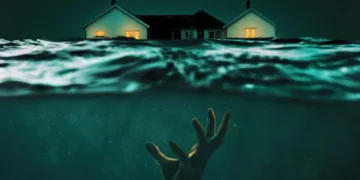
There is something deeply unsettling about a safe house that offers no safety. The one at the center of The Drowned is not a shadowy hideout but a stark, modern box of glass and pale wood, perched precariously on a shingle beach. It is the kind of place you might see in an architectural magazine, celebrated for its clean lines and minimalist aesthetic, yet as a refuge, it is a transparent failure. Its windows turn the vast, empty sea and sky into a permanent audience.
This is where three thieves arrive after a successful art heist, their heads filled with plans for their score. But the house’s exposure mirrors their own. The fourth member of their crew is missing, and her absence hangs in the salty air, breeding a quiet paranoia that the clean, open spaces of the house only seem to amplify. The initial mystery is not about what supernatural force lurks outside, but about the potential for betrayal within their own ranks. The film brilliantly uses this setting to create a pressure cooker, a stripped down crime story where the real prison is the lack of any place to truly hide.
The Weight of Isolation: Crafting a World
The Drowned is a testament to the idea that in horror, atmosphere is paramount. Director Samuel Clemens builds his world not with exposition, but with a palpable sense of place and mood. The film’s distinct visual style is immediately striking, with most scenes shot in the hazy, ambiguous light of dawn or dusk.
This choice does more than just look good; it traps the characters, and by extension the viewer, in a perpetual state of transition, a world without the certainty of full daylight or the cover of complete darkness. The camera work reinforces this feeling of vulnerability. Sweeping overhead drone shots portray the house as a tiny, insignificant speck against the vastness of the coast, emphasizing the characters’ isolation from the outside world. At other times, the camera adopts a voyeuristic point of view, creating a persistent and unnerving feeling of being watched.
The production design itself is a masterstroke of subverting expectations. I have seen countless horror films set in gothic mansions full of secret passages and dark corners. The terror here comes from the exact opposite. The modern house, with its open floor plan and glass walls, is a prison of exposure. There are no secrets it can keep.
This architectural choice forces the characters’ paranoia out into the open. The sound design is the final, crucial layer. The rhythmic crash and pull of the waves becomes a living, breathing entity, a constant companion to the characters’ rising anxiety. This natural soundscape is then violently interrupted by a strange, piercing electronic tone that seems to attack the senses, causing the characters to black out. It is a brilliant auditory cue that signals the intrusion of an unnatural, hostile force into their world.
Three Strangers at the Door
Just when the tension among the thieves feels like it can’t get any tighter, the film fundamentally changes the game. The arrival of three women—Opal, Noé, and Pixie—who appear from the gloom claiming to be shipwrecked, pivots the story on its axis. The narrative shifts almost instantly from a paranoid crime thriller to a mythological horror story.

The genre change is so decisive it feels like an ambush. The men’s decision to allow these strangers into their compromised sanctuary, a choice driven by a dangerous cocktail of chivalry and lust, is the critical error from which there is no return. The film’s centerpiece is a seemingly innocent game of “two truths and a lie,” a scene that crackles with subtext and shifting power dynamics. It functions as a masterclass in narrative efficiency, allowing the women to dismantle the men’s fragile alibis while weaving their own enigmatic identities.
Here, the theme of lust as a disarming weapon becomes explicit. The women’s attractiveness is their camouflage, and the men’s desires make them blind to the very clear threat they represent. This dynamic positions the characters as archetypes in a much older story. They are not meant to be deep psychological portraits but rather figures in a fable about greed and temptation.
This stylistic choice helps explain why the characterizations can feel thin. The actors do a commendable job of conveying suspicion and fear through a script that is sparse with dialogue, but they are ultimately playing parts that were written by mythology long before this screenplay. They are the greedy men, and these are the women who have come from the sea to punish them.
Whispers from the Deep
The film’s conclusion leans heavily into its mythological source material, drawing on the ancient terror of sirens. It is a smart move that connects the story to a lineage of folk horror, and it joins a contemporary trend in independent filmmaking that re-contextualizes old myths to explore modern themes. The sirens here feel less like simple monsters and more like an elemental force of justice, rising from the depths to reclaim what was stolen.

The Drowned commits fully to a strategy of suggestion over spectacle. We feel the creatures’ presence through sound and shadow long before we understand their nature. This ambiguity is the film’s greatest strength, creating a lasting dread that a more explicit monster reveal would likely shatter. It is a film that values mood over a neatly resolved plot, a choice that I often find more rewarding.
However, this commitment to atmosphere comes at a cost. The deliberate, slow pacing, while effective at building a sense of unease, frequently borders on narrative inertia. There are long stretches where the story feels stagnant, caught in the same contemplative loop as its characters.
The film presents a fascinating conflict for the viewer. It offers a rich, immersive aesthetic experience, with stunning visuals and a soundscape that is genuinely unsettling. At the same time, its narrative momentum is so restrained that it struggles to fully support its intriguing ideas. It is a beautifully crafted vessel that seems content to drift in its own mysterious waters, leaving you to admire the view without ever promising to take you to a clear destination.
The Drowned is a Supernatural Thriller/Horror film directed and written by Samuel Clemens. The story follows three thieves who, after stealing a priceless painting, arrive at a secluded safe house by the sea, only to find their fourth accomplice missing, leading them to question if one of them is responsible or if a sinister mythological presence is lurking in the deep water below. The film premiered at FrightFest Halloween and is scheduled for a multi-territory digital release, beginning on October 6, 2025, in the UK and Ireland (Vertigo Releasing), and October 7, 2025, in North America (Sunrise Films).
Full Credits
The Review
The Drowned
The Drowned is a masterclass in atmosphere, a visually stunning and sonically unsettling film that excels at creating a world of profound dread. Its technical craft is impressive, turning an isolated, modern house into a prison of paranoia. However, its deliberate, slow pacing and underdeveloped characters prevent the narrative from ever matching the strength of its mood. While it succeeds as an unnerving, mythological art piece, its story feels submerged beneath its own style, making for an experience that is more to be admired for its construction than felt as a compelling thriller.
PROS
- Exceptional atmosphere and a genuinely unsettling mood.
- Stunning cinematography and a brilliant use of its unique, isolated location.
- Immersive and suspenseful sound design.
- Successfully subverts typical haunted house tropes.
CONS
- The slow pacing frequently stalls, becoming monotonous.
- Characters feel more like thin archetypes than developed individuals.
- The narrative prioritizes mood to the detriment of momentum.
- An ambiguous ending that may feel unfulfilling.







