


























Leonard and Hungry Paul, a six-part comedy-drama, frames itself as a deliberate answer to television’s loudness culture. The series arrives like a warm mug of Ribena, a kind of foil blanket for viewers worn out by maximalist spectacle. Adapted from Rónán Hession’s 2019 novel, it studies two men who resist modern ambition and its constant invitations to perform.
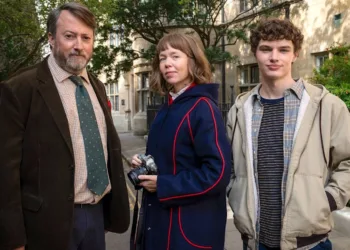
Leonard (Alex Lawther) works as a ghostwriter of children’s encyclopedias and moves through life with quiet desperation. His best friend, Hungry Paul (Laurie Kynaston), delivers post part-time and lives contentedly at home in a quiet Dublin suburb. The show reads as an ode to introversion, a clear celebration of people who feel comfortable beneath the social parapet.
The drama turns inward. Leonard’s mother dies, and the shift rattles his sense of self, pushing him to question his “minor, harmless existence” and feel a new “need to open the doors and windows of his life a little.”
The Cartography of Minor Lives
The series pays rigorous attention to the structure of a friendship that becomes a world. Leonard and Hungry Paul share a bond built on recognition and repetition, a symposium of the non-eventful sealed by weekly board game nights. This ritual creates a refuge where small philosophy acquires the gravity of national debate. A running topic: the precise taxonomy of why children pee in warm pools. In this room, such questions earn serious time.

Leonard’s search for emotional definition powers the story’s engine. Lawther plays him with convincing tension, a guarded moustache paired with suppressed longing. He circles “big questions” about his use to society and feels himself growing “more invisible.” The anxiety sounds post-Freudian, the itch that asks what one contributes and who gets to decide.
Hungry Paul arrives with a rare steadiness. He behaves like a reluctant life coach for Leonard, calm and awkward in equal measure, and comfortable with part-time postal work. He takes up Judo without pressure. The reason for his nickname remains a cheerful mystery, a narrative shrug that refuses to manufacture meaning where none is offered.
Two mild shocks nudge the orbit. Leonard senses a possible romance with his “spring-loaded” colleague Shelley (Jamie-Lee O’Donnell). Hungry Paul faces the social strain of his sister’s wedding. These developments carry weight because they are ordinary. Small ruptures create space for different futures.
Silence as Social Critique
Leonard and Hungry Paul runs on atmosphere more than conventional mechanics, a carefully managed vibe that reads as social theory. The pacing feels unhurried by design, and that design rejects the modern habit of equating volume with virtue or ambition with worth. The series looks at unnecessary noise with open disapproval. It prizes everyday kindness and the clear joy of simple things. The stance feels Socratic: know your scale, and live within it.
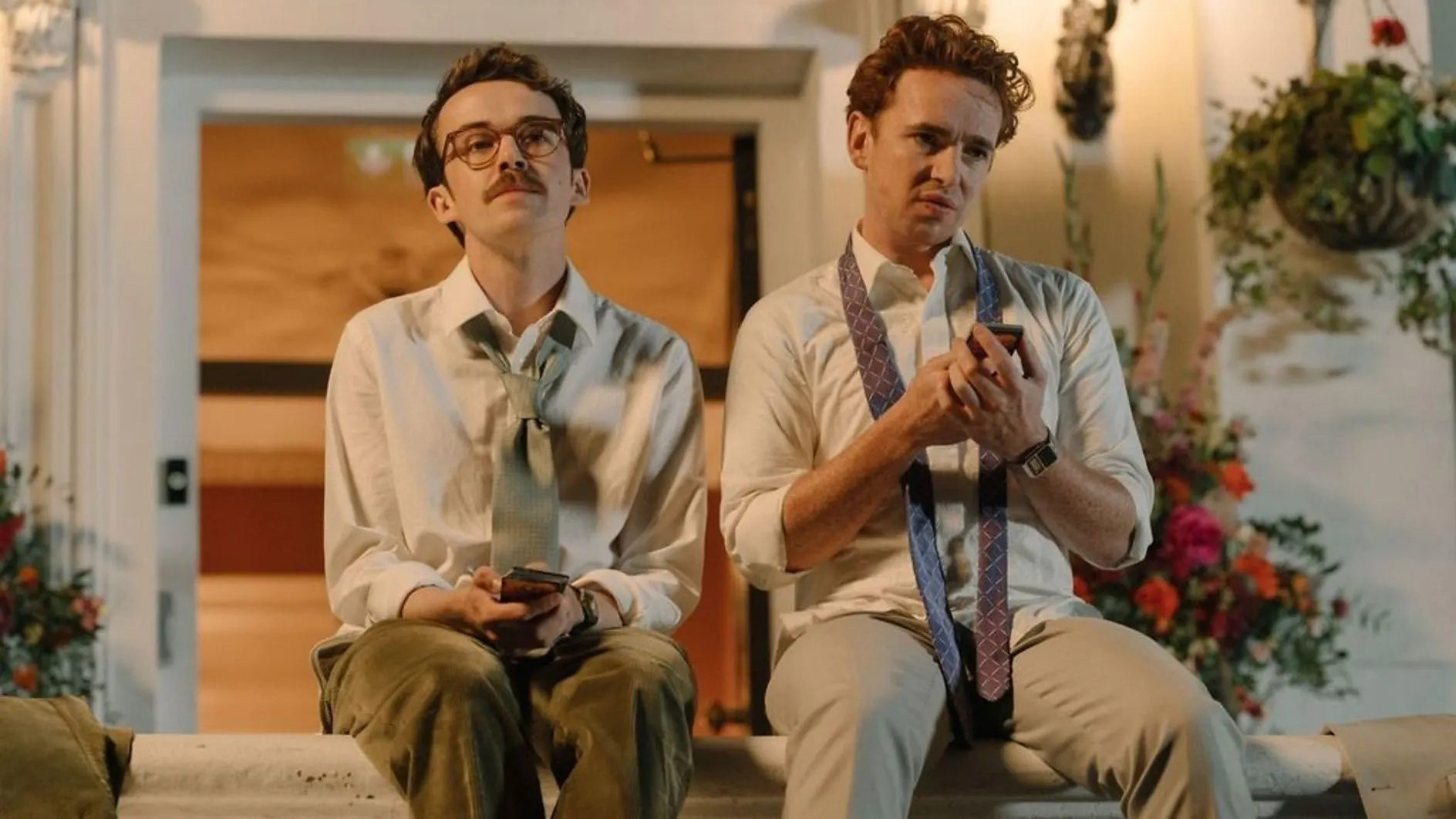
Silence here suggests strength. Routine anchors people who might otherwise get swept up in a culture of constant broadcasting. The idea works as a balm against the daily blast of the “infosphere of clamor.” In a media environment that rewards loud certainties, the show holds a quiet room for doubt and patience. The minor key civility functions like a political position.
Warmth spreads to the supporting figures. Hungry Paul’s father, played by Lorcan Cranitch, practices quiz shows in secret so he can look knowledgeable for his wife. These details build a gentle human comedy. The images remain crisp and clear, catching the mildness of Dublin’s suburbs without turning them into a postcard or a fantasy field.
The Celebrity Meta-Narrative
The production makes a striking choice. Julia Roberts, an Oscar-winning icon, serves as the guiding voice. A star of that magnitude entering a modest Irish comedy seems poised to tip the balance toward self-awareness. The move reads like a meta-gamble.

The narration works. Roberts admires the novel, and her delivery comes through warm and steady, an off-screen storyteller who earns the job. Leonard lacks a “eureka” face and struggles to render his inner weather. The narration behaves like a channel for that weather, translating unspoken doubts into clear language and easing the audience into the inner lives the protagonists cannot voice. The device supplies psychological exposition without breaking the shell of the characters’ behavior.
A BBC/RTÉ co-production, the series holds fast to the book’s spirit. The original publisher reported the adaptation had the tone “absolutely spot-on.” Lawther and Kynaston fill their roles with nuance and quiet energy. The show uses charm and gentle humor to develop observations about ordinary life that land with surprising force, and it positions itself as a heartfelt piece of television.
Leonard and Hungry Paul is a six-part comedy-drama adapted from the novel of the same name by Rónán Hession. The series premiered on October 17, 2025, and is a co-production for BBC Northern Ireland and RTÉ. Viewers in the UK can watch the series on BBC iPlayer, with broadcast airings on BBC One Northern Ireland and BBC Two. The story follows two quiet, kind-hearted friends in their thirties who navigate small, yet profound, life changes while finding solace in their routines.
Credits
Director: Andrew Chaplin
Writers: Richie Conroy, Mark Hodkinson
Producers and Executive Producers: Tristan Orpen Lynch, Aoife O’Sullivan, Adam Barth, Kate McColgan, Wally Hall, David Harari, Morwin Schmookler, Ross Boucher, George Rush, Natalie McAuley, Paula Warwick
Cast: Alex Lawther, Laurie Kynaston, Jamie-Lee O’Donnell, Julia Roberts, Helen Behan, Lorcan Cranitch, Niamh Branigan, Paul Reid, Charlotte McCurry, David O’Reilly
The Review
Leonard and Hungry Paul
Leonard and Hungry Paul is a beautiful and necessary counterpoint to modern television's demands for constant spectacle. It elevates the "minor, harmless existence" of its deeply relatable characters, finding profound strength and wisdom in silence and introverted routine. The series is emotionally rich, philosophically engaging, and perfectly paced, making it a compelling study of contemporary anxiety and friendship. The unexpected use of a celebrity narrator is surprisingly effective, anchoring the show's gentle humor and heartfelt observations about finding purpose.
PROS
- A profound and necessary celebration of introversion and quiet lives.
- Excellent, subtle performances by Alex Lawther and Laurie Kynaston.
- The unique, unhurried tone functions as a comforting antidote to high-stress television.
- Effective and sophisticated use of the celebrity narrator as a psychological device.
- Insightful philosophical themes about purpose, ambition, and the value of simple things.
CONS
- The deliberately slow, observational pace may deter viewers accustomed to traditional plot momentum.
- The initial introduction of the celebrity narrator risks momentarily distracting from the unshowy aesthetic.