


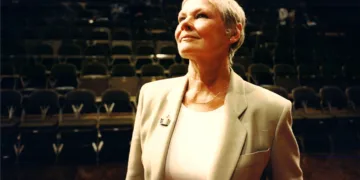




























Adolfo Borinaga Alix Jr.’s The Time That Remains opens with a dark, foreboding tone. The story follows Lilia, an elderly woman recovering in a hospital after a violent home invasion. From her bed, she recounts her life to her nurse, Isabela, shaping a decades-spanning account of forbidden love. The focus of that love is Matias, an ageless, vampiric figure who has stayed beside her through years marked by historical and personal turmoil.
The film moves through Lilia’s fractured recollections, linking a present-day mystery to vivid scenes from the past. This structure shapes a romance defined by two fixed conditions: Lilia faces mortality and Matias carries immortality. The conflict rests on the pressure of time itself. The narrative studies how years erode one partner who ages while the other remains unchanged.
Blending Genre and History
The screenplay reaches for a wide canvas, pairing epic romance with cultural and historical commentary. The plot travels across timelines, using the Japanese occupation of the Philippines during WWII as a setting for the first steps in Lilia and Matias’s relationship. Alix Jr. mixes modes, combining a supernatural thriller, a traditional love story, and a modern police mystery, with touches of Filipino folklore such as the aswang.

This reach creates the film’s toughest challenge. Ambition collides with uneven execution, and the variety of elements tugs the narrative in many directions. The result is a structure that rarely feels cohesive. The modern detective thread with police officer Angua often plays like a detour that draws attention away from the primary emotional line. The pacing moves at a slow crawl, which exposes roughness in the writing rather than tightening suspense.
The Poignancy of Mortal Love
The bond between Lilia and Matias gives the film its strongest pulse. Their pairing forms a charged contrast that holds the story together. Lilia embodies the tenderness and pain of human life, moving through love, loss, and the certainty of death. Matias carries the weight of an endless lifespan, fixed in time with memories that never loosen their grip.
The central idea argues that permanence does not guarantee peace. Finite life grants moments their value. The standout passages are quiet ones: Lilia and Matias sitting together, talking, or sharing a silence that carries fatigue and care. These scenes land with more feeling than the movie’s supernatural flourishes. Attempts to show Matias’s vampirism or shapeshifting come across as gimmicks with hurried execution. The imagery does not support the weight of the mythic allegory, which creates shifts in tone that weaken the tragic core.
Atmosphere, Aesthetics, and Performance
On a technical level, the film maintains a consistently oppressive look. The craft team, including cinematographer Odyssey Flores and the sound designers, builds a gothic mood with persistence. That commitment to atmosphere stands out. Several images in the historical flashbacks leave a strong impression. Visual quality, though, varies. Some shots turn overly grainy, and others are so dim that they limit clarity. The score sets a brooding air, yet it can slip into repetition or sharpness that blunts tension.
The performances provide a steady base. Bing Pimentel’s elderly Lilia and Carlo Aquino’s Matias bear most of the emotional history. In the present-day sections, Beauty Gonzalez as Isabela offers a grounded human counterpart. The cast works with material that often feels unpolished, yet Pimentel and Gonzalez in particular communicate the wear and cost of a romance stretched beyond its natural span.
This Filipino supernatural romance film, directed by Adolfo Borinaga Alix Jr., premiered on Netflix on October 16, 2024. The movie is a reimagining of the vampire genre, steeped in Filipino folklore, telling the story of an elderly woman who recounts her decades-long, forbidden love affair with an immortal being. It explores themes of mortality, the weight of history, and the enduring nature of love across generations.
Credits
Director: Adolfo Borinaga Alix Jr.
Writers: Adolfo Borinaga Alix Jr., Mixkaela Villalon, Jerry Gracio
Cast: Carlo Aquino, Bing Pimentel, Beauty Gonzalez, Jasmine Curtis-Smith, Bembol Roco, Rita Avila, Allan Paule, Cristine Reyes
Director of Photography (Cinematographer): Odyssey Flores
Editors: Mark Victor
Composer: Paul Sigua, Myka Magsaysay-Sigua
The Review
The Time That Remains
The Time That Remains is a film defined by its lofty aspirations and its deeply poignant core. While the narrative struggles to balance its various genres—from historical drama to police procedural—the central tragedy of Lilia and Matias’s love is genuinely moving. The film succeeds in exploring how mortality gives love its meaning, though technical inconsistency and pacing issues prevent it from becoming a truly cohesive masterpiece. A recommended watch for fans of tragic, character-driven supernatural stories.
PROS
- The tragic relationship between Lilia and Matias is powerful.
- Excellent exploration of mortality, time, and the value of finite life.
- The visual crew successfully creates a dark, melancholic gothic mood.
- Bing Pimentel and Beauty Gonzalez anchor the film emotionally.
CONS
- The film often moves too slowly, exposing script weaknesses.
- Over-ambitious narrative fails to blend its mystery, horror, and romance elements smoothly.
- Supernatural effects often look cheap or laughable, detracting from the drama.
- The detective narrative often feels unnecessary.