




























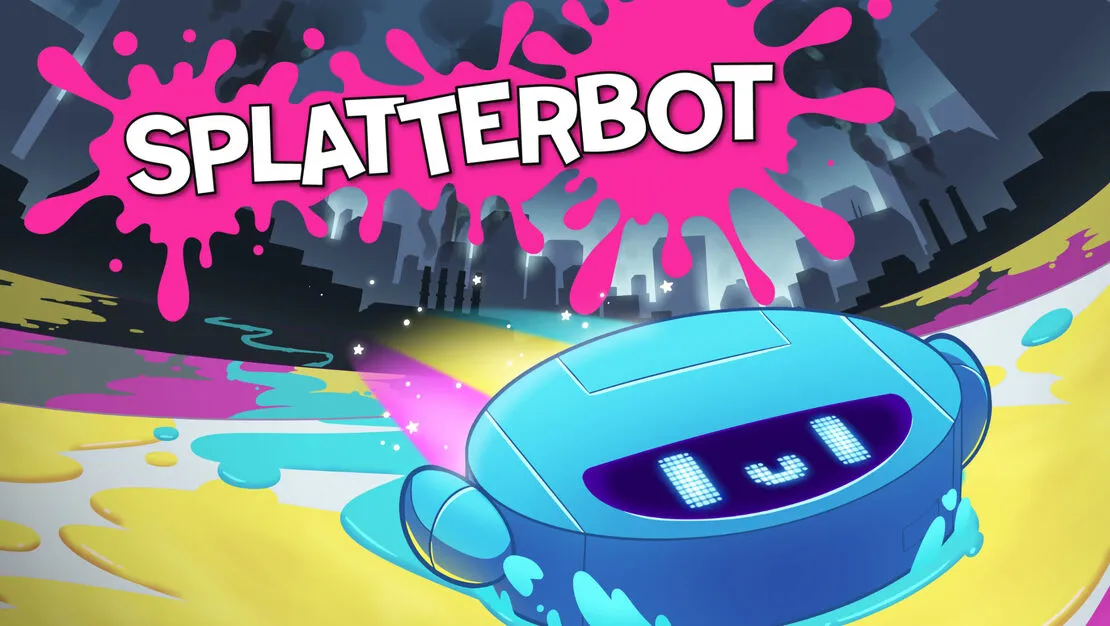

Splatterbot arrives from solo developer Hey! Kookaburra with a premise that flips the script on robotic helpers: what if your vacuum decided to redecorate instead of clean? This local multiplayer party game, available on PC and Nintendo Switch for $9.99, hands you control of rogue cleaning robots that leave colorful trails across every surface they touch.
The goal is territorial domination through paint coverage before the clock runs out. Up to four players can compete (or team up), filling empty slots with CPU opponents if needed. The game’s stripped-down approach recalls Splatoon’s territory battles from a top-down perspective, though it trades that series’ depth for pure accessibility.
This is a family-friendly experience that prioritizes ease of entry over mechanical complexity, designed for those moments when you need something everyone at the table can play immediately. While its ambitions remain modest, Splatterbot knows exactly what it wants to be: a quick burst of colorful competition that doesn’t demand much from anyone involved.
How Mess-Making Becomes Strategy
The control scheme strips away everything unnecessary. Your left analog stick moves the robot, which automatically paints as it travels. Press B, Y, or X to dash forward, useful for snatching power-ups or escaping tight corners. That’s the entire input vocabulary, and this simplicity serves the game’s goals well. Anyone can understand what’s happening within seconds of picking up a controller.
Two modes split the competitive focus. Free-for-All assigns each player a distinct color, turning matches into four-way scrambles where allegiances don’t exist. Teams mode creates 2v2 battles, pairing players who share a color and must coordinate their coverage. Both modes run on the same timer system, defaulting to 2 minutes though adjustable to 60, 120, or 180 seconds through the settings. The percentage of territory you’ve claimed determines victory, revealed after the buzzer sounds.
The back-and-forth nature of painting over opponents’ work creates the game’s central tension. You can’t simply claim a section and consider it safe. Every patch of floor remains contested until the final second, forcing constant movement and decision-making about whether to expand into new areas or defend what you’ve already covered.
Playing against CPU opponents exposes the game’s weakest element. The AI lacks the unpredictability that makes competitive games engaging. Bots sometimes fixate on walls, repeatedly painting the same narrow strip while ignoring large unpainted sections. They fail to prioritize power-ups effectively and rarely adapt their strategies. Winning against them feels automatic rather than earned. The game clearly expects you to fill those slots with actual people, where the chaos of four competing human minds creates genuine tension. Local multiplayer remains your only option here; no online functionality exists.
Match pacing moves quickly. Two-minute rounds prevent fatigue and make it easy to squeeze in a game between other activities. The structure works for its intended purpose: short bursts of competition rather than extended play sessions.
Tools of Territorial Control
Four power-up types spawn randomly across each map, and their permanent effects create both excitement and potential frustration. The Speed Boost increases your movement rate for the rest of the match. Grow enlarges your robot, letting you paint wider swaths with each pass. Splat triggers an immediate explosion of color covering a significant radius. Ball releases an autonomous sphere that bounces around, leaving paint trails independent of your position.
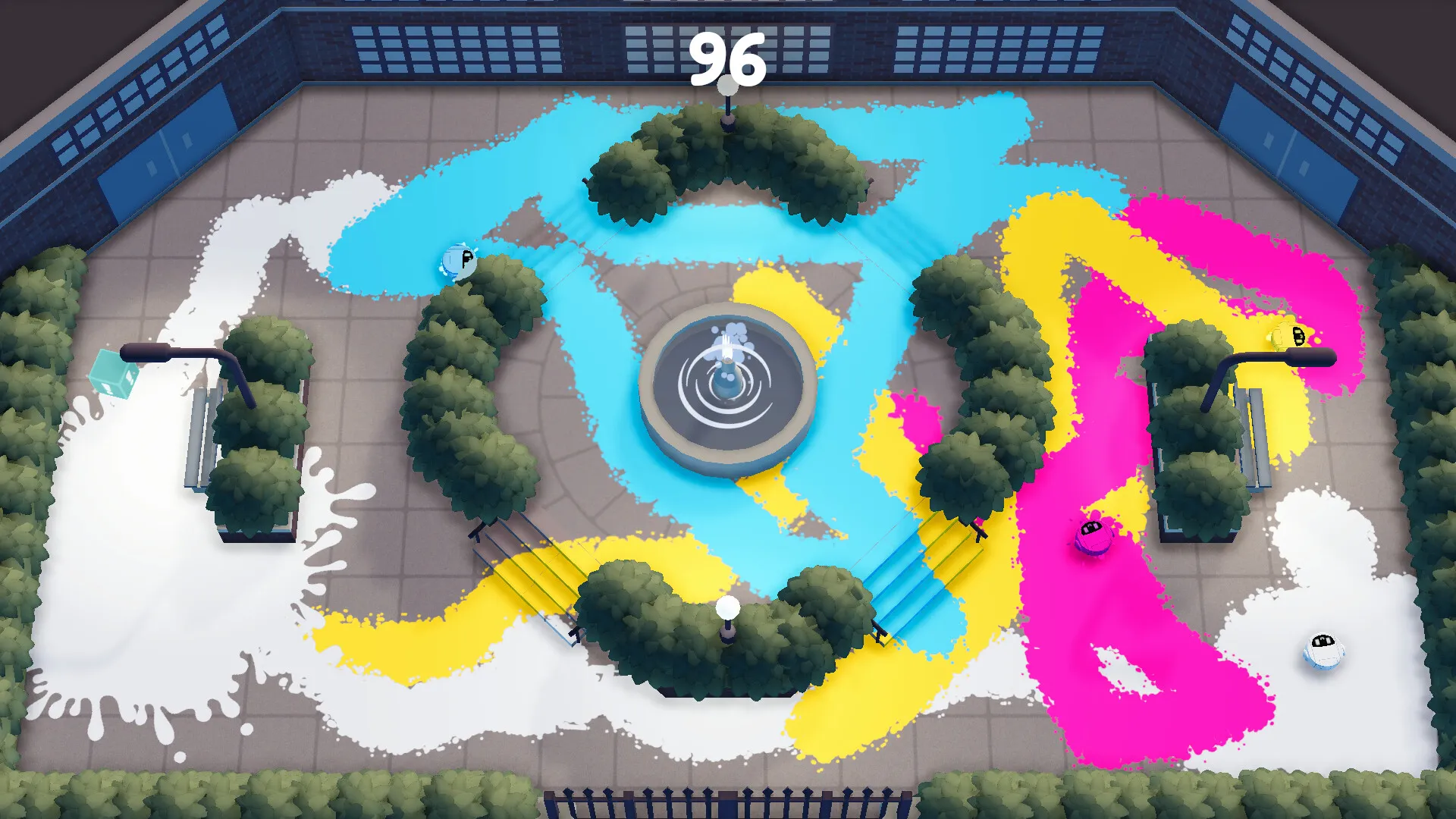
The permanent nature of Speed Boost and Grow, borrowed from Bomberman’s approach to power-ups, creates snowball effects. A player who grabs two or three early enhancements gains overwhelming advantages, moving faster and covering more ground than opponents can match. This player naturally reaches subsequent power-ups first, compounding their lead. The imbalance becomes frustrating in competitive matches, though the settings menu lets you disable power-ups entirely. I wish this option appeared during game setup rather than buried in a separate menu.
Six maps provide the arenas for these paint battles. The office stands out with its connected rooms and destructible elements like windows and doors, creating dynamic pathways that change as players crash through barriers. The seaport splits the arena between two boats and two piers, with gaps forcing strategic decisions about when to jump between platforms. Plaza, factory, hexagon, and dock round out the selection, each keeping the scale small and the layouts straightforward. The variety helps, though all six maps feel like variations on the same basic formula rather than dramatically different challenges.
Customization options let you personalize your robot with four base colors: yellow, magenta, blue, and white. Playing matches unlocks trails (the visual effects that follow your robot) and costumes like halos or bubble generators. These additions inject personality into what would otherwise be identical machines. The game misses an opportunity by not announcing unlocks as they happen. A simple notification would create moments of accomplishment and incentive to keep playing. The color-blind mode deserves mention as a thoughtful accessibility feature, ensuring color distinction doesn’t become a barrier to enjoyment.
What Two Minutes Can Sustain
The game’s scope reveals itself quickly. Six maps and two modes exhaust their novelty after a handful of sessions. By your fourth or fifth match in a single sitting, patterns emerge and the experience starts feeling repetitive. The two-minute match length keeps individual games from overstaying their welcome, but it also highlights how little variety exists within that structure.
This limitation matters less if you approach Splatterbot as intended. The game works best as a warm-up activity before shifting to something meatier, or as a palate cleanser between heavier experiences at a game night. It fills the same role as a quick card game might, something you can explain in thirty seconds and play while people arrive or during breaks. The family-friendly design means genuinely anyone can participate regardless of gaming experience. The lack of violence and straightforward mechanics lower the barrier to entry as far as it can go.
At $9.99, the price tag feels appropriate for what you’re getting. This isn’t a game you’ll spend dozens of hours exploring, but it delivers exactly what it promises: accessible, immediate fun that works across age groups and skill levels. Families searching for multiplayer options that don’t require gaming literacy will find value here. People who host casual gaming sessions can slot it into their rotation as a low-stakes option.
Hey! Kookaburra’s first release shows promise for future projects. The core mechanics work, the presentation is cheerful without being obnoxious, and the technical execution holds up. Adding more modes or expanding the map count would address the longevity concerns without fundamentally changing what makes Splatterbot work. For now, you’re getting a solid foundation that feels somewhat underbuilt. Splatterbot succeeds by keeping its goals modest and executing them cleanly. It’s a game you’ll pull out when you need something instantly understandable and lighthearted, play for twenty minutes, then put away until the next gathering.
The Review
Splatterbot
Splatterbot delivers exactly what it promises: an accessible, family-friendly party game that anyone can pick up instantly. The permanent power-ups create unfortunate imbalances, and the limited content (six maps, two modes) wears thin after a few rounds. Yet for $9.99, it's a reasonable investment for families or casual gatherings. The weak AI means you'll need real people to enjoy it properly. Hey! Kookaburra's debut shows solid fundamentals that would benefit from expanded content. Perfect for quick bursts between heavier games, less so for sustained play.
PROS
- Extremely accessible controls anyone can learn immediately
- Charming aesthetic with fun customization options
- Perfect for family gatherings and all ages
- Reasonable price point at $9.99
- Color-blind mode included
CONS
- Only six maps and two modes
- Permanent power-ups create snowball advantages
- Weak AI opponents offer minimal challenge
- No online multiplayer
- Becomes repetitive after 4-5 matches
- Missing unlock notifications