





























Trap House, directed by Michael Dowse (previously of Stuber) and written by Gary Scott Thompson with Tom O’Connor, frames the contemporary border crisis as a pulpy thought experiment. Set in El Paso, Texas, it plants a story about suburban fear and parental anxiety against a landscape loaded with geopolitical tension.
The central idea arrives with a mix of brazenness and absurdity. Ray Seale (Dave Bautista) works as a DEA agent, a single widowed father assigned to the hazardous Mexico frontier. After a cartel raid that kills a fellow agent, Ray’s son Cody (Jack Champion) responds with a drastic reinvention of the family business.
Cody joins forces with a cluster of DEA agents’ children and launches a homemade campaign of revenge and charity. They draw on their parents’ professional training and gear to rob local cartel trap houses, first to support the dead agent’s family. This vigilante GoFundMe scheme escalates quickly. Their robberies collide with Ray’s official mission to bring down cartel leaders Benito (Tony Dalton) and Natalia (Kate del Castillo), a pair of siblings presented as leaders in this conflict. The result is a split narrative: the sanctioned drug war and its adolescent mirror image.
The Tonal Fugue State: Gritty Cartel vs. Teen Capers
Trap House assembles a genre mixture that fascinates and confounds. The film attempts to fuse the buoyant charge of a teen action adventure, a kind of “Teenage Fast and Furious,” with the grim stakes of a cartel thriller that lives in the R rating.
The teenagers, wielding non-lethal weaponry, approach their high-risk robberies with the casual bravado of a weekend stunt. Their antics sit beside graphic violence and lethal consequences that define the lives of the adult DEA agents and cartel members. The film invites the viewer into a world where a high school student successfully raids a trap house with beanbag shotguns and night-vision goggles borrowed from a parent’s closet. The initial charitable goal, helping a bereaved friend’s family, operates as an emotional solvent that softens the premise’s raw implausibility. The kids behave recklessly, yet their urge to care for one another feels recognizably adolescent.
Dowse keeps the tempo brisk and channels energy toward the slow grind of anxiety, especially the sense that these teenagers will eventually make a disastrous mistake, while large-scale set pieces stay secondary.
That tightrope routine falters. The film vacillates between acerbic dark comedy about insulated kids playing at danger and a grave vision of cartel violence. The script gravitates to the straight-faced thriller mode and leaves most of the comedy underdeveloped, which turns the film into a kind of unintended tonal fugue state. Two narrative ecosystems occupy the same space but rarely mingle, and the result lacks a coherent vantage point.
The Weight of Silence and the Flimsy Rebellion
The most effective element arrives with the film’s quietest figure. Dave Bautista’s Ray Seale operates as a portrait of stoic grief. His performance stabilizes the surrounding absurdity. Ray lives inside constant professional risk and the mute ache of widowhood. Bautista, so often asked to supply sheer force and charisma, delivers a controlled study of paternal worry and looming betrayal. His wordless stretches carry real emotional force and supply the moral weight that keeps the story from collapsing into a cartoon. The restraint matters.
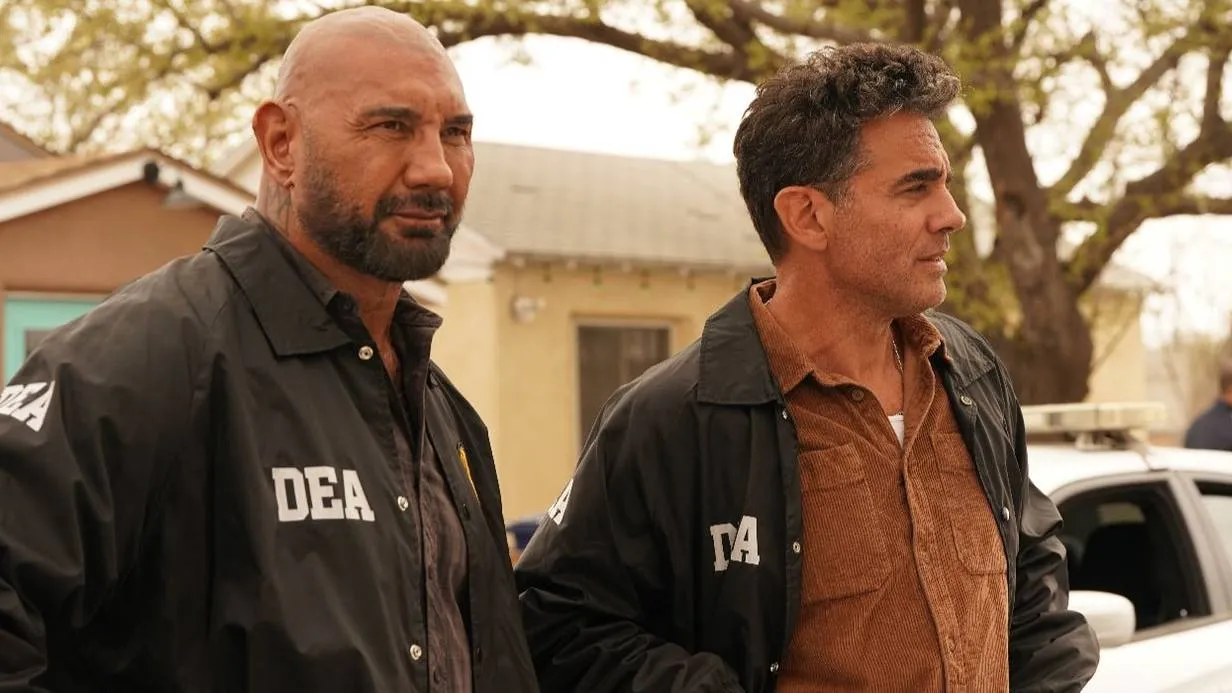
The film still limits him to brooding looks and functional exchanges. He becomes the designated “Action Stoic,” and he plays that archetype with skill, yet the material gives him surprisingly little to explore.
Attention drifts to Cody, the teenage mastermind whose revolt shapes the drama. His drive grows from a supposedly broken relationship with his overprotective father after his mother’s death. That rift feels underdeveloped, missing the narrative groundwork that would make robbery and escape feel like a credible emotional progression. Cody’s late escalation of the heists, as he ignores his friends’ calm requests to stop, shifts him from a misguided but sympathetic figure into a source of grating impulsiveness.
The rest of the teen crew barely moves past outline form. Aside from Sophia Lillis’s character, the group mostly reacts to Cody’s decisions. Among the adults, Tony Dalton’s Benito and Kate del Castillo’s Natalia project recognizable menace yet remain trapped in flat action-villain modes. They function as loud, exaggerated cartel bosses, a choice that curbs the dramatic texture suggested by their earlier work elsewhere. The subplot about Cody’s high school relationship with Teresa (Inde Navarrette), complete with a heavily signaled revelation about who she really is, plays like an extraneous side quest.
The Socioeconomic MacGuffin and the Unearned Embrace
Trap House opens with a striking socioeconomic hook: the financial fallout of border enforcement, specifically the absence of real support for families of slain DEA agents. The script treats this as a kind of “Thematic MacGuffin.” It sparks Cody’s crusade and then recedes, replaced by domestic melodrama and familiar action patterns. The film glances at a chance for pointed social critique and retreats to a more intimate father-son dispute.
The story leans hard on audience patience with improbability. Logical gaps pile up: children of undercover agents advertise themselves as a visible high school clique; a DEA father brings his son to an active crime scene where cartel cash lies in plain sight; the teen robbers string together a flawless run of heists. The film drifts away from its initial promise and prefers digestible action beats over any sustained examination of the socioeconomic idea it raises.
The closing chapter exposes the weakest element, the treatment of the father-son reckoning. The ending feels rushed and overly tidy. When Ray finally faces Cody, the confrontation passes with minimal friction. The emotional fallout from Cody’s behavior, from the extreme danger he creates for himself and his friends, barely appears.
Their reconciliation feels unearned and fails to deal with the severity of the crimes and their likely consequences. A film that briefly acknowledges the lethal reality of cartel conflict finishes with a neat, unpersuasive hug. That choice encourages the viewer to reassess the entire dramatic structure and to see early flashes of daring intent give way to a conventional, if propulsive, wrap-up.
The movie Trap House is an action thriller that focuses on the high-stakes world of DEA agents and their rebellious children living near the Mexican border in El Paso, Texas. The film centers on a group of teenagers who, after the death of a friend’s father (a DEA agent), use their parents’ top-secret tactics and gear to rob a dangerous drug cartel. Directed by Michael Dowse and starring Dave Bautista, the movie had its wide theatrical release in the United States on November 14, 2025, distributed by Aura Entertainment. It carries an R rating for strong violence and bloody images.
Credits
Title: Trap House
Distributor: Aura Entertainment
Release date: November 14, 2025
Rating: R
Director: Michael Dowse
Writers: Gary Scott Thompson, Tom O’Connor
Producers and Executive Producers: Marc Goldberg, Sarah Gabriel, Dave Bautista, Jonathan Meisner, Michael Pruss, Rebecca Feuer, Todd Lundbohm, Christian Mercuri, Ridley Scott, Paul O. Davis, Justin Alvarado Brown, Robert Dean, David Haring, Roman Viaris-de-Lesegno, Ruzanna Kegeyan, Gareth Williams, David Sullivan, Simon Williams, Joe Simpson, Jonathan Bross, Jennifer Eriksson, Richard Kondal, Dasha Sherman, Patrick Fischer, R. Wesley Sierk, Jina Panebianco, John D. Straley
Cast: Dave Bautista, Jack Champion, Sophia Lillis, Tony Dalton, Whitney Peak, Inde Navarrette, Zaire Adams, Kate del Castillo, Bobby Cannavale, Blu del Barrio
Director of Photography (Cinematographer): Matt Flannery
Editors: Tim Porter
Composer: Amanda Yamate, Jack Latham
The Review
Trap House
Trap House possesses a compelling, absurd premise—the teenage rebellion as cartel heist—that briefly promises sharp socio-economic commentary. Dave Bautista’s grounded performance provides the necessary gravitas and the pacing maintains high tension. However, the film ultimately buckles under its own weight. The tonal shifts between gritty thriller and lighthearted caper are jarring, and the narrative sacrifices complex thematic depth for generic action tropes. The climax, which ignores genuine consequences, leaves the resolution feeling unearned.
PROS
- His contained, restrained performance as Ray Seale is essential, lending seriousness to an otherwise absurd narrative.
- Director Michael Dowse maintains a brisk pace, successfully building suspense and dread as the teenagers escalate their dangerous activities.
- The premise is highly original, offering a novel take on the DEA/cartel conflict through the perspective of the agents’ children.
- The use of non-lethal weapons by the teens provides some creative action sequences and enhances the feeling of high stakes.
CONS
- The film fails to harmonize its two disparate genres (lighthearted teen adventure and hard-core crime thriller), resulting in jarring shifts.
- The supporting teens are mostly one-dimensional, and the adult supporting cast (Cannavale, Dalton, del Castillo) is underutilized and typecast.
- The core conflict between Cody and Ray is not established thoroughly enough to justify Cody’s radical, late-stage impulses.
- The climax is rushed, and the final father-son reconciliation skips over the necessary emotional and legal ramifications of the teens' actions.
- The film quickly abandons its intriguing socio-economic themes in favor of conventional action tropes and plot inanities.