
























![Kingdom Hearts Collection [I-III] Review](https://gazettely.com/wp-content/uploads/2026/10/Kingdom-Hearts-Collection-I-III-1-360x180.webp "Kingdom Hearts Collection [I-III] Review: KHII Holds Steady as Newer Entries Fluctuate 39")

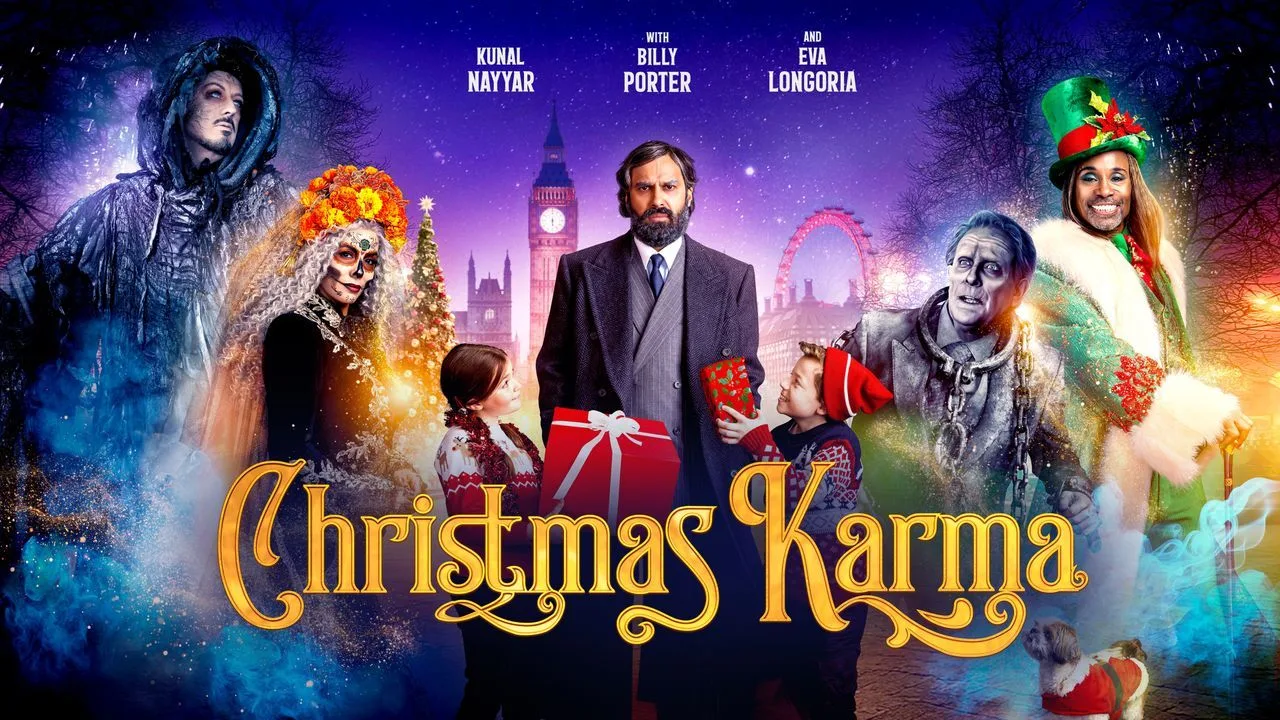

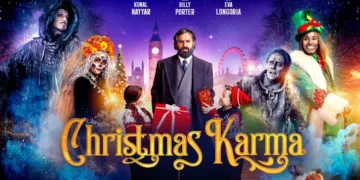
Gurinder Chadha, who made her name by placing British Asian lives at the center of popular British films such as Bend It Like Beckham, returns with Christmas Karma. The film adapts Charles Dickens’ A Christmas Carol into a contemporary musical set in London. The story recasts Ebenezer Scrooge as Mr. Sood, played by Kunal Nayyar. Mr. Sood works as a conservative, miserly Hindu moneylender.
Chadha assigns him a concrete origin for his miserliness: the trauma of his family’s expulsion from Uganda under Idi Amin and the racial abuse they suffered after arriving in the United Kingdom. That history explains his bitterness and his detachment from the social rituals around Christmas. The film pairs this heavy historical context with the conventions of a light Christmas musical.
The Cultural Lens and Thematic Clutter
Christmas Karma places immigrant history at the center of its reworking of Dickens. Mr. Sood’s backstory, which revolves around the 1972 Ugandan Asian expulsion, supplies a specific motive for his fixation on wealth and his impulse to limit other people’s chances.
The screenplay treats that immigration trauma as a defining psychological force behind the protagonist’s actions. The film frames a predominantly Christian holiday within a multicultural British setting and asks how such traditions sit alongside multiple faiths and histories. That cultural framing gives the adaptation a distinct angle.
At the same time, the film’s formal choices undercut some of its political heft. The visuals often present an idealised version of London, with repeated establishing shots of Big Ben and Oxford Street. Those images sit uneasily next to other production choices. The Cratchit family’s dwelling appears as a brightly coloured Notting Hill house rather than a cramped, poverty-stricken interior.
That choice weakens the film’s efforts to comment on poverty and the cost-of-living pressures it gestures toward. Tonal shifts between serious social history and broad musical comedy produce uneven moments where messaging feels simplified. The director’s attempt to merge immigrant memory with seasonal spectacle generates scenes that register strongly in concept but land inconsistently in execution.
Baffling Cast, Wobbly Visuals
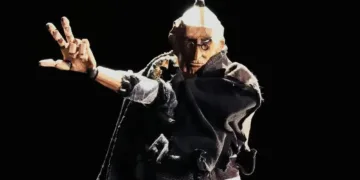
Casting decisions draw attention in ways that do not always serve the narrative. The three visiting spirits read as stunt casting. Eva Longoria appears as the Ghost of Christmas Past, wearing Day of the Dead–style makeup. Billy Porter takes the role of the Ghost of Christmas Present. Boy George plays the Ghost of Christmas Future in a bulky, black shroud. These celebrity appearances interrupt narrative flow at times and push spectacle to the foreground.
Kunal Nayyar’s portrayal of Mr. Sood often feels restrained. His performance can read as muted and occasionally fails to convey the full range of the miser’s cantankerous energy. The actor’s age and tonal choices sometimes make the long-standing nature of Sood’s resentment harder to accept. The Jacob Marley figure is presented as a poorly rendered, video-game-like CGI version of Hugh Bonneville, a visual decision that rarely convinces.
Supporting players add tonal contrast. Danny Dyer appears as Colin, a cheerful Cockney cabbie whose familiar EastEnders background contributes to the film’s low-budget visual register. The Tiny Tim figure requires travel to Switzerland for private treatment, a specific plot detail that, when paired with the Cratchits’ expensive neighborhood, raises questions about the film’s social commentary on class and healthcare.
Technically, the picture leans toward a televisual look. Green-screen artifacts, rough CGI, and awkward projections create a cheap-and-cheerful panto quality rather than a polished cinematic texture. Those production limitations affect the sense of scale the musical sequences aim to achieve.
A Bhangra-Pop Soundtrack
The film treats music as a cultural meeting point and borrows stylistic cues associated with South Asian film song traditions. The songwriting roster mixes British pop figures such as Gary Barlow and Shaznay Lewis with composers including Nitin Sawhney and Panjabi MC.

That variety yields a soundtrack with strong contrasts in approach and quality. The bhangra take on “We Wish You a Merry Christmas” stands out as a clear example of East-meets-West arrangement. Other songs feel less secure in their ambitions and are unlikely to become enduring holiday standards.
Staging and choreography for the musical numbers frequently appear unsteady. Performers at times seem unsure of blocking or gestures during group sequences. Those problems combine with limited production values to blunt the intended spectacle.
The film aspires to the large-scale emotional sweep associated with South Asian musicals, yet many sequences deliver a smaller, more amateurish effect. The soundtrack’s unevenness and the unpolished musical staging emphasize the gap between the film’s transnational musical aims and the realities of the finished product.
Christmas Karma is a British Christmas musical comedy-drama that serves as a modern, Bollywood-inspired adaptation of the classic Charles Dickens novella A Christmas Carol. Written and directed by Gurinder Chadha (known for Bend It Like Beckham), the film tells the story of Mr. Sood (Kunal Nayyar), a miserly, conservative Hindu businessman in London whose cynicism is rooted in the trauma of his family’s expulsion from Uganda. The film is set to premier in the United Kingdom on November 14, 2025, and features an ensemble cast including Eva Longoria, Billy Porter, and Boy George as the Ghosts of Christmas. It was released in cinemas in the UK via True Brit Entertainment.
Full Credits
Title: Christmas Karma
Distributor: True Brit Entertainment (UK), Ketchup Entertainment (US)
Release date: November 14, 2025 (United Kingdom)
Rating: PG (for thematic material, some violence, scary images, language, and suggestive references)
Running time: 118 minutes
Director: Gurinder Chadha
Writers: Gurinder Chadha, Charles Dickens (adapted from A Christmas Carol)
Producers: Gurinder Chadha, Celine Rattray, Trudie Styler, Amory Leader
Executive Producers: Zygi Kamasa, Anushka Shah, Paul Mayeda Berges, Sophia Pedlow, Hannah Leader, Richard Kondal, Jennifer Eriksson, Stephen Jones, Sunil Sheth, Jackie Donohoe
Cast: Kunal Nayyar, Eva Longoria, Billy Porter, Boy George, Leo Suter, Charithra Chandran, Pixie Lott, Danny Dyer, Hugh Bonneville, Bilal Hasna, Rufus Jones, Allan Corduner, Tracy-Ann Oberman
Director of Photography (Cinematographer): Niels Reedtz Johansen
Editors: Josh Cunliffe
Composer: Gary Barlow, Shaznay Lewis, Nitin Sawhney, Ben Cullum, Panjabi MC
The Review
Christmas Karma
The film sets out to deliver a necessary adaptation, giving Scrooge a powerful, specific backstory rooted in the 1972 Ugandan expulsion. Director Gurinder Chadha's multicultural intent is commendable, asking relevant questions about Christmas in a diverse Britain. However, the production quality severely compromises this vision. Weak performances from the lead and baffling stunt casting for the spirits detract from the drama. The musical numbers are unevenly written and poorly staged, reducing the entire cinematic attempt to a cheap, amateurish pantomime. The potential for a meaningful cultural statement is lost to visual clutter and technical sloppiness.
PROS
- Rich, unique backstory for the Scrooge character (Ugandan Asian trauma).
- Ambitious cultural commentary on a multifaith Christmas.
- Thematically interesting approach to the classic story.
- The bhangra version of "We Wish You a Merry Christmas" works well.
CONS
- Low production values (janky CGI, noticeable green-screen).
- Uneven songwriting and poorly staged musical numbers.
- Baffling stunt casting for the Ghosts (Eva Longoria, Boy George, Billy Porter).
- Kunal Nayyar's performance often appears too young or joyless.
- Setting disconnect (Cratchit’s home in Notting Hill).