

























Marvel’s Deadpool VR, developed by Twisted Pixel for the Meta Quest 3 and 3S, marks the character’s first full VR outing and wastes no time locking the player into Wade Wilson’s mindset and mechanics. The premise leans into absurdity from the outset: the interdimensional tyrant Mojo captures Deadpool and forces him to compete in, or occasionally host, the highly rated, blood-soaked Mojo Games reality show.
The core experience focuses on fast-paced parkour combat, where constant movement, slicing, and shooting through shifting arenas form the basic rhythm of play. The game captures the character’s anarchic spirit with R-rated humor, relentless fourth-wall jokes, and a self-aware, chaotic tone that feels authentic to the source material. The result is a high-intensity introduction to a character who feels unusually suited to VR.
Kinetic Flow and the Combat Engine
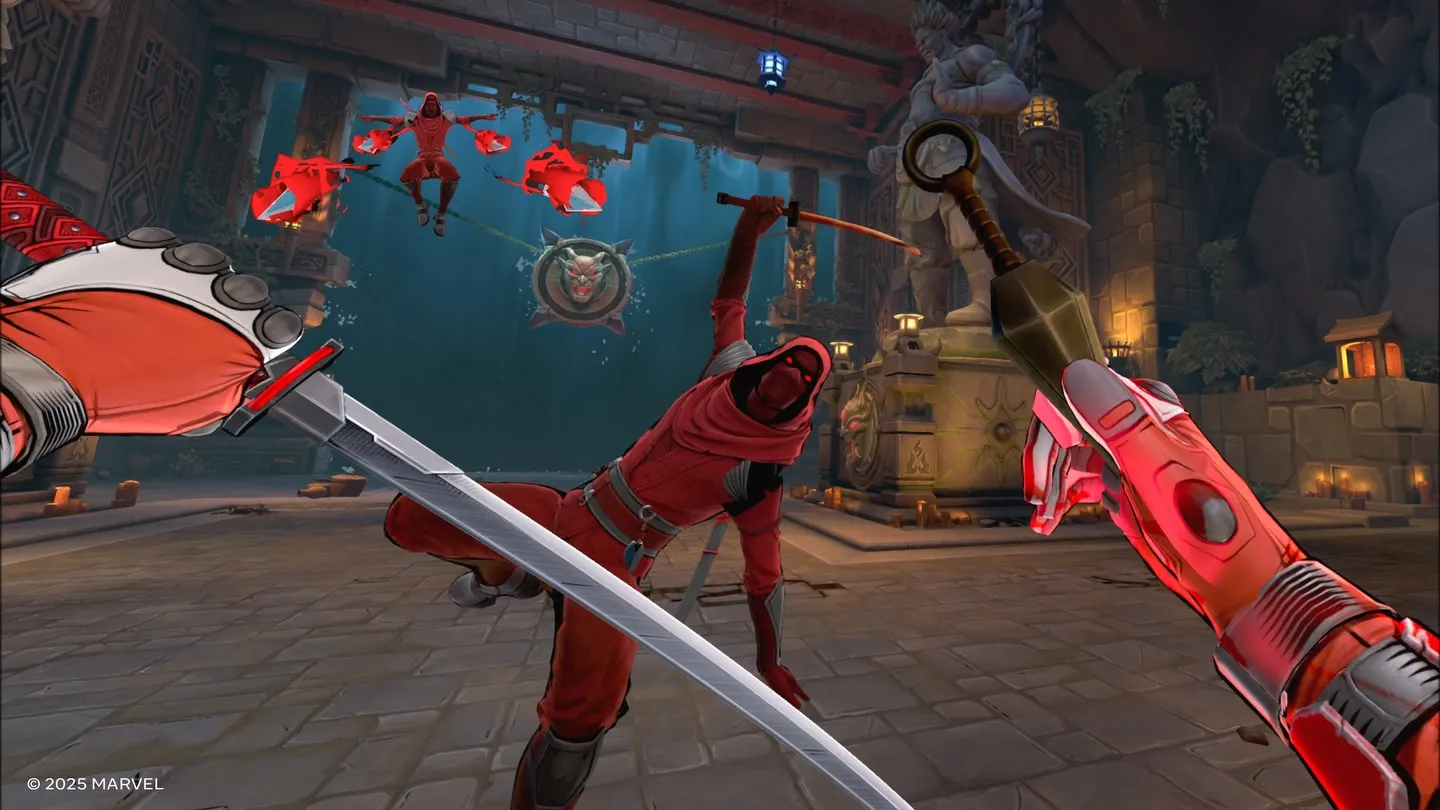
The combat design embraces an openly arcadey style and prioritizes momentum over the deep simulation many VR projects chase. The fantasy of inhabiting Deadpool comes through with striking clarity. Mobility rules every encounter, with players chaining wall-running, double-jumping, using grapples, and dive-kicking across each arena. Stages are shaped to reward inventive use of these moves and encourage stylish kills. Dual pistols and twin katanas serve as default tools.
The katanas occasionally fall into the familiar VR “sword-waggle” problem, yet the wider system still encourages players to vary their attack patterns. Tactical depth lives in the smaller details: katanas can temporarily break through blocks, and wrist grenades need a brief recharge. Temporary heavy weapons such as shotguns and chainsaws must be scavenged from enemies to keep damage output high.
Deadpool’s famed regeneration fuels one of the game’s most gruesome and entertaining mechanics. Cartoonish gore stays constant, and the player can lose limbs or even their head mid-fight. This forces improvisation, since players may need to finish encounters one-handed or briefly control their body from the ground, a repeat source of low-brow jokes.
Between stages, Mojo bucks earned during missions can be spent in the hub on weapon upgrades, including variants like shotgun pistols or katanas that boomerang back to the player. The “Big Money Time” meter provides another layer to the combat loop. Triggering it grants a brief surge of power from a famous Marvel weapon such as Thor’s Hammer, increasing destructive potential and pumping up the flow of in-game currency. Every component of this toolkit is tuned to keep motion constant and satisfying.
Also Read




Meta-Narrative and Comedic Pacing
The narrative frame built around the Mojo Games looks deceptively simple yet supports a surprising range of mechanics and tone. Deadpool’s task of capturing Marvel villains for Mojo’s streaming service gives the design a clean excuse to hop between wildly themed zones every hour or so, from ninja schools to Omega Red’s stronghold. This structure helps the roughly 10-hour campaign stay lively.
The humor keeps a steady rhythm, built on continuous fourth-wall gags and self-aware commentary about both the Marvel Universe and VR gaming. Jokes reference pop culture and Marvel lore, with touches like Deadpool griping about fighting Ultimo when he wants a more recognizable opponent such as Ultron.
The reality show frame stays present in the moment-to-moment action. Post-battle rankings feed Mojo bucks into the player’s wallet, while the “viewer count” climbs on screen, accompanied by chaotic audience comments. This detail reinforces the sense of living inside a digital spotlight. Voice work ties the chaos together.
Neil Patrick Harris delivers the required snark and unstable energy with real confidence. John Leguizamo’s sleazy spin on Mojo gives the villain a clear personality that grounds the show concept. However, the heavy emphasis on dialogue creates a real pacing issue. Long cutscenes and extended dialogue sequences cannot be skipped, which grows frustrating, especially during repeated runs through levels. Boss fights present another sore spot.
These encounters feel heavily choreographed and rely on specific, timed actions that break the free-flowing combat rhythm and sometimes trigger jarring glitches if the player stands in an awkward position. The contrast between open-ended regular fights and tightly scripted bosses undercuts both the narrative payoff and the mechanical satisfaction of these climactic moments.
Variants, Vision, and Comfort
The game’s structure supports long-term engagement through smart replay hooks. After finishing the campaign, players can revisit stages as alternate Deadpool variants such as Lady Deadpool or Deadpool Kid. Their fundamental mechanics remain intact, yet they add fresh, often very funny dialogue and distinct Easter eggs that reframe familiar encounters. Each variant gains access to hidden doors or special challenges that unlock secret stages stocked with puzzles and collectibles, including comic books and weapon skins. These incentives give players clear reasons to return to earlier content.

On the visual side, the cel-shaded presentation nails the comic book look and produces a sharp, colorful world. Performance stays stable for most encounters. Intense battles with large enemy groups can make the hardware struggle, which leads to minor audio hiccups or occasional dips in frame rate. The difference in visual quality between the Quest 3 and the 3S stands out, with the Quest 3 offering notably stronger results.
Twisted Pixel builds in thoughtful accessibility options, including three comfort modes aimed at VR newcomers and a toggle that lets players skip intense sequences such as vehicle shootouts. A “Kidpool” mode that strips out profanity exists for those who want it. This setting naturally removes a key piece of the character’s appeal. Even when the screen threatens to buckle under the sheer amount of on-screen chaos, the presentation holds together in a way that suits the game’s loud, unfiltered energy.
The Review
Marvel’s Deadpool VR
Marvel’s Deadpool VR is a successful and thoroughly entertaining translation of the Merc with a Mouth into virtual reality. The fluid, arcade-style parkour combat, coupled with Neil Patrick Harris’s exceptional performance and the game's relentless meta-humor, creates a consistently high-energy experience. The clever reality show framing and the substantial replayability system with character variants solidify its value. While frustratingly long, unskippable cutscenes and some choppy boss fights hinder the pacing, the game delivers on the chaotic, R-rated fun the character demands. It sets a new benchmark for licensed VR superhero action.
PROS
- Kinetic parkour combat
- Authentic R-rated humor
- Exceptional voice cast
- Strong replayability loop
- Unique body regeneration mechanic
CONS
- Unskippable story cutscenes
- Choreographed boss battles
- Occasional frame rate hitches
- Melee combat "waggle" issue