















Roach Games makes its debut with Kingdoms of the Dump, an indie JRPG that transforms literal garbage into the foundation of an entire fantasy realm. After six years of development following a successful Kickstarter campaign, this 2025 release drops players into The Lands of Fill, where sentient trash cans, animated vermin, and living household objects populate kingdoms with names like Garbagia. Your protagonist is Dustin Binsley, an anthropomorphic garbage can serving as a clumsy squire who oversleeps his duty and arrives too late to prevent his king’s kidnapping. This failure sets him on a redemptive quest through a world that wears its 16-bit JRPG heritage proudly.
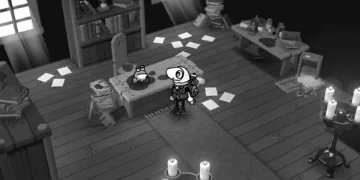
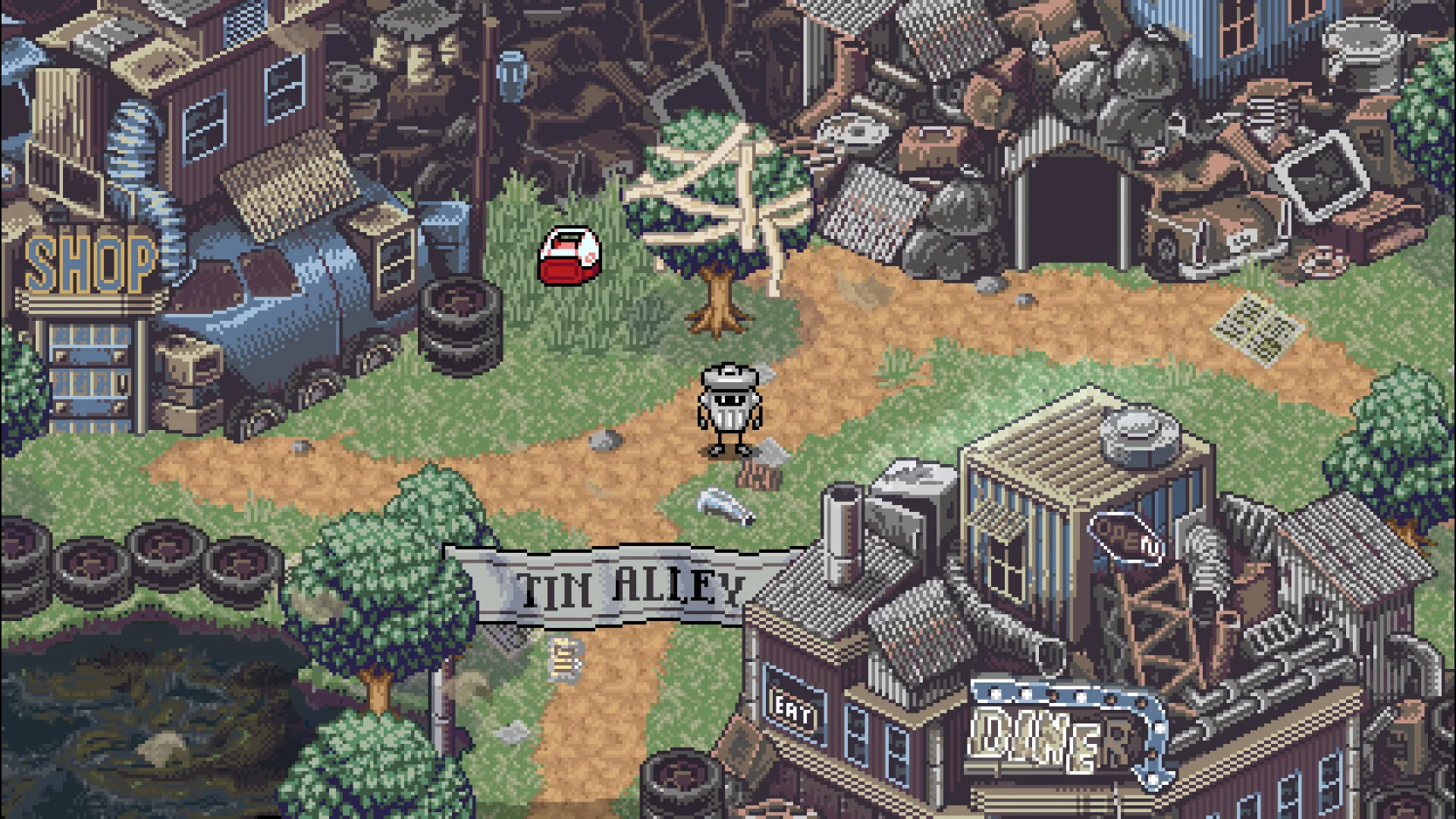
The visual commitment to the trash motif is remarkable. Enemies include fire ants sporting oversized cowboy hats and knights constructed entirely from traffic cones and road signs. The sprite work demonstrates genuine creativity, with animations like Dustin pulling items directly from his own body lending personality to every action.
Composers BobblyGhostly and William Kage deliver a soundtrack steeped in 16-bit nostalgia, with Kage’s specialty in SNES-era soundfonts evoking Final Fantasy VI and Chrono Trigger. Guest composer Hiroki Kikuta of Mana fame adds his signature touch. This is clearly a love letter to Super Mario RPG and its contemporaries, complete with turn-based combat and a quirky aesthetic that promises something memorable.
Narrative Familiarity in Strange Wrapping
The narrative structure follows well-worn JRPG paths. Dustin fits squarely into the naive young hero template, and his journey to rescue the king from the villainous bug Rutilius unfolds with predictable beats. What distinguishes the experience is how the game balances its absurd premise against genuine attempts at emotional storytelling. Despite featuring a world of walking trash and sentient furniture, Kingdoms of the Dump plays its story relatively straight, avoiding constant winking at its own ridiculousness. When it reaches for emotional moments, it occasionally succeeds in landing them, which is admirable given the inherently silly setup.
Your party assembles familiar archetypes. Ratavia the rat serves as both combatant and emotional anchor for Dustin during difficult moments. Walker, a librarian, acts as diplomat between kingdoms. His protege Lute carries a mysterious past that unfolds throughout the adventure. Musk, a shapeshifting stinkbug with mob connections, and Cerulean, an insecure wizard with genuine kindness, round out the core team. Guest characters rotate through your roster, and they’re given surprising depth for temporary companions. Each main party member receives spotlight moments where their particular skills or personality traits drive the plot forward.
The writing quality proves inconsistent. Early acts manage competent dialogue and character interactions, but the second half introduces problems. Conversations become stilted, and the script is littered with typos that grow more frequent as you progress. The story leans heavily on betrayals, deploying this twist so often it loses impact. Pacing falters considerably after the halfway point, with Act III particularly guilty of dragging players through extended sequences that test patience rather than engage interest. The worldbuilding itself remains solid, with The Lands of Fill feeling cohesive and thoughtfully constructed, but the story told within it can’t sustain momentum across its 20 to 25 hour runtime. Completionists tackling side content might add another 5 to 10 hours.
The world map deserves specific praise for its approach to discovery. Hidden locations don’t appear until Dustin wanders close enough to reveal them. The game pauses to fill in these new areas, creating genuine satisfaction each time you uncover a secret. These locations typically contain equipment or resources superior to anything purchasable in towns, which transforms exploration from optional activity to rewarding gameplay loop. Towns themselves pack in hidden items, encouraging thorough investigation of every corner.
Combat That Starts Strong
Kingdoms of the Dump builds its combat around a 3×6 grid split between your party and enemies. Your three active characters (occasionally joined by a fourth AI-controlled guest) each occupy panels on your side while enemies mirror this setup on theirs. Positioning carries real weight. Characters stationed closer to the enemy’s side dish out increased damage but also absorb heavier hits. You can shift one tile per turn for free, creating a risk-reward calculation for every round of combat. The system borrows conceptually from Radiant Historia while adding its own mechanical wrinkles.
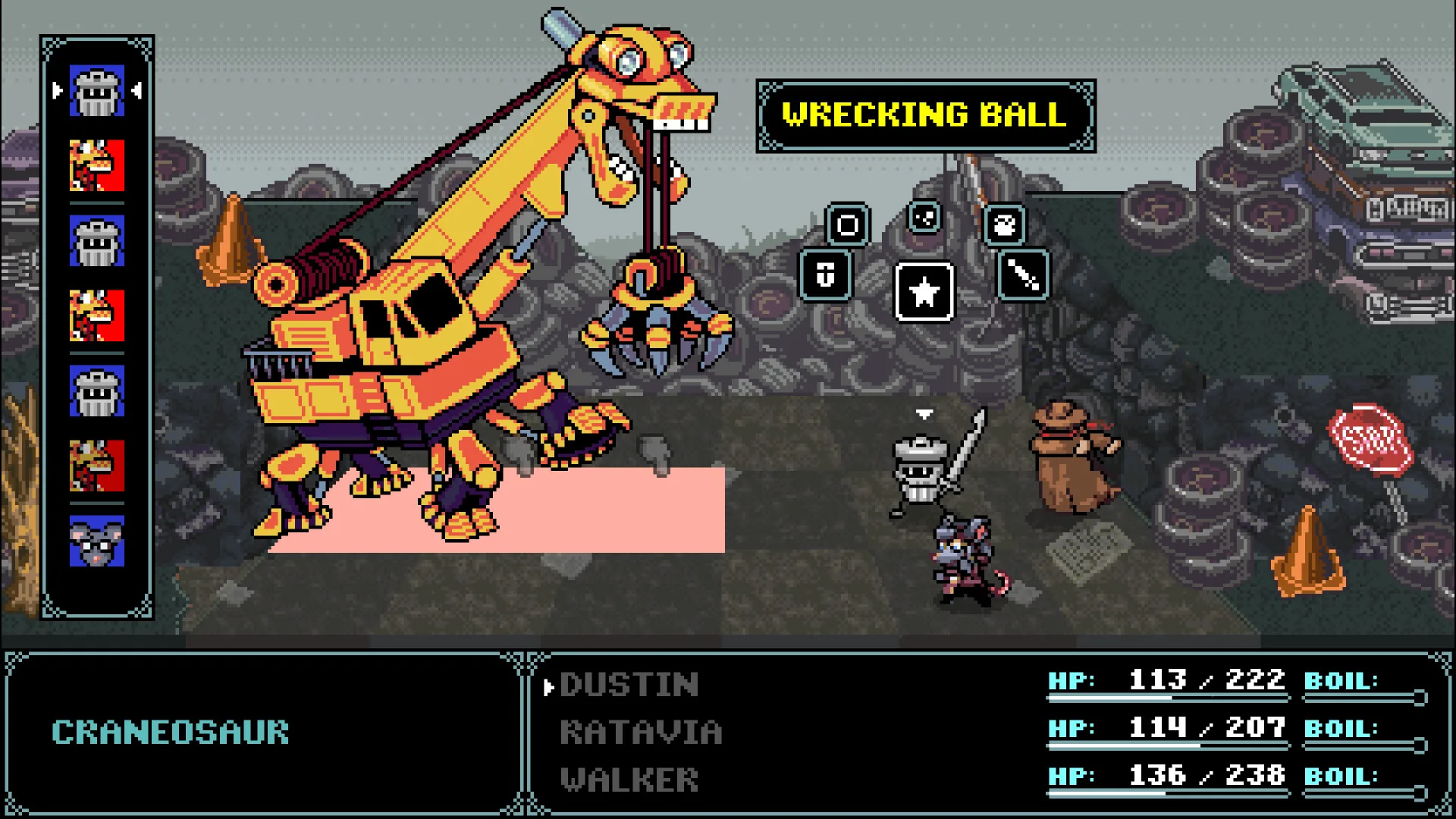
Battlefield hazards expand tactical options. You can place bear traps on tiles to damage enemies repeatedly, ignite oil slicks for fire damage, or electrify water puddles. This environmental interaction adds a layer beyond simple attack selection. The game borrows timed hits from Super Mario RPG and Paper Mario, requiring button presses at specific moments to boost your damage output or reduce incoming hits. Learning enemy attack patterns becomes necessary to master the timing windows. Unfortunately, the timing remains largely identical across different enemy types, which limits the satisfaction of encountering new foes. A garbage bag enemy and a late-game opponent will telegraph their attacks with the same rhythm, making battles feel samey once you’ve internalized the basic timing.
The Boil meter functions like Final Fantasy VII’s Limit Breaks. Taking damage fills this gauge, and reaching the boiling point allows devastating super attacks that replace standard commands. Character progression offers choices about which skills to equip for battle as you level up, though new abilities become sparse after roughly 40 percent of the campaign. The combat system shows all its cards early and then repeats the same hand with minimal variation.
Metal Points serve as your MP resource, and their management defines much of the combat experience. This shared pool across all party members doesn’t refill at inns or through conventional rest mechanics. Instead, you must collect scrap metal from the overworld using Dustin’s ability to interact with metallic objects, or you can drain it from enemies using specific skills. Special statues scattered throughout the world provide the only means to increase your maximum MP. Skills consume substantial amounts of this resource, creating scarcity that demands careful planning in the early game.
This system grows increasingly frustrating as you progress. Late-game encounters feature bosses with absurdly inflated health totals that transform battles into wars of attrition. With MP so difficult to replenish and healing spells consuming significant portions of your pool, many fights devolve into Dustin spending turns recharging MP while other party members burn through it for healing. The final stretch before the last dungeon includes a boss so spongy and tedious that it genuinely feels like someone accidentally added an extra zero to its health value. These aren’t mechanically complex encounters testing your mastery of systems. They’re endurance tests that drag on for 15 to 20 minutes simply because enemies refuse to fall.
The difficulty curve swings wildly. Initial battles skew easy, then sharp spikes appear seemingly at random. You might face an area with brutal enemies that shred your party, followed immediately by a zone where foes die in single hits. Experience yields never align properly with enemy difficulty, suggesting the back half of the game received minimal balance testing. Platforming integrates into dungeon exploration, with each party member offering unique traversal abilities. Paperclips scattered throughout environments serve as currency. The platforming itself introduces problems that deserve their own discussion.
Technical Troubles Run Deep
Kingdoms of the Dump launched in rough shape. The technical issues aren’t minor inconveniences you can overlook with generous interpretation. They’re fundamental problems that repeatedly interrupt gameplay and, in some cases, halt progress entirely. Softlocks occurred frequently enough during my playthrough that I developed a habit of creating multiple save files and rotating between them. Characters would get stuck after cutscenes, requiring full restarts. Falling through floor geometry happened often enough to feel like a standard hazard rather than a rare glitch. Invisible barriers trapped me inside buildings with no exit until I reloaded. Characters phased through sprites and geometry constantly, breaking immersion with every occurrence.
The platforming system combines poorly with collision detection problems. Jumps that appear properly executed result in falls because the game misjudges your position. Getting stuck behind buildings or other geometry happens regularly, and the problems compound as you gain more party members with expanded traversal options. The Toy Mine dungeon in Act III becomes genuinely nightmarish, with the character rapidly falling repeatedly in the same spot and losing health chunks each time. The game includes an “unstuck” option in the menu, which tells you everything about how aware the developers were of these collision issues.
Visual problems extend beyond platforming. Pixel art buildings layer incorrectly, creating confusion about elevation and making it unclear where your character stands relative to structures. Items display at wrong depth positions. Open doors frequently can’t be entered, with no clear indicator distinguishing accessible doorways from decorative ones. Loading zones prove difficult to identify at a glance. The game scatters pre-opened treasure chests everywhere, which might serve some narrative purpose in moderation but becomes genuinely annoying at this frequency. Character portraits for NPCs show noticeably less polish than main cast portraits. Areas sometimes fail to load correctly. Wrong characters speak during cutscenes. Music goes missing from battle sequences. Attack animations and sound effects disappear. NPCs turn invisible.
The script needs another full editing pass. Typos appear multiple times per conversation, particularly in later acts. Simple spelling errors and grammar mistakes that any proofreading would catch make it through to the final release. Design flaws compound technical problems. The game offers no rebindable controls, providing only preset control schemes. A stealth section features guards with absurdly wide sight cones that make progression feel almost impossible. Transition times between areas stretch unreasonably long, with some world map movements taking 26 seconds or more. Act III fills large rooms with mostly empty space and forces excessive backtracking. World map travel becomes tedious through sheer repetition.
Roach Games deserves credit for actively patching the game post-launch. Some issues I encountered were fixed within days of reporting them. Continued support seems likely given how responsive the team has been. However, this doesn’t excuse the launch state. The front half of the game feels noticeably more polished than the back half, suggesting time or budget constraints forced the team to prioritize early content that would appear in demos and initial impressions. By the final act, I genuinely questioned whether certain sections had been playtested at all.
I recognize that Roach Games operates as a small studio with limited resources for quality assurance. The six-year development cycle and successful Kickstarter backing show genuine passion and commitment to realizing this vision. But technical problems became too pervasive to wave away with understanding nods toward budget constraints. These aren’t edge cases discovered by players intentionally breaking the game. They’re issues that emerge from normal play, and they fundamentally undermine what could have been a charming throwback experience. The bones of something special exist here. The creativity poured into the setting and the interesting ideas embedded in the combat system demonstrate real talent. Unfortunately, the execution needed more time in the oven before serving to players.
Kingdoms of the Dump is an independent, retro-styled JRPG that draws heavy inspiration from classic 16-bit role-playing games like Chrono Trigger and EarthBound. The game is set in a unique fantasy world entirely themed around garbage, known as the Lands of Fill, which was conceptualized and created by the developers, who were full-time custodians. Players join Dustin Binsley, the Trash Can Knight, on a grand adventure through the Five and a Half Kingdoms of the Dump to save the land from the toxic grimelin army. It features turn-based combat with timed hits, character swapping with unique field abilities, and exploration of a large Mode 7 world map. The game was released on November 18, 2025, and is available on PC via Steam for Windows, macOS, and Linux.
Full Credits
Director (Creative/Game Director): Roach
Writers (Lead Writer/Narrative Designer): Everdredd
Producers/Studio Leadership (Producers, Executive Producers, and Key Studio Heads): Roach, Everdredd
Art Director/Lead Artist: DM404, Francis Coulombe
Key Engineering/Technical Leads: Solar Mongoose
Composer/Sound Director: Bobby Ghostly, William Kage, Hiroki Kikuta
Developer, Publisher: Roach Games, Dream Sloth Games, Roach Games
Release Date: November 18, 2025
The Review
Kingdoms of the Dump
Kingdoms of the Dump showcases genuine creativity in its trash-themed world and grid-based combat system, but technical problems severely damage the experience. The charming visual design and satisfying exploration can't overcome pervasive bugs, poor collision detection, and unbalanced late-game encounters. While Roach Games demonstrates clear passion and has been actively patching issues, the launch state reveals inadequate testing. For patient players willing to wait for updates, there's potential here. Right now, it's a flawed gem buried under too much rough.
PROS
- Creative, fully realized trash-themed world
- Satisfying hidden location discovery system
- Strong sprite work and visual commitment to theme
- Grid-based combat offers tactical positioning
- Nostalgic 16-bit soundtrack
CONS
- Frequent softlocks and game-breaking bugs
- Poor platforming collision detection
- Severely unbalanced late-game difficulty
- Tedious MP management system
- Repetitive betrayal plot twists
- Numerous typos and script errors