




























Can This Love Be Translated? traces the lives of Joo Ho-jin and Cha Mu-hee. Ho-jin works as a professional interpreter. Mu-hee is an actress who falls into a coma after a dangerous stunt on a film set. While she is unconscious, her performance in a zombie movie becomes a worldwide sensation. She wakes to discover she has become a global celebrity. The narrative follows their path from a brief meeting in Japan to a reunion on the set of a reality dating show.
A Japanese star named Hiro Kurosawa appears in the production. The plot moves across international locations while attending to how people exchange meaning. The series examines a stoic man and a woman who must manage sudden fame and past trauma. Language functions as a way to study how characters hide and reveal their true selves.
Linguistic Filters and Emotional Expression
Ho-jin practices a distinct professional ethic. He refuses to translate insults and words spoken in anger. This choice creates a sanitized version of reality for the people who rely on him. His habit of softening and altering language changes the dynamics between Mu-hee and her rivals. He carries the responsibility of speaking for two people who cannot address each other directly. That position clarifies the influence an interpreter exercises over what counts as truth.
The series treats individual communicative styles as something beyond grammar. Ho-jin can render many literal languages but struggles to read Mu-hee’s private signals. This difficulty suggests that fluency in language does not guarantee fluency with a person. Learning another’s speech patterns operates as a metaphor for learning another’s interior life. The process is slow and involves decoding patterns of gesture, pause, and omission.
Early scenes in Japan stage this problem. A confrontation in a ramen shop becomes the foundation of their connection. The absence of subtitles in these scenes places viewers in the same disoriented position as the characters. The audience experiences confusion and the pressure of not knowing. Silence between people often speaks more loudly than spoken lines. Words frequently hide feelings and fail to make them plain. This use of silence underscores the limits of verbal exchange.
The Do Ra-mi Persona and the Stoic Shield
After she wakes from the coma, Mu-hee undergoes a severe internal struggle. She begins to see hallucinations of a Do Ra-mi figure. This zombie persona stands for her internal chaos and anxiety. The presence of that figure darkens the series’ tone and signals Mu-hee’s fear that she does not deserve sudden success. Go Youn-jung shifts physical manner and posture to present two versions of the same character. One version is the polished star. The other functions as a materialization of trauma.
Ho-jin functions as a study in stoicism. He provides help and keeps distance from others. His pragmatic habits conceal a deep reservoir of past regrets. He retains an attachment to his ex-girlfriend, Ji-seon. That lingering tie prevents him from moving forward. Kim Seon-ho plays a man who uses multilingual skill as a protective covering. He works as an interpreter while avoiding direct speech for himself.
Hiro Kurosawa’s arrival complicates the situation. Hiro brings external pressure that forces both leads to confront emotional facts. The juxtaposition of Hiro’s public charm with the private tension between the main pair is immediate and clear. Hiro exemplifies the easy social connection associated with celebrity life. Ho-jin stands for the hard labor of real understanding. The emergent love triangle reflects aspects of Mu-hee’s fragmented self.
Visual Storytelling and the Global Canvas
The series adopts a travelogue approach to visual design. Locations such as Tokyo, Italy, and Canada frame the narrative. These settings anchor the reality show element inside the plot. Scenery shifts to match the characters’ emotional states. The Japan sequences register as dreamlike. Later episodes present a more grounded tone as characters confront practical consequences. Visual change maps the movement from fantasy into a more adult form of reckoning.
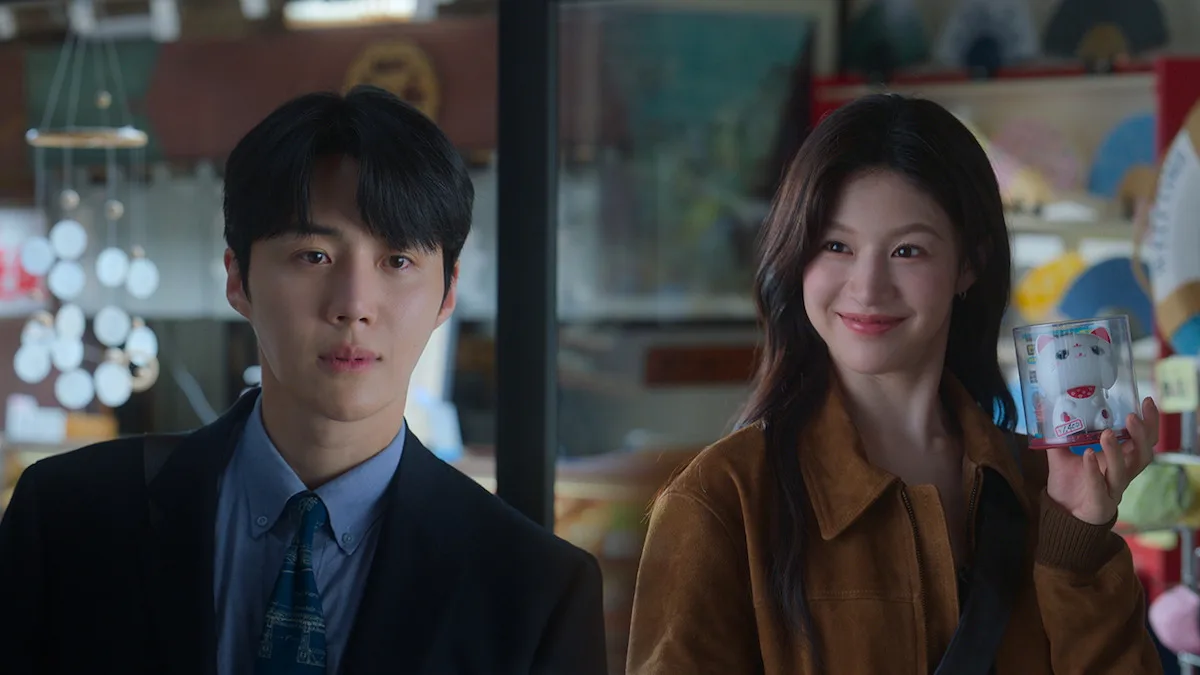
Director Yoo Young-eun applies specific visual motifs. Mirrors and reflections recur across episodes. These images make Mu-hee’s fractured self visible on screen. Red carpet scenes stress the gap between public celebrity and private vulnerability. Flashbulbs and paparazzi glare appear against the silent panic in Mu-hee’s eyes. Those sequences stage a critique of the predatory aspects of modern fame.
The dating show inside the series supplies a regulated stage for romantic beats. The program is a manufactured environment where feelings are scripted and rehearsed. Behind-the-scenes moments reveal the artifice that television constructs. The staged drama of the show sits beside the translator’s lived emotion. The series proposes that truth often appears in the margins of production rather than on the program’s front-facing surface.
Scripting Shifts and Narrative Pacing
The script follows the style associated with the Hong Sisters. The series moves from a light romantic comedy into a heavier psychological drama. Later episodes adopt a more serious register as secrets come to light. This tonal change aligns with a streaming-era tendency to blend genres to sustain audience engagement. The series’ mood darkens as characters reveal previously held truths.
Pacing presents a problem in the midseason. The narrative decelerates to examine characters’ interior lives. Certain plot threads run long to occupy a twelve episode structure. The drama adds fresh obstacles in final episodes to preserve tension ahead of resolution. That pattern challenges viewer patience while offering payoff for those who remain invested in the characters.
Genre balance functions as a central formal choice. Romance and the horror textures of zombie hallucinations sit together and produce a disquieting mixture. Flashbacks cover the year the characters spent apart and show incremental personal growth. The narrative shape places emphasis on time and distance as necessary conditions for deeper understanding.
Can This Love Be Translated? premiered globally as a Netflix original series on January 16, 2026. The 12-episode romantic comedy quickly became a streaming sensation, trending in the top ten across multiple countries during its debut week. You can watch the entire series exclusively on Netflix, where all episodes were released simultaneously for a binge-ready experience. The story follows a multilingual interpreter and a world-famous actress as they navigate their growing feelings across international settings, including South Korea, Japan, Italy, and Canada.
Full Credits
Title: Can This Love Be Translated?
Distributor: Netflix
Release date: January 16, 2026
Rating: TV-PG
Running time: 56–82 minutes per episode
Director: Yoo Young-eun
Writers: Hong Jung-eun, Hong Mi-ran
Producers and Executive Producers: Choi Jin-hee, Kim Jin-yi, Park Joo-yeon, Lee Yong-soo
Cast: Kim Seon-ho, Go Youn-jung, Sota Fukushi, Lee Yi-dam, Choi Woo-sung, Ahn Tae-rin, Baek Joo-hee, Im Chul-soo, Kim Won-hae, Sung Joon
Director of Photography (Cinematographer): Keeha Choi, Kim Young-jin
Editors: Kim Hyang-sook
Composer: Choi In-hee
The Review
Can This Love Be Translated?
Can This Love Be Translated? succeeds as a thoughtful exploration of human connection through the lens of linguistics. While the psychological shifts and pacing occasionally falter, the chemistry between Kim Seon-ho and Go Youn-jung provides a stable anchor. The series moves beyond the typical romantic template by addressing the trauma of fame and the difficulty of authentic speech. It is a visually lush, contemplative drama that rewards patience, even when the plot stretches thin. It proves that some feelings remain universal, regardless of the language used to describe them.
PROS
- Strong lead chemistry and performances
- Unique focus on the ethics of translation
- High production value and global locations
- Creative use of the "show within a show"
CONS
- Sluggish pacing in the middle episodes
- Jarring tonal shifts into psychological horror
- Overly familiar "love triangle" tropes
- Plot feels stretched to fit 12 episodes