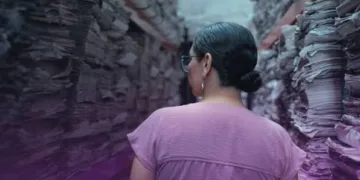








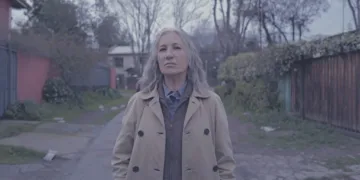









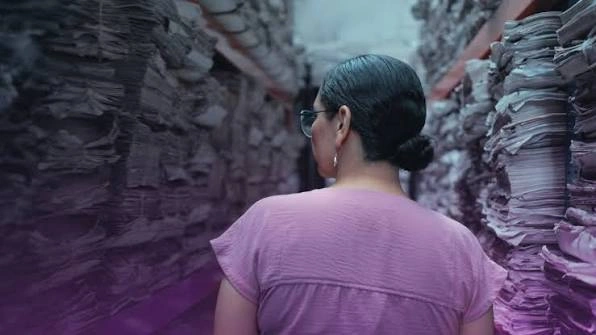

Netflix true crime usually knows how to sell dread; this series keeps asking who profits from that sale. The Prosecutor, the three-part Mexican documentary series directed by Paula Mónaco Felipe and Miguel Tovar, enters Mexico City’s Femicide Department without the genre’s familiar machinery of thunderous music, reenactments, and cliffhanger ghoulishness. The opening image of stacked paper files inside the public prosecutor’s office is not glamorous television. Good. It should not be.
The series centers on Sayuri Herrera Román, the first head of the department created to investigate femicide in Mexico City. In 2020, the figures placed at the start are horrifying: thousands of women murdered in Mexico, with hundreds classified as femicides.
That statistic could have become the usual streaming hook, the number flashed before the algorithm serves up three hours of morbidity. Here, it becomes a charge against the institutions that turned murdered women into files, categories, delays, and jurisdictional arguments. Herrera’s presence is commanding, but the documentary resists polishing her into a prestige-TV heroine. She speaks like someone who has learned that outrage is useless unless it can survive paperwork.
An Activist Inside the System
Herrera’s biography gives the series its sharpest political tension. Her legal identity was shaped by the 1999-2000 UNAM student strikes, by her family’s experience with exploitation, and by her work representing victims of torture, sexual assault, and gendered violence. Before leading the Femicide Department, she worked with the family of Lesvy Osorio, whose death at UNAM had to be fought back from institutional misclassification before it could be named as femicide.
That history matters because the series places her inside the very machine she once challenged from the outside. Ernestina Godoy’s decision to appoint her through a public process has the texture of reform, yet the backlash is immediate. Male employees resign rather than work under her. The gesture is almost too blunt as institutional symbolism: a department created to confront violence against women is greeted by men who treat a woman’s authority as an emergency.
The show is most alive in that contradiction. Herrera attends meetings with families, gives interviews with austere focus, visits scenes connected to the cases, and later speaks to her staff about a major professional change. Her adoption of a baby daughter runs alongside this work, not as softening material, but as a quiet pressure point. The woman charged with confronting a culture of gendered death is also choosing care, attachment, and domestic risk. Television loves that kind of parallel because it looks elegant on the page. Here, it feels heavier.
The Cases Speak Before the System Does
The Joana Esmeralda Trejo Orduña case shows the series’ method at its cleanest. Her husband confesses to killing and dismembering her, then frames the murder through the old logic of male entitlement: alleged infidelity, punishment, control.
Herrera’s team searches near a sewage canal and the Remedios River for remains and weapons. The procedural detail matters because the team’s insistence on recovering Joana’s body is also an argument about personhood. The state cannot claim to honor a victim while settling for fragments.
Karen Itzel Rodríguez Barrales’ case turns the home into a crime scene with terrible precision. Her husband claims she left to submit her bachelor’s thesis. Her mother, Nadya, refuses to let him file the missing-person report alone. That refusal becomes a form of maternal investigation before the state catches up.
The later testimony from Karen’s young son, describing violence inside the house involving her partner and in-laws, gives the series one of its most painful truths: domestic space is often treated as private until a woman dies there.
The Yrma Lydya Gamboa case shifts the violence into public view. She is shot inside Suntory Restaurant in Del Valle by her older husband, influential lawyer Jesús Hernández Alcocer. Witnesses, the tablecloth message about wanting to end the marriage, and prior surveillance footage of him assaulting her near an elevator all produce a devastatingly clear pattern. The case asks how much evidence a society requires before it stops calling possession love.
Ariadna Fernanda López Díaz’s case gives the final episode its strongest institutional shape. Her body is found in Morelos, and local authorities first describe the death through alcohol rather than violence. Mexico City’s investigators identify blunt force trauma, surveillance footage shows Rautel Astudillo carrying her body, and blood is found in his apartment. The jurisdictional conflict exposes the ugly administrative poetry of femicide: a woman can be killed in one place, dumped in another, and nearly erased in the space between offices.
What the Title Hides
For all its restraint, The Prosecutor has a focus problem. A series with this title should show prosecution as craft: legal strategy, argument preparation, evidentiary choices, courtroom pressure, the anticipatory chess of facing defense teams.
Instead, much of the visible work belongs to investigators such as Melody Zambrano, Héctor Ortiz, Carolina Espinoza, Jovanni Linares, Brenda Bazán, and Rodolfo Arce. They search, document, interview, and reconstruct. Herrera often narrates the moral stakes around that labor rather than demonstrating the legal mechanics behind it.
That choice weakens the series while revealing something useful about streaming’s current relationship to justice stories. Platforms are increasingly comfortable with institutional access, activist language, and sober aesthetics. They are less comfortable with bureaucracy as process. The messy middle of law, where a case becomes prosecutable through motions, records, classifications, and strategy, remains stubbornly untelevisual. Apparently paperwork still tests the patience of an industry that can make serial killers trend by breakfast.
Episode 2 shows the strain most clearly, cutting between Karen and Yrma’s cases in a way that blurs rather than deepens both. Episode 1 benefits from the focus of Joana’s case, and Episode 3 regains force through Ariadna’s case and the Morelos cover-up. The series never loses its ethical seriousness. It does lose, at times, the sharpness needed to distinguish an institutional portrait from a case-file procedural.
What remains valuable is its refusal to turn dead women into puzzle pieces. The camera stays with mothers, sisters, investigators, office rooms, search areas, and the evidence that men leave behind when they assume the world will understand them. That assumption is the real subject. The series keeps returning to it, case after case, until the pattern becomes impossible to misread.
The stylized martial arts legal thriller The Prosecutor expanded to select international cinema networks via Well Go USA Entertainment on January 10, 2025, following its holiday season launch in major Asian markets. Audiences looking to watch the film at home can currently stream it via premium video-on-demand networks, including Amazon Prime Video. Loosely inspired by a real-life 2016 Hong Kong drug-trafficking case, the narrative centers on an unyielding police detective turned public prosecutor who risks his life and legal career to launch an independent investigation, intent on overturning the conviction of a young man who was maliciously manipulated into entering a false guilty plea.
Where to Watch The Prosecutor Online


Full Credits
Title: The Prosecutor
Distributor: Well Go USA Entertainment, Mandarin Motion Pictures
Release date: December 21, 2024 (Hong Kong Theatrical Release), January 10, 2025 (United States Limited Theatrical Release)
Rating: 16+
Running time: 118 minutes
Director: Donnie Yen
Writers: Edmond Wong
Producers and Executive Producers: Donnie Yen, Raymond Wong
Cast: Donnie Yen, Julian Cheung, Michael Hui, Francis Ng, MC Cheung Tin-fu, Kent Cheng, Mason Fung, Locker Lam
Director of Photography (Cinematographer): Noah Wong
Editors: Li Ka-wing
Composer: Chui Chit-ho
The Review
The Prosecutor
The Prosecutor treats femicide with rare documentary restraint, refusing the genre’s usual appetite for spectacle. Its best material sits with Sayuri Herrera Román’s team as they search canals, read evidence, and face families who already know the system has failed them. The weakness is structural: a series named for a prosecutor rarely lets us see prosecution as legal craft. Still, as a portrait of gendered violence, institutional resistance, and streaming’s uneasy true-crime conscience, it has real force.
PROS
- Respectful treatment of victims
- Strong institutional subject
- Clear social urgency
- Casework grounded in detail
- No lurid true-crime tricks
CONS
- Limited legal strategy shown
- Episode 2 feels muddled
- Herrera can feel under-observed
- Avoids unsolved-case pressure