










![Kingdom Hearts Collection [I-III] Review](https://gazettely.com/wp-content/uploads/2026/10/Kingdom-Hearts-Collection-I-III-1-360x180.webp "Kingdom Hearts Collection [I-III] Review: KHII Holds Steady as Newer Entries Fluctuate 40")


Andrew Stanton is back in live-action after a long break, and his Pixar legacy still frames the way he thinks about heart and scale. WALL-E and Finding Nemo proved how easily he can place real warmth inside huge, quiet spaces. That’s why this return matters. Stanton has a knack for taking big science-fiction ideas and pinning them to recognizably human needs.
His new film, In the Blink of an Eye, lands on Hulu in 2026 after a messy road to release. The script comes from Colby Day and once appeared on the Black List. Stanton sets out to map human existence across time by linking three separate eras: a Neanderthal family in 45,000 BCE, two academics in 2025, and a lone astronaut in the 25th century. The film works to fuse these lines into one portrait of evolution and survival, with Stanton treating connection as the thread our species keeps reaching for, even when the world changes beyond recognition.
A Narrative Spanning Millennia
The film opens in the deep past, following a Neanderthal family led by Thorn and Hera as they endure a brutal prehistoric environment. Jorge Vargas and Tanaya Beatty play the roles with an emphasis on physical need. This chapter leans on nonverbal communication and uses on-screen text to label family members. It captures the harshness of the “end of the Neanderthal age,” a stretch of life where danger sits close and survival decisions happen fast. The storytelling stays tight on the bonds that hold their small group together.

The 2025 section shifts into a modern academic world. Claire, an anthropologist played by Rashida Jones, studies the bones of ancestors we’ve already spent time with. She’s joined by Greg, a statistics student played by Daveed Diggs. Their relationship grows, then strains under distance when Claire returns to Vancouver to care for her dying mother.
This timeline builds a clean bridge between the ancient story and the present, treating the hunt for the “missing link” as a research goal that carries emotional weight. Continuity matters to these characters, and the film keeps returning to the idea that knowledge and longing can sit in the same room.
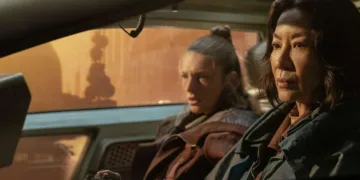
The third strand jumps to the year 2400. Kate McKinnon plays Coakley, an astronaut on a century-long mission to seed a new colony on Kepler-16B. Her only companion is ROSCO, an artificial intelligence voiced by Rhona Rees. Coakley exists in a “longevity enhanced” state that has kept her alive for hundreds of years.
The plot in this era tightens around a crisis in the ship’s plant life, a failure that threatens the oxygen supply. The stakes return to basics: air, time, and the fragile systems that keep a person alive. Stanton draws a clear parallel between prehistoric survival and futuristic survival, even as the tools and surroundings look radically different.
Connecting the Dots of Human History
Stanton links these lives through a kind of philosophical rhyme, using repetition and echoed moments to create meaning across the gaps. A fossilized acorn appears as a recurring symbol, tracking growth and time in a way that reads instantly, even when the characters live centuries apart.
The film avoids a clinical, detached posture that hard sci-fi sometimes leans on. Technology here carries warmth. ROSCO functions as a supportive presence, with the film treating A.I. companionship as something people can lean on. That choice lands as a reflection of current cultural hopes about A.I., the version that looks like partnership and care rather than cold management.
Mortality presses on every timeline. The Neanderthals face extinction. Claire faces her mother’s death. Coakley faces the isolation of extended life, where longevity starts to feel like a sealed room. Stanton packs all of this into a ninety-minute runtime, and that compression shapes the film’s rhythm.
Transitions can hit with a jolt. The cutting moves quickly and sometimes plays like a montage, racing through emotional beats that could breathe more with extra time. I kept thinking about the title during these jumps. The film wants history to feel brief in a cosmic sense, and the editing pushes that sensation hard. The trade-off is intimacy. Some moments arrive, sting, and vanish before they fully settle.
Even with its high-budget lineage, the film carries the spirit of an indie experiment. The structure refuses a straight line. It insists that these moments share the same vast timeline, even when the characters will never meet. The film asks you to hold three stories in your head at once, then trust the echoes to do the connecting.
The Art of Visual and Sonic Echoes
The craft work supplies the film’s firmest emotional handholds. Cinematographer Ole Bratt Birkeland gives the prehistoric chapter a luminous texture. The images feel tactile, lived-in, and close to nature, and I found myself thinking of Terrence Malick’s kind of naturalism while watching the light and movement in these scenes. The future setting, designed by Ola Maslik, presents a sleek, clinical space.
That visual approach charts a shift in environment from wild earth to sterile steel without needing a speech to explain it. The Neanderthal makeup and prosthetics stay grounded enough to let the actors express feeling through the transformation, which is essential in a section that depends on faces and bodies more than words.
Thomas Newman’s score works like a pulse under the whole film. The music begins with mechanical, rhythmic textures in the spacebound future. As the film moves toward the past, the score turns more fluid and untamed. Newman’s cues carry huge narrative weight in stretches without dialogue, guiding attention and mood when language drops out. Sound editor Ryan Joe Allam uses J-cuts to stitch time together, letting audio lead us across centuries. You might hear prehistoric wind while watching Claire in a modern lab. Those overlaps make the timelines feel less like separate films and more like one continuous memory.
All of this also highlights the film’s scale. The imagery and sound feel designed for a big theater, the kind of space where sound bridges can physically wash over you. That makes the move to streaming feel bittersweet for anyone who loves immersive cinema and the way a large room can amplify quiet, careful craft.
Giving Life to the Human Collective
The cast keeps the film sincere, even when the structure moves fast. McKinnon delivers a dramatic performance that leans into weariness and restraint, playing Coakley as someone shaped by centuries of solitude. Her final monologue gives the film a grounded emotional anchor near the ending, a moment that gathers the film’s ideas into a human voice.
Jones and Diggs face a tricky task: making an academic romance feel urgent while much of it runs through logistics. Their scenes often involve phone calls and digital messages, and the film treats that as a plain reality of modern connection. Screens mediate intimacy, and the distance between people can arrive through pixels and time zones as much as geography.
Vargas and Beatty bring physical clarity to the Neanderthal chapter. They convey parental love and fear without traditional dialogue, relying on movement, attention, and protective instinct. The performances underline an idea the film returns to again and again: emotion predates our formal languages by an immeasurable margin.
Rees, as the voice of ROSCO, gives the A.I. a pragmatic warmth that lets it read as a character with presence, not a device built to push plot. Across all three eras, the actors do the hard work of turning Stanton’s huge conceptual design into scenes with specific human texture, so the film’s big time span still feels personal, moment by moment.
In the Blink of an Eye is a 2026 science fiction drama directed by Pixar veteran Andrew Stanton. After a world premiere at the Sundance Film Festival on January 26, 2026, where it received the Alfred P. Sloan Feature Film Prize for its depiction of scientific themes, the film is scheduled for a global streaming release on Hulu beginning February 27, 2026. The narrative weaves together three stories spanning thousands of years, exploring the nature of life and human connection through a prehistoric family, modern-day academics, and a distant future space traveler.
Full Credits
Title: In the Blink of an Eye
Distributor: Searchlight Pictures, Hulu
Release date: January 26, 2026 (Sundance Film Festival), February 27, 2026 (Hulu)
Rating: PG-13
Running time: 94 minutes
Director: Andrew Stanton
Writers: Colby Day
Producers and Executive Producers: Jared Ian Goldman
Cast: Kate McKinnon, Rashida Jones, Daveed Diggs, Jorge Vargas, Tanaya Beatty, Skywalker Hughes, Rhona Rees
Director of Photography (Cinematographer): Ole Bratt Birkeland
Editors: Mollie Goldstein
Composer: Thomas Newman
The Review
In the Blink of an Eye
Andrew Stanton’s return to live-action is a bold, visually arresting swing that finds its greatest strength in silent, primal storytelling. While the triptych structure offers moments of profound beauty, particularly in the prehistoric and deep-space sequences, the film often struggles to balance its ambitious reach with a lean ninety-minute runtime. It feels like a beautiful, fragmented poem rather than a fully realized epic. For those willing to forgive a few narrative shortcuts, it remains a sincere, optimistic reflection on the thin threads that bind the human experience together across time.
PROS
- Luminous cinematography and a soul-stirring score by Thomas Newman.
- A nuanced, sincere dramatic turn that grounds the future timeline.
- Exceptional non-verbal sequences in the prehistoric era.
- A refreshing, humanist perspective on technology and AI.
CONS
- The short runtime prevents deep emotional investment in the modern-day characters.
- Some timelines feel significantly more developed and engaging than others.
- Reliance on phone calls and texts in the 2025 section can feel emotionally distant.