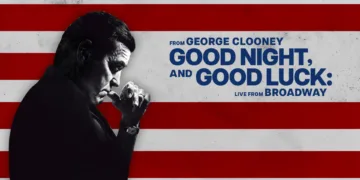

























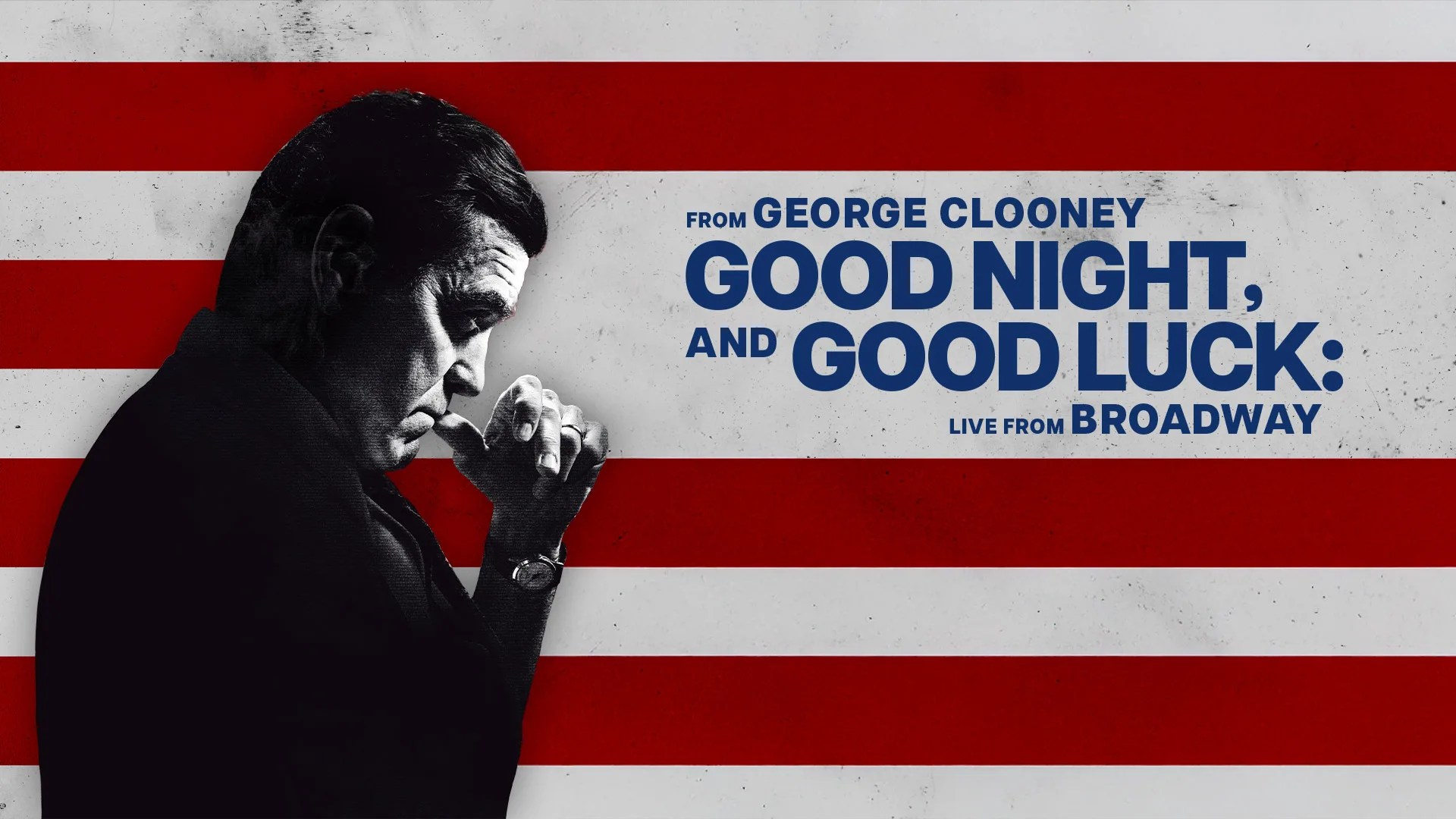

The air in the CBS newsroom of 1954 feels thick with the static of the Red Scare. Edward R. Murrow stands at a precarious intersection of history. He prepares to challenge Senator Joseph McCarthy over the discharge of Air Force lieutenant Milo Radulovich. A live broadcast staged at the Winter Garden Theatre reconceives George Clooney’s 2005 film as theatre.
Clooney returns to the historical crucible and takes the lead role himself. The play opens with Murrow delivering his 1958 speech to the Radio and Television News Directors Association, a grim prologue about the soul of the medium. The narrative traces friction between the duty of the fourth estate and relentless corporate pressure.
A newsman fights to maintain integrity while ideological purging looms over every broadcast. The production freezes a moment when the light of a studio lamp tries to pierce a growing national darkness. Journalism registers here as a heavy burden.
Chiaroscuro and the Architecture of Paranoia
Scott Pask assembles a monochromatic bunker. The set functions as a modular machine, desks and glass partitions sliding into place to mirror the frantic pulse of a 1950s newsroom. The production treats grayscale as a formal device. Chiaroscuro heightens the moral starkness of the era. On monitors flanking the stage archival clips of Senator McCarthy appear as a flickering, mediated specter.
The archival presence drains ordinary human detail from the antagonist and renders him a digital infection inside the apparatus. Georgia Heers supplies a haunting counterpoint with live jazz interludes; her voice moves through the artificial fog of cigarette smoke and that haze softens the sharp lines of period tailoring. Perhaps the cast is being paid in cloves. Broadcast director Micah Bickham manages a difficult coordination.
He frames tight shots to bridge the distance between proscenium and home viewer so that we see the sweat on a brow and the glint of a lens. The framing echoes the expressionistic strategies of classic noir. Shadows grow long. Truths hide in corners of the frame. Camera movement maintains a deliberate economy. It acts with the clinical precision of a scalpel.
The Weight of the Public Scowl
George Clooney brings a necessary exhaustion to his Murrow. The performance functions as a study of public conscience under strain. Cameras linger on his creased forehead and the heavy scowl that organizes his face. That scowl reads as the look of a man who has seen the future and found it wanting. Clooney negotiates the mid-century staccato of the dialogue with practiced ease.
Glenn Fleshler provides a grounded anchor in the role of Fred Friendly. Paul Gross portrays William Paley with a calculated, boardroom coldness, a network head balancing on a razor’s edge. The supporting ensemble forms a choir of anxiety; they bustle through the frame with a quiet desperation. The subplot of the secretly married Wershbas offers a brief glimpse of domesticity under threat and highlights the pervasive reach of the era’s paranoia.
Every interaction carries a rhythmic, journalistic drive. Tension tightens in the silences. These actors move inside a world in which a misplaced word results in professional erasure. The psychological toll registers in small, precise movements. Clooney at times seems to carry the ghost of David Strathairn with him.
Flickering Lights and the Cost of Color
The year 2026 provides an uneasy mirror for the anxieties staged in the 1950s. A line about reasonable people leaving for Europe lands with painful force in the audience and reflects a modern sense of political displacement. The fear of ideological contagion keeps a strong hold on the national psyche.

Toward the end a two-minute montage tears the audience out of the past and flashes through seven decades of history. The sequence runs images of the moon landing and the rise of digital misinformation and it underlines Murrow’s warning about television. The medium risks becoming a box of lights and wires made for distraction. The production proposes that the battle for truth recurs across eras.
In the final moments the monochrome world slowly shifts into color and that transition registers as a loss of clarity. Color arrives as complication and the present’s ambiguity replaces the past’s starkness. We end with the image of a man alone in the light of a monitor. The silence that follows is heavy. It asks what happens when the guardians of truth fall silent. That unease is the point of the exercise.
Good Night, and Good Luck: Live from Broadway premiered as a historic television event on June 7, 2025. This production captures the Tony-nominated stage adaptation of the original 2005 film. It features George Clooney in his first Broadway role as Edward R. Murrow. Audiences can currently stream the recording on Netflix and Max. The broadcast originally aired on CNN as a live global event. The story remains a vital examination of journalistic ethics during the 1950s.
Full Credits
Title: Good Night, and Good Luck: Live from Broadway
Distributor: CNN, Max, Netflix
Release date: June 7, 2025
Rating: TV-14
Running time: 90 minutes
Director: David Cromer, Micah Bickham
Writers: George Clooney, Grant Heslov
Producers and Executive Producers: George Clooney, Grant Heslov, Sue Wagner, John Johnson, Jean Doumanian, Robert Fox
Cast: George Clooney, Glenn Fleshler, Paul Gross, Clark Gregg, Carter Hudson, Ilana Glazer, Georgia Heers, Christopher Denham, Fran Kranz, Mac Brandt, Will Dagger
Director of Photography (Cinematographer): David Bengali
Editors: Michael N. Knue, Stephen Mirrione
Composer: Georgia Heers, Bryan Carter, Daniel Kluger
The Review
Good Night, and Good Luck: Live from Broadway
Good Night, and Good Luck: Live from Broadway serves as a sharp reminder that the lens through which we view power is often as fragile as a vacuum tube. Clooney finds a resonant weariness in Murrow that anchors the technical scale of the broadcast. The decision to keep McCarthy as a flickering archival ghost emphasizes the parasitic nature of demagoguery. While the transition from film to stage occasionally loses the intimacy of a close cut, the sheer weight of history creates a vacuum of tension. It is a haunting, cold, and necessary artifact for a divided era.
PROS
- George Clooney’s authoritative and weathered lead performance.
- Ingenious modular set design that captures newsroom claustrophobia.
- Effective use of archival footage to depersonalize the antagonist.
- Stark, expressionistic lighting and camera work.
CONS
- The stage medium occasionally dilutes the sharp focus of the original film.
- The office romance subplot feels secondary to the central conflict.