







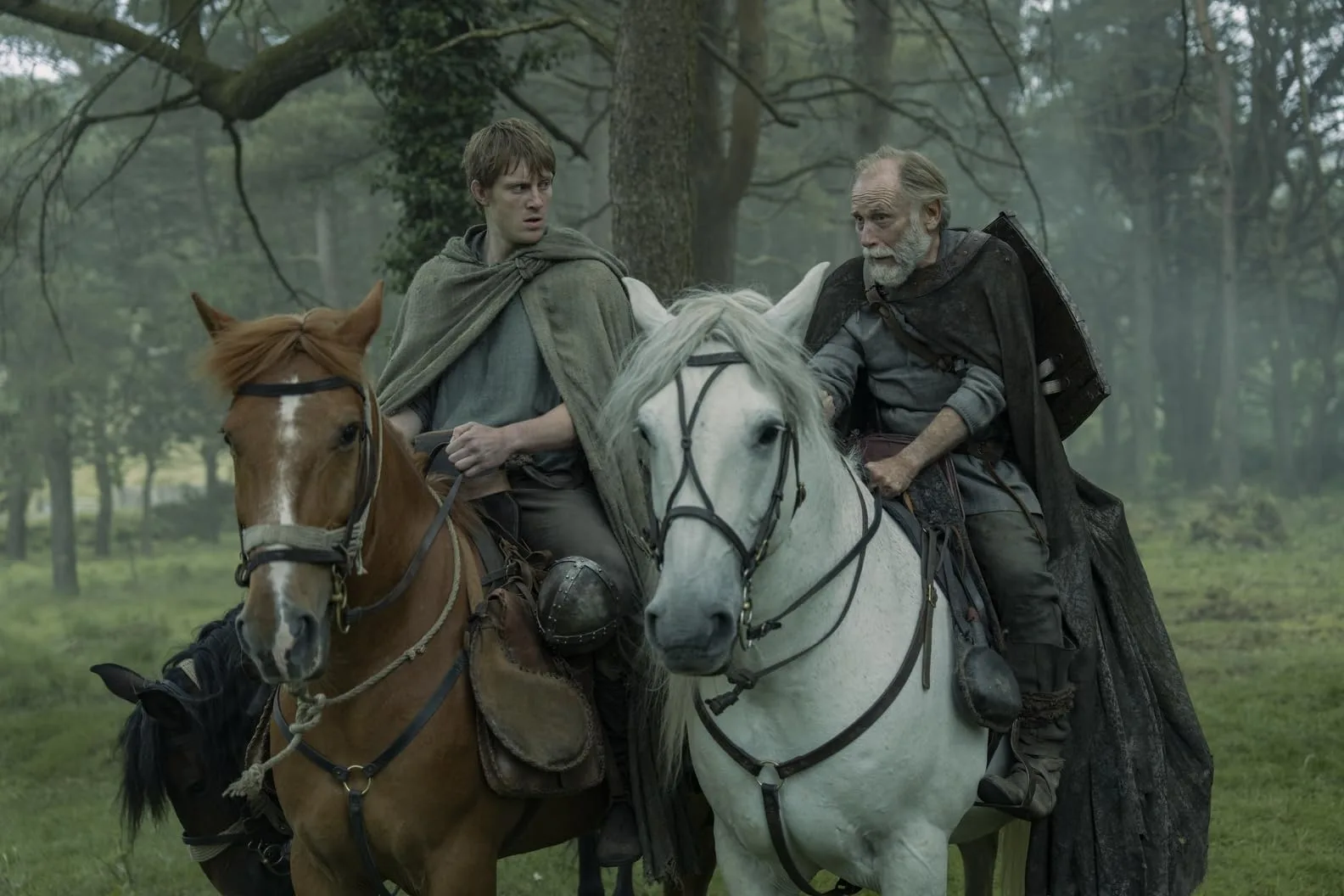

A Knight of the Seven Kingdoms returns the viewer to Westeros while stepping aside from the sprawling political manoeuvres that dominate other adaptations. The series follows Ser Duncan the Tall and his squire Egg as they travel. Set roughly a century before the better-known saga, the Seven Kingdoms sit under Targaryen rule during a rare stretch of relative peace.
The second episode, “Hard Salt Beef,” finds them at the Ashford Meadow tourney. Dunk seeks to prove his worth as a knight while carrying the memory of his mentor, Ser Arlan of Pennytree. The narrative sustains a quieter, more intimate angle, keeping the spotlight on hedge knights and the ordinary people who live at the fringes of great power.
The Arlan Mythos and Heroic Revisionism
Memory functions as a distorting lens in “Hard Salt Beef.” Dunk spends the episode building an internal monument to his dead mentor, Ser Arlan, whom he insists embodied chivalry. The opening scene undermines that hagiography in an unexpected, physical way. By lingering on a crude bodily detail, the sequence drags romantic memory down into mud. Call it myth-puncturing (a useful label for sudden deflation). Dunk eulogizes a knight who, on the evidence offered here, was an average combatant and a habitual drinker with no tournament victories to his name.
Prince Baelor notes that tales expand with telling. He recalls a bout with Arlan lasting four lances; Dunk claims it ran seven. That discrepancy exposes a common urge to locate meaning in origins. Dunk requires Arlan’s legend to justify his ambitions. He names himself Arlan’s legacy and bears that weight with more sincerity than the courtly sons who inherited rank. The episode argues that honor often arrives after the fact, assigned by survivors to soothe purpose.
Dunk occupies huge physical space; he is frequently the largest figure in every room. Technical finesse eludes him. A practice scene displays blunt, awkward power. He uses reach to compensate for a lack of trained grace. The result is persistent tension. He presents as a potential champion. He experiences profound self-doubt.
The series exploits this interior friction to question whether knighthood flows from bloodlines or from personal conduct. Dunk remains morally sound because he believes Arlan embodied virtue. The objective question of Arlan’s skill does not erase the ethical education he provided his squire.
Royal Entourages and the Friction of Class
The arrival of the Targaryen princes imposes a strict social ladder. Prince Baelor “Breakspear” registers as an oddity in a house famous for “Fire and Blood.” His darker hair (a visual nod to a Dornish mother) and temperate manners suggest a ruler with an uncommon capacity for empathy. He vouches quietly for Dunk, an act that unsettles the usual feudal rhythms. He listens to a giant commoner instead of having him dismissed. Such courtesy functions as scarce currency in a milieu where authority more often takes the form of public shaming.
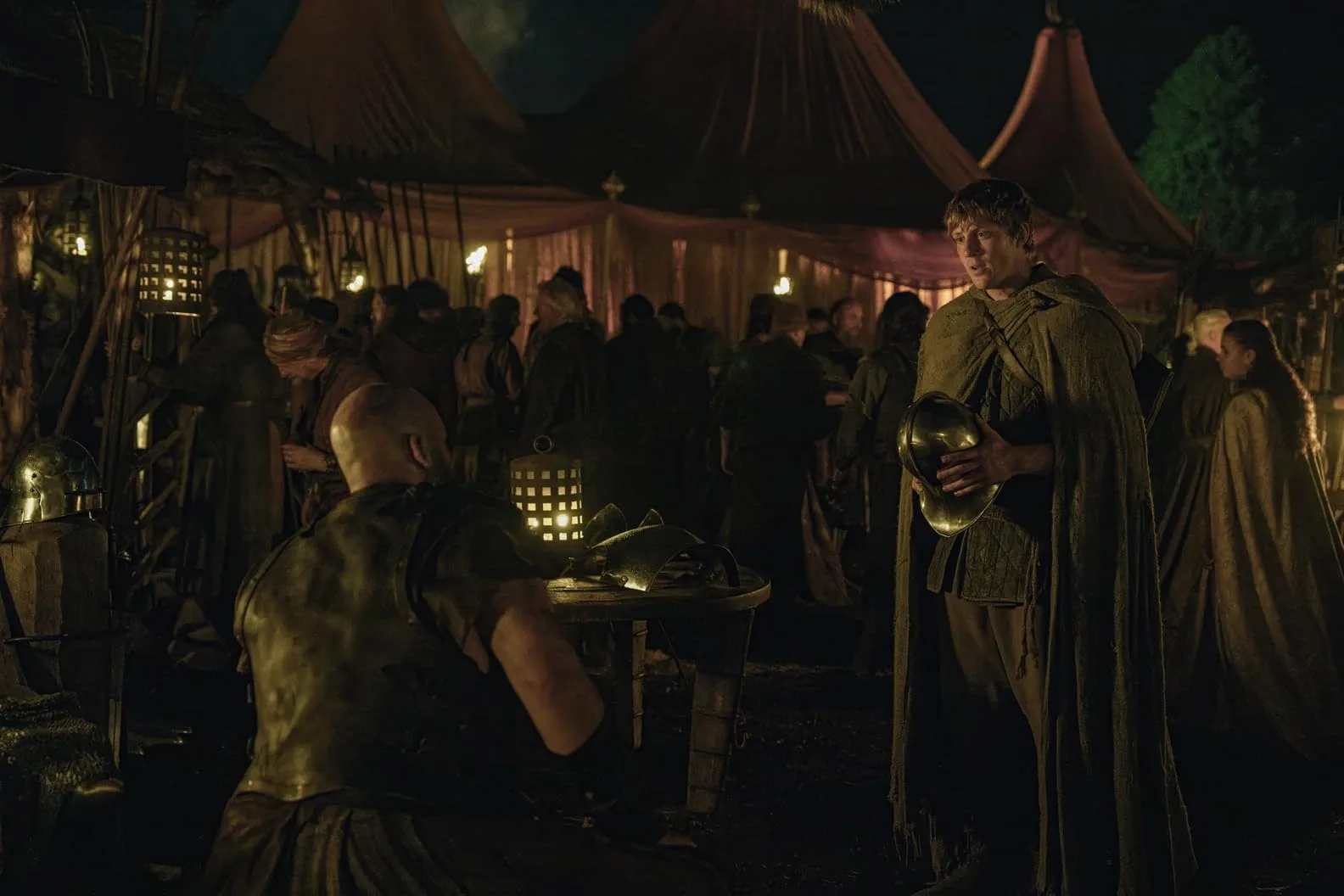
Maekar and the volatile Aerion occupy the other end of the spectrum. These brothers inhabit a Targaryen model of aloof superiority. Aerion carries a sneering entitlement that echoes the worst patterns of absolute monarchies from our histories. He treats the tournament as an earned privilege rather than an arena for proving skill. Social tension at Ashford Meadow feels tangible. The tents of lords resemble walled compounds next to the muddy encampments of hedge knights.
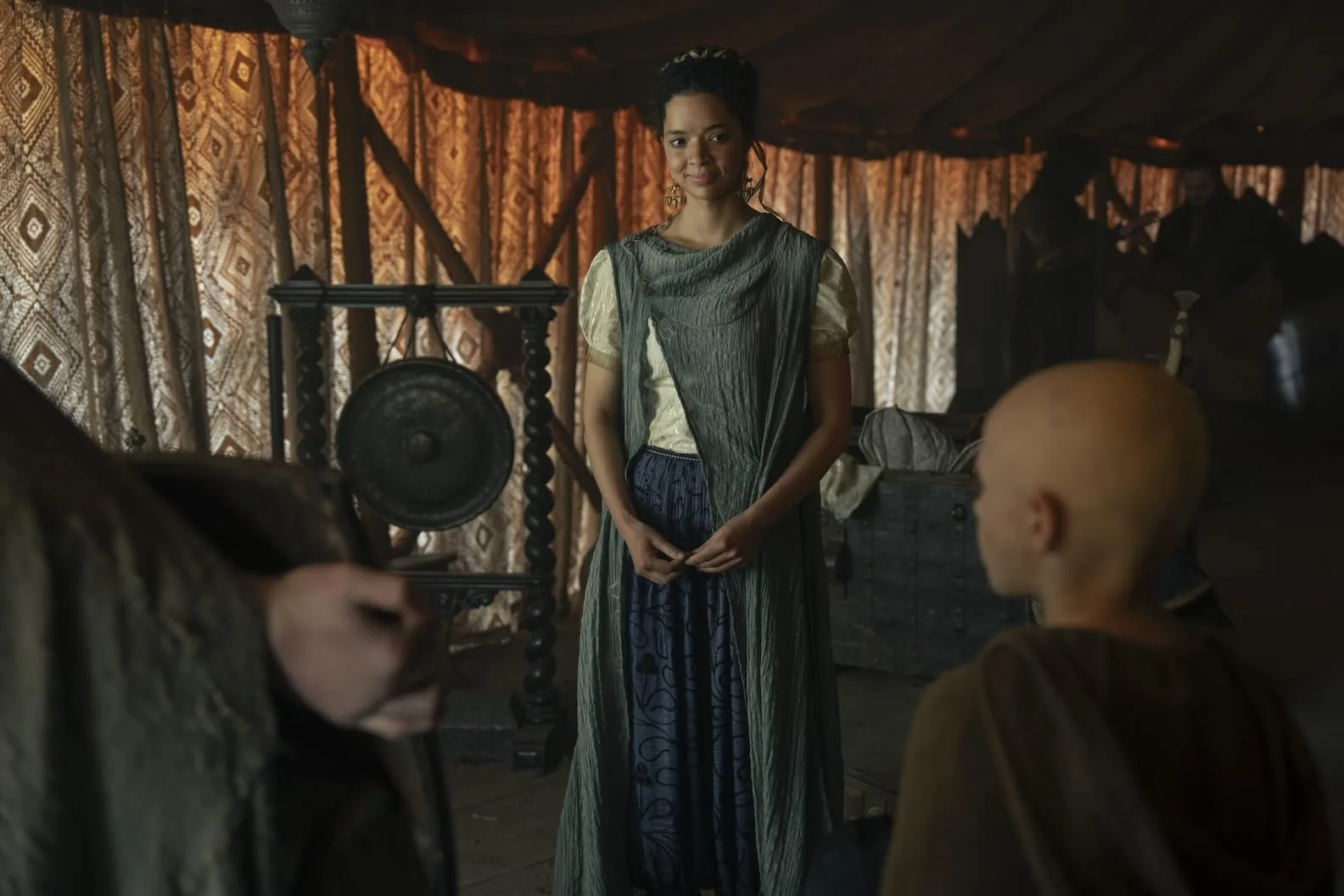
Egg serves as an intellectual bridge across these social divides. He knows heraldry and history with an uncommon depth for an orphan. His discomfort in the Targaryen camp hints at ties that run deeper than mere curiosity. In his scenes with Tanselle the puppeteer, a steadier maturity appears next to Dunk’s awkwardness. Tanselle embodies the precarious artist: someone who crafts beauty for public amusement while eking out a living. Her “Too-Tall” nickname offers Dunk a human connection that the brutality of the lists cannot supply.
The Economic Barrier to Chivalry
Knighthood demands heavy funds. Dunk’s errand to the armorer, Steely Pate, demonstrates what I will call feudal friction: systemic costs that block social mobility. A suit of armor costs hundreds of stags, an amount a hedge knight cannot amass without patrons. To enter the lists Dunk must sell his palfrey, Sweetfoot. The choice slices deeply. The farewell to the horse carries emotional weight that many on-screen deaths lack. It becomes a commerce of the heart.
The shield Dunk commissions from Tanselle functions as a small manifesto. He selects an elm tree and a falling star, emblems of a life lived outdoors and on the move. The device rejects static heraldry offered by the Great Houses. He constructs identity from dirt and craft. That self-fashioning collides with a sobering revelation: some narratives of commoner ascent are manufactured. The tale that a Kingsguard knight sprang from a crabbing family turns out to be one of merchant capital, not working-class toil.
The discovery stings. It implies that the path from hedge to high table resembles a mirage. Even with dragons in the background, wealth preserves its gates with determined zeal. Lord Lyonel Baratheon supplies a brief humanizing counterpoint. His involvement in a communal tug-of-war provides a momentary crossing of class lines. His later wandering off for a drink reminds the viewer that for many lords the tourney remains sport, not livelihood.
Visceral Lists and the Spectacle of Pain
The jousting at Ashford favors ground-level immediacy. The production declines tidy, heroic camera choreography. Instead the sequence unfolds from the vantage of the crowd. Lances shatter among spectators. Horses fall with appalling force. The result is disorder and fear. The camera dwells on bodily damage to insist that these contests amount to sanctioned violence.
Dunk’s response to the spectacle proves grave. He observes the carnage with dread and recognizes that knighthood requires bodies to break. He perceives the moral and physical cost of glory. Egg behaves differently; he cheers with the careless delight of youth. That split feels significant. Egg adores story; Dunk confronts flesh. The difference exposes the danger in spectacle’s bright appeal.
The episode runs a tight thirty-one minutes. The compact runtime channels attention toward character rather than sprawling subplots. Space opens for small human moments without becoming a classroom of lore. The score supports this focus by avoiding the grand, brassy cues of the older show. It favors intimate melodic strings that underline Dunk’s inner conflict. The Meadow’s sunlit palette paints safety that proves deceptive. A comfortable veneer covers the jagged reality in which a hedge knight’s life often reduces to the value of a single contest.
“Hard Salt Beef” premiered on HBO and Max on January 25, 2026. This sophomore outing for the Game of Thrones prequel shifts the action to the Ashford Meadow tourney, where Dunk attempts to navigate the rigid social hierarchies of the Seven Kingdoms. The episode is available to stream on Max, with new installments of the six-episode season airing every Sunday night at 10:00 p.m. ET.
Full Credits
Title: A Knight of the Seven Kingdoms: “Hard Salt Beef” (Season 1, Episode 2)
Distributor: HBO, Max
Release date: January 25, 2026
Rating: TV-MA
Running time: 31 minutes
Director: Owen Harris
Writers: Aziza Barnes, Ira Parker, George R. R. Martin
Producers and Executive Producers: George R. R. Martin, Ira Parker, Ryan_Condal, Vince Gerardis, Owen Harris, Sarah Bradshaw
Cast: Peter Claffey, Dexter Sol Ansell, Finn Bennett, Bertie Carvel, Sam Spruell, Tanzyn Crawford, Daniel Ings, Youssef Kerkour
Director of Photography (Cinematographer): Stephan Pehrsson
Editors: Yan Miles
Composer: Dan Romer
The Review
A Knight of the Seven Kingdoms Episode 2 (Hard Salt Beef)
"Hard Salt Beef" succeeds by stripping away the typical grandeur of its predecessors. It replaces sweeping wars with the quiet desperation of a man trying to buy a set of used armor. The chemistry between Claffey and Ansell carries the weight of the brief runtime. While the humor occasionally veers into the juvenile, the grounded perspective provides a necessary antidote to high-fantasy tropes. It is a focused character study that values human sincerity over political games. This episode confirms the series as a stripped down, emotionally honest addition to the Westeros canon.
PROS
- Sincere character chemistry
- Relatable economic struggle
- Effective myth deconstruction
- Evocative production design
CONS
- Extremely short runtime
- Scatological humor choices
- Narrow narrative focus