


















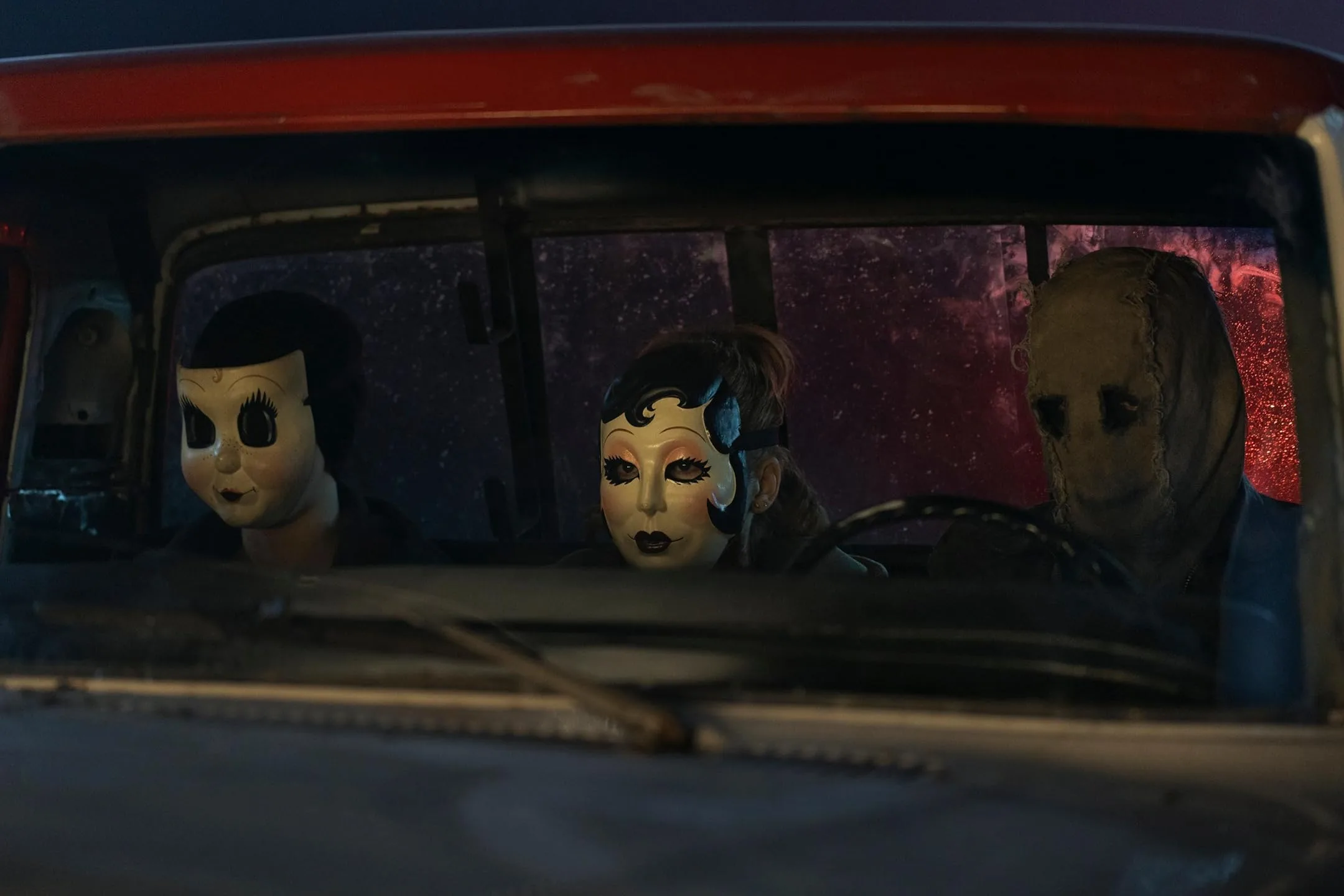

The narrative of ‘The Strangers: Chapter 3’ resumes immediately after the previous chapter. Maya wakes alone in the thick woods outside Venus, Oregon. Her boyfriend is dead. She has stopped one attacker. Two attackers remain. The forest exerts a presence. Silence presses in. Maya discovers a small church filled with candles. In that candlelight she meets Gregory. He presents himself as another survivor. The meeting alters the tenor of danger.
The masked killers leave shadow and step into light. The film follows Maya as she tries to survive a final pursuit. It introduces family members who search for her and threads that attempt to explain the history of the people behind the masks. The setting migrates from woods to an old sawmill, the declared final stage of the conflict. The hunters become prey and then hunters once more.
Geometric Deadlocks and Geographical Voids
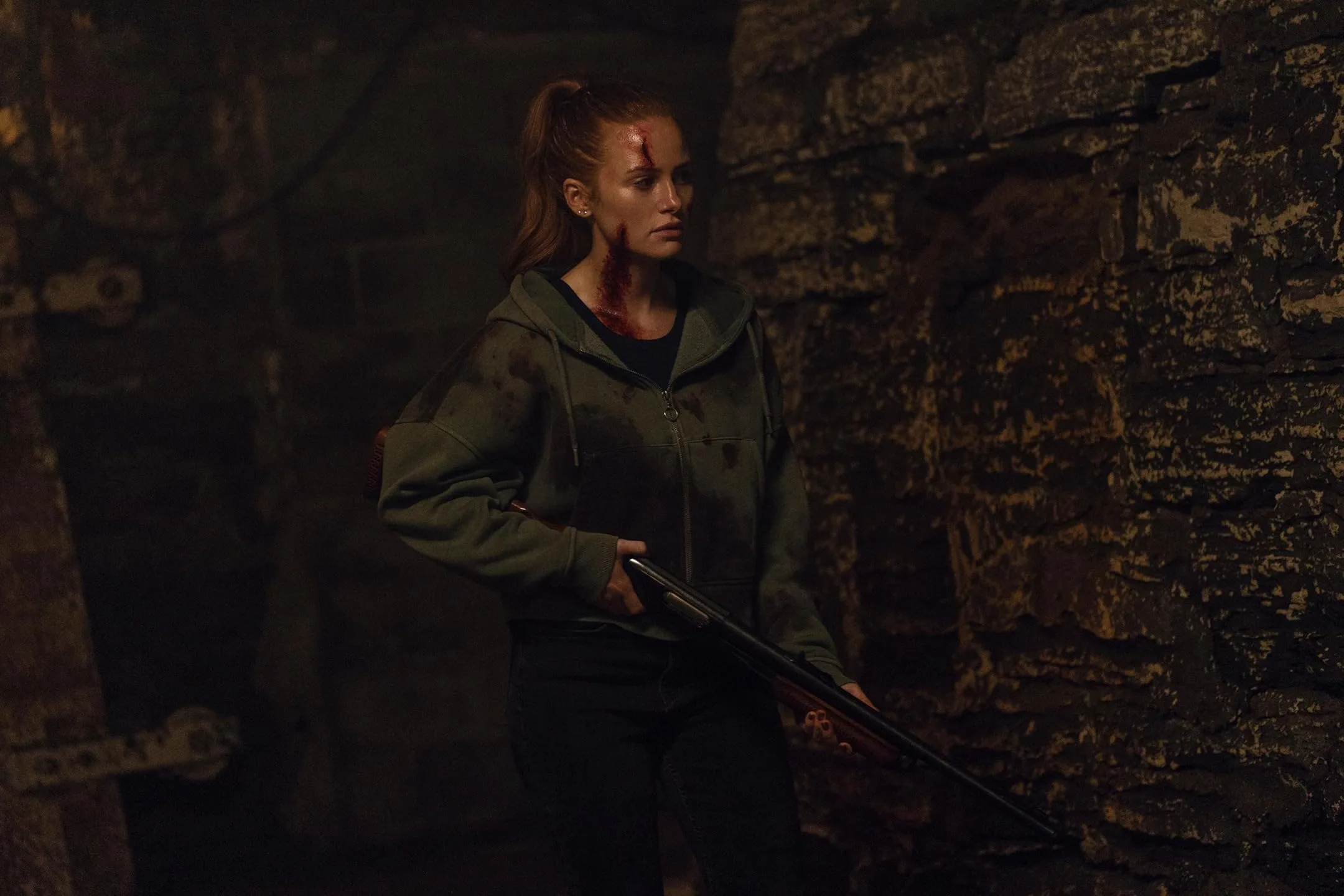
Maya’s body, in the wake of her partner’s death, reads as a study in curated suffering. Her makeup remains oddly intact (a quiet nod to waterproof cosmetics) while blood appears with the neatness of a gallery application. She hobbles through Oregon brush. Discovering the forest church creates a surreal pause. A mass of pre-lit candles functions as a makeshift sanctuary. Her opening conversation with Gregory carries taut tension. Both speak as grieving partners. They share a bottle of rye. The exchange lands like a sleepy confession, the kind of talk someone offers at three in the morning with nothing left to lose.
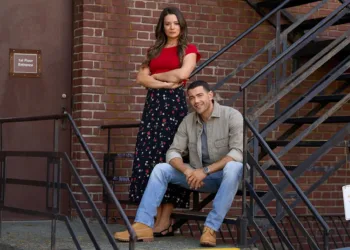
The search subplot introduces Maya’s sister, Debbie. Debbie arrives from Portland with a rescue team. The group includes a private security agent who, oddly, cannot keep a vehicle on a single road. The searchers suffer a persistent geographical confusion. They drift across fields and head toward the sawmill. The Oregon landscape takes on an erasing quality. It consumes movement. Their progress often resists logical tracking. They discover an RV on a road that leads to the lumber mill.
When the film shifts to the abandoned sawmill the environment hardens. The organic chaos of the woods yields to an enclosed, industrial topology. Maya is captured there. She recognizes the place as the killers’ base. The killers stop trying to murder her outright. They apply a sustained psychological pressure. They attempt to recruit her. Maya is proffered as a successor to the fallen Pin-Up Girl. The film frames this as a replacement project. The hunters want to rebuild their trio. Maya is presented as raw material for a new iteration of violence; she is to be remade.
Performative Trauma and Sublimated Identities
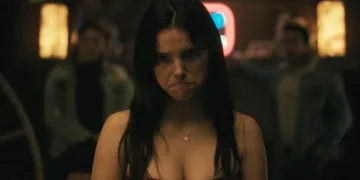
Madelaine Petsch renders Maya with an insistence on exhaustion. The role bends from a terrified victim to a numbed participant. She moves with the furtive energy of a fieldmouse trapped in a cage. In key scenes Maya wears a mask. The mask functions as a symbol of lost individuality. She becomes a blank surface. Response narrows to a single tear on a face that has seen too much.
Also Read





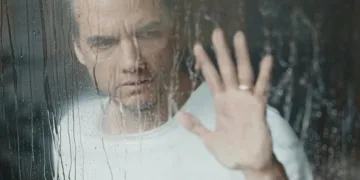
Gabriel Basso’s Gregory is revealed without the mask, which allows a different acting register. He vacillates between unhinged bursts and quiet menace. At times he is a cold-blooded hunter. At others he slouches in a basement, morose. His private room is shown in detail. The walls are scrawled with words such as “death” and “pain.” That visual shorthand for a damaged psyche feels somewhat dated. The scenes suggest a character who attempts to soothe himself with aggressive music.
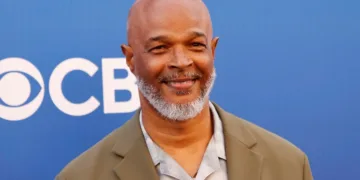
Richard Brake appears as Sheriff Rotter, a figure of local complicity. His objective aligns with protecting the town’s buried secrets. He treats outsiders as expendable sacrifices for communal calm. The name fits. The supporting cast, including Debbie and the search party, populate the margins. They slow the principal thread. They exist to be eliminated in a desultory fashion. Their deaths read like genre-checklist items and provide a recurrent distraction from the core survival arc.
The Demystification of Malevolence
Flashbacks supply a formal backstory labeled “Bio-Horror-Documentation.” The killers appear as children. Scenes depict Scarecrow and Pin-Up Girl in their youth. They share an early pattern of violence. The film stages how they met and how Dollface joined them. These sequences establish a rote genealogy. They imply that killers emerge from simple juvenile impulses toward bloodshed, a reduction the film presents bluntly.
A small-town rationale is offered as explanation. The town tolerates the killers because the victims are visitors. A past trial scene ties the Sheriff to the perpetrators. That bond produces a social compact based on exclusion. The dynamic recalls historical company towns where local law protected a local industry and its abuses. The film removes anonymity. It gives the killers names and pasts. Knowledge of motive alters the emotional charge. Where the original concept relied on random violence, the film now supplies motive and provenance so that violence acquires a resume and a pedigree.
The film opens with a dictionary definition of “serial killer.” That choice sets a tone of over-explanation. The narrative seeks psychological parallels between Maya and her attackers. It proposes that trauma can numb a person until survivor and tormentor appear indistinguishable.
The basement scene in which Maya reads the scratched walls literalizes that claim. The filmmakers try to connect her pain to Gregory’s origins. The comparison creates a problematic equivalency. Victims and perpetrators are portrayed as points on the same loop, an assertion that unsettles the ethical frame of the story.
Formalism in a State of Arrested Development
Renny Harlin directs with steady pacing. The stated 90-minute runtime stretches perceptually. The film depends heavily on extended silences. This dead air separates action beats. The jump scares feel routine. Only the prologue produces a true startle. The remainder operates at low-voltage tension.
Cinematography uses Slovakian locations as a stand-in for Oregon. Church lighting is warm. The sawmill reads as cold and blue. Those choices establish atmosphere. The score plays continuously beneath the images. The use of “Nights in White Satin” during the climax yields an almost comic jolt. A vintage rock classic surfaces at a moment of high drama and wakes the viewer from stupor.
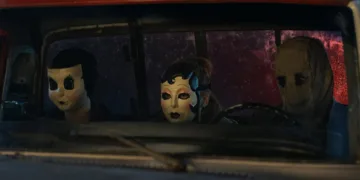
The stalk-and-slash sequences are executed with competent craft. The masks remain the film’s most effective visual icons. They generate a persistent unease. The chase logic often thins to convenience. Characters appear precisely where a scare is required. The mill’s geography bends to meet those beats. Movement through that space sometimes defies simple physics.
In the final seconds Maya makes choices that mark a substantial shift in her character. The ending’s tone is cynical. It treats the trilogy’s lingering threads with a dismissive shrug. The narrative closes quietly. Questions remain about the purpose of the expansion. Mystery recedes as motive fills the gaps. Carnage remains.
The Strangers: Chapter 3 is the final installment in the horror trilogy reboot directed by Renny Harlin. It was released theatrically in the United States on February 6, 2026. As of now, the film is available exclusively in theaters, with a streaming release on platforms likely to follow the theatrical window, typically handled by Lionsgate’s distribution partners such as Starz or PVOD services.
Full Credits
Title: The Strangers: Chapter 3
Distributor: Lionsgate
Release date: February 6, 2026
Rating: R
Running time: 91 minutes
Director: Renny Harlin
Writers: Alan R. Cohen, Alan Freedland
Producers and Executive Producers: Courtney Solomon, Mark Canton, Christopher Milburn, Gary Raskin, Alastair Burlingham, Charlie Dombek
Cast: Madelaine Petsch, Gabriel Basso, Richard Brake, Rachel Shenton, Ema Horvath, George Young, Ella Bruccoleri, Miles Yekinni
Director of Photography (Cinematographer): José David Montero
Editors: Michelle Harrison, Kate Hickey
Composer: Justin Burnett, Oscar Senen
The Review
The Strangers: Chapter 3
The Strangers: Chapter 3 attempts to finalize an ambitious trilogy by dismantling the very anonymity that made its predecessors effective. It sacrifices pure, existential dread for a "Psych-Slasher" origin story that feels both over-explained and curiously empty. While the technical polish remains, the narrative choice to turn a victim into a potential protege results in a stalemate of tension. It is a work of genre expansion that inadvertently shrinks its world.
PROS
- Atmospheric use of lighting and isolation within the forest church and sawmill settings.
- Madelaine Petsch delivers a committed performance despite the script’s repetitive demands.
- High production value and effective, traditional slasher cinematography.
CONS
- The removal of mystery through rote flashbacks lessens the impact of the villains.
- Heavy reliance on "dead air" and slow pacing that creates boredom rather than suspense.
- Illogical character decisions that serve the plot at the expense of credibility.
- A recruitment subplot that feels unearned and underdeveloped.