

























The film begins with a violent clash between two desperate lives in a quiet part of Connecticut. Franny embodies a specific kind of contemporary precarity, a young woman just fired from a care home after an informal lapse in judgment involving a resident. She is heavily pregnant, and she carries a loud, defiant charge that covers for the fact that she has no safety net. Her route crosses Billie’s during a frantic, badly conceived robbery at a local bank.
Billie is a former soldier living with the physical and psychological damage of her service, including an injury that has left her blind in one eye. One need drives her forward: stopping the auction of her family home. When the heist collapses into chaos, Billie takes Franny hostage, and they run south in a getaway vehicle.
That first burst of violence works like sandpaper, forcing two strangers into a high-pressure flight across a bleak American expanse. Directors Ruben Amar and Lola Bessis move their attention away from city spaces toward rural stretches, filming with a sense of immediacy and rough-edged vitality.
The Friction of Unlikely Allies
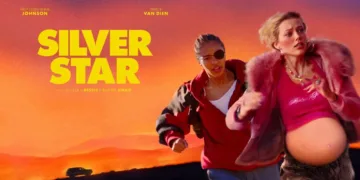
The film finds its strength in the relationship between Franny and Billie as it changes shape over time. At first, they share little beyond closeness to a crime and the cramped reality of a car. Grace Van Dien gives Franny a high-voltage presence, playing her as talkative and rebellious, a person who turns her voice into armor. Her punk-leaning styling, with rhinestones and bright colors, reads as a public insistence on identity in a world trained to overlook her. Troy Leigh-Anne Johnson plays Billie with heavy inward quiet.

Her performance leans on watchfulness and the visible weight of a past as a soldier. Their connection registers through small, consequential exchanges rather than big declarations. Van Dien’s micro-expressions and constant motion hint at fear underneath the noise. Johnson uses pauses and controlled glances to present a woman exhausted by struggle and still locked into it.
Also Read





Their link shifts from the cold terror of a kidnapping into a sincere, messy partnership. It lands because the script gives them air inside the car, allowing the tension to stretch and settle. They clash often, settling into a “frenemy” rhythm that generates real humor under pressure. Franny’s nonstop talking keeps pressing against Billie’s guarded exterior until cracks show, and the film finds moments where they share vulnerability without making a spectacle of it.
A rare kind of relief appears between them as they recognize a shared experience of being discarded by the systems they served or depended on. That partnership supplies the emotional gravity, shaping their run as a search for somewhere they will not be treated like problems awaiting correction. Their exchanges carry an unspoken understanding of what life looks like at the edge of a society with little space for their particular damage.
A Sensory Study of Anarchy
The film’s visual approach mirrors the internal disorder of its protagonists. Cinematographer Cole Graham shoots with handheld restlessness that feels anxious and immediate. The effect is constant motion, like the audience is stuck in the backseat with them.
The shaky camera language is used with intent, tightening intimacy inside the vehicle and making tension feel physical. Color becomes another signature. Saturated reds and neon tones line up with Franny’s Y2K look, while the rural backgrounds read as drab and worn. One of the most striking images shows their faces in the reflection of a broken mirror, a blunt piece of symbolism that points to fragmented lives and accumulated damage.
Amar and Bessis often choose intense close-ups that deny distance from the leads’ raw emotion. The tight framing tracks anxiety and the way trust shifts between Franny and Billie from moment to moment. When the camera steps back, wide overhead shots stress the scale of the country around them. The car becomes a small, exposed vessel surrounded by an indifferent stretch of land.
The film avoids the slick finish associated with many contemporary features, choosing raw, lo-fi force suited to a story about people living outside the law. That choice feeds a sense of modern anarchy, where polish gets traded for the feeling of catching something unstable in real time. The images carry unpredictability, reinforcing the sense that their future wobbles with the same uncertainty as the camera.
Echoes of History and Social Margins
The story operates like a modern western, stripping the frontier myth down to class pressure and identity strain. Economic hardship drives the plot through Billie’s crushing debt and Franny’s empty cupboard of options. Billie’s military history carries a charged subtext, set against the neglect faced by her family. Her father, a decorated lieutenant and Silver Star recipient, has a legacy that cannot keep the home from going to auction.
That bitter gap sits near the film’s thematic center, showing how the country fails people it claims to honor. A Civil War reenactment scene brings historical commentary into view. With Billie inside staged battles, the film draws a line between America’s violent past and the systemic breakdowns of the present, suggesting that conflicts over land, honor, and survival keep repeating in altered forms.
Franny and Billie are framed as people pushed to the margins, rejected by a world that prizes stability and compliance. Their shared outsider status becomes the adhesive holding them together. The film also traces a quiet queer connection between them, adding tenderness to a survival-driven trip. The approach stays understated, letting the bond feel discovered rather than engineered. A horse and a getaway truck serve as key modes of transport, signaling a link between a mythic American past and today’s grit.
These women hunt for a version of freedom that the modern world keeps refusing them. Their flight becomes a defiant gesture against a society that has already written them off. By the time they reach the southern stretches of the drive, the film has sharpened its critique of the American dream, presenting it as a fading promise for people trapped in cycles of poverty and trauma.
Silver Star is an independent road drama that follows the collision of two lives on the fringes of society. Having premiered at several international film festivals including Deauville and Glasgow, the film was released theatrically in France on November 26, 2025. For audiences in the United States, the film is set for a limited theatrical debut on March 6, 2026, via Indican Pictures. Currently, the film can be seen in French cinemas, with the domestic U.S. release appearing in select theaters in approximately two weeks.
Where to Watch Silver Star (2024) Online







Full Credits
Title: Silver Star
Distributor: Indican Pictures, Wayna Pitch
Release date: November 26, 2025 (France), March 6, 2026 (United States)
Rating: 18
Running time: 102 minutes
Director: Ruben Amar, Lola Bessis
Writers: Ruben Amar, Lola Bessis
Producers and Executive Producers: Ruben Amar, Lola Bessis, Philippe Imhaus, Simon Lefort, Jamin O’Brien, Virginie Lacombe, David Solal, Valerie Steinberg, Amy Gilliam, Giorgia Lo Savio, Eric Mathis, Keanu Mayo
Cast: Grace Van Dien, Troy Leigh-Anne Johnson, Johnath Davis, Tamara Fruits, Getchie Argetsinger, Ekaterina Baker, Joey Giambattista, Josh Silverman, Amy Tribbey, Noa Fisher, Odley Jean
Director of Photography (Cinematographer): Cole Graham
Editors: Rafael Torres Calderón
Composer: Polérik Rouvière
The Review
Silver Star
Silver Star is a gritty, sensory expedition that reimagines the American road movie through the lens of those the system has discarded. The raw chemistry between Grace Van Dien and Troy Leigh-Anne Johnson anchors the narrative, turning a chaotic kidnapping into a sincere study of mutual precarity. While the restless camera work and fragmented pacing may frustrate some, the film succeeds as a vibrant, lo-fi critique of the American dream. It is a messy, neon-soaked western for the modern age that prioritizes atmosphere and authentic connection over polished plot resolution.
PROS
- Magnetic and contrasting lead performances.
- Bold, saturated visual style and Y2K aesthetic.
- Authentic, understated queer character development.
- Strong thematic exploration of class and military legacy.
CONS
- Shaky camera work can feel erratic or distracting.
- Certain plot developments feel slightly clichéd.
- Character depth is sometimes sacrificed for style.