








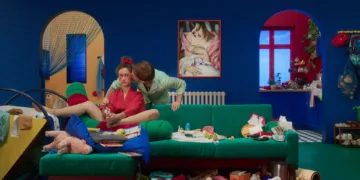




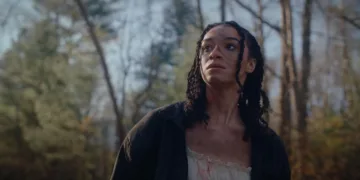

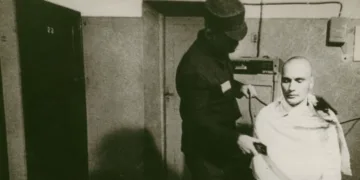










Memory carries a cold, bone-white gravity in Judith Godrèche’s cinematic adaptation of A Girl’s Story, drawn from the autobiographical prose of Nobel Laureate Annie Ernaux. The film places us in provincial France in 1958, where seventeen-year-old Annie, played by Tess Barthélémy, leaves her small, severe Catholic town.
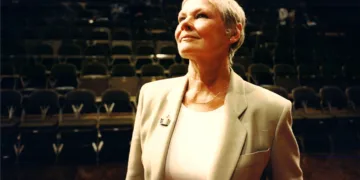
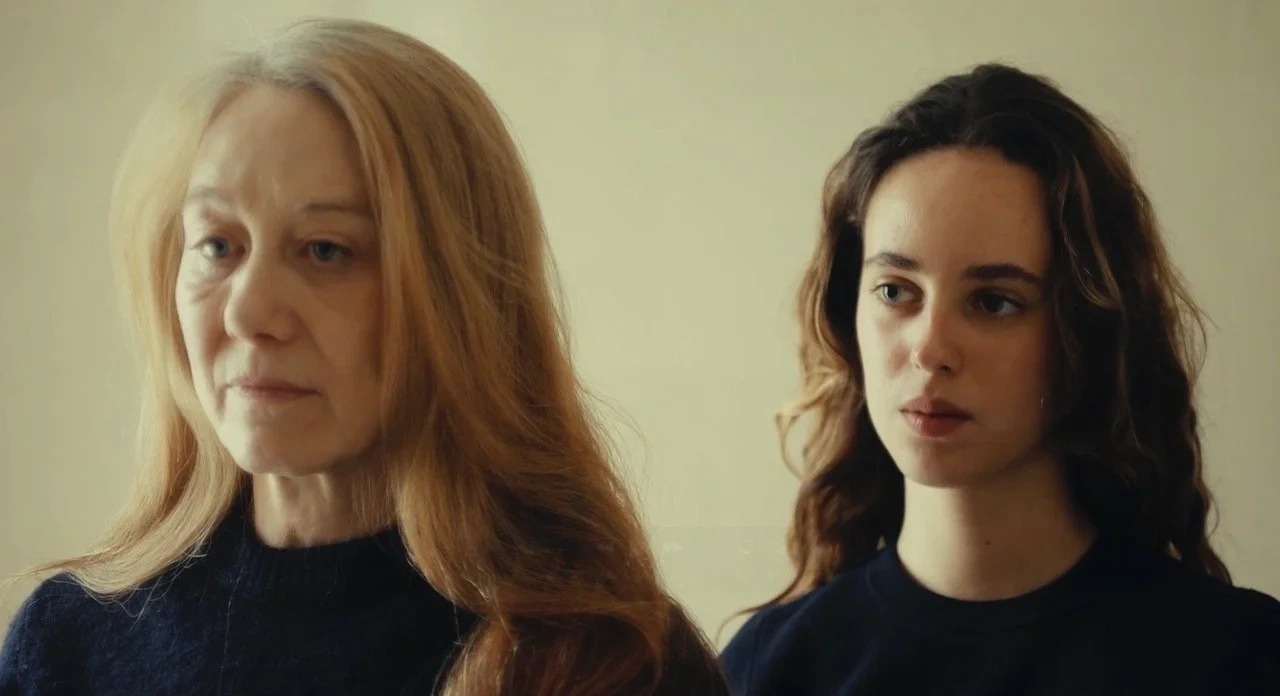
She wants autonomy, companionship, and escape through work as a summer camp counselor for underweight children. The pastoral setting becomes a chamber of existential injury. Decades later, the older author, played by Valérie Dréville, stands at a lectern and reads these recollections aloud. Her voice draws the buried past into the present, giving the film its spectral retrospective form.
Somatic Detachment and the Cartesian Split
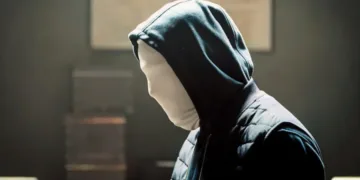
Barthélémy gives Annie a frail, birdlike presence, tracking each inward fracture as the bookish girl becomes a wounded teenager. The force that breaks this fragile order is H, the athletic and coldly arrogant head counselor played by Victor Bonnel. Their first intimate encounter carries blunt, wordless aggression.
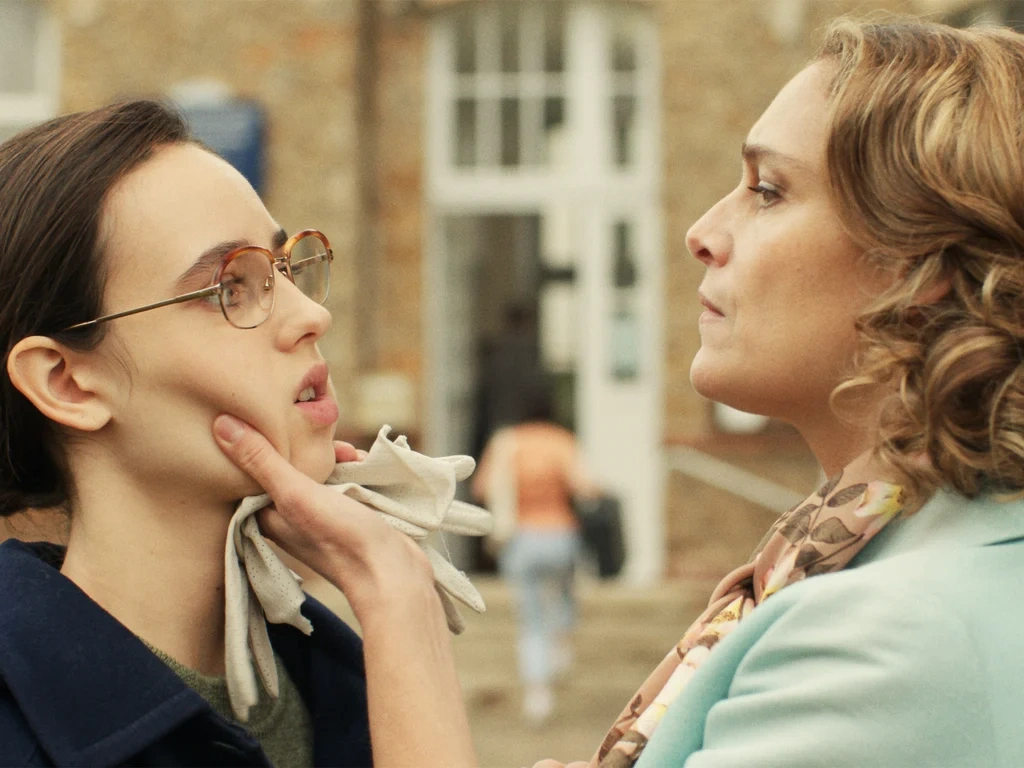
It leaves Annie with physical pain and shattering disillusionment, far from the ecstasy she expected. Her response is retreat. Annie enters an inner exile, building denial into a form of psychic armor. She recasts the encounter through romantic fiction, deceiving herself so she can preserve some frail command over a world already slipping from her grasp.
The camp’s social order deepens the damage. The other counselors turn her repressed background into a weapon. They mock her modesty, then cast her into an icy social isolation. Claudine, played by Maïwène Barthélémy, remains fiercely loyal and gives Annie a small refuge from the surrounding cruelty.
The film’s most disturbing psychological insight arrives through Annie’s absolute detachment from her body. As her physical self becomes the site of violation and shame, her conscious mind separates from flesh. She drifts like a ghost inside her own form, caught in a Cartesian wound where intellect survives by refusing to recognize the self’s violent diminishment.
The Geometry of the Lens: Lightbulbs and Wide Landscapes
The film’s visual design turns Annie’s dissociation into a severe grammar of images. Cinematographer Joachim Philippe keeps the camera close to her face, using tight close-ups that trap her isolation within the frame. During the central violation, the gaze fixes on a buzzing bare lightbulb hanging above her, seen from her prone upward view. The image has a terrible purity. It reduces the room to exposure, objectification, and the cruel indifference of light.
As the story progresses, the visual field changes. The dizzy, claustrophobic framing of the earlier passages gives way to wide shots of the French countryside, open and pastoral. The shift mirrors Annie’s growing agency through space itself. The film’s rhythm changes too. After the initial assault, the editing turns sharp, sudden, and aggressive. These cuts echo the frantic drive of the rock ’n’ roll records the young people consume, converting sonic rebellion into the fractured beat of shock.
This formal precision lives inside a deliberately fluid sense of time. Elisa Ingrassia’s costumes and Damien Rondeau’s minimalist production design resist suffocating period exactness. Their work favors atmosphere and texture over rigid historical display. The result is a suspended space where mid-century pain feels immediate, as if the past has refused to remain safely buried.
Subjectivity Opposed: The Fractured Epilogue
Godrèche’s strongest formal gesture arrives in a silent auditorium encounter, where the elderly author locks eyes with the ghost of her teenage self. The scene becomes a temporal instrument. Writing appears as a vessel for self-compassion, a way for an older consciousness to approach the wounded girl she once was and offer some form of reconciliation.
The film’s central philosophical question gathers force here: how can a person preserve subjectivity when sexual cruelty and social expectation reduce the body to an object? Questions of ownership, memory, and bodily autonomy hang over the historical scenes with grave persistence.
The film’s clarity weakens when secondary figures disappear too soon. The camp nurse, played by Guslagie Malanda, and a marginalized coworker enter as possible intellectual anchors. Both vanish before they can meaningfully alter Annie’s isolation. This instability grows sharper in the 2016 epilogue. Perhaps a clean bridge between these eras cannot exist.
I remain unsure if this friction is a chosen thematic rupture or a structural fault. The final section replaces the haunting orchestral score with sugary modern needle drops and turns toward direct modern political commentary. Those moments feel engineered. The shift disturbs the film’s delicate text, trading the quiet devastation of the historical timeline for an explicit message with less of the poetic uncertainty that gives the earlier passages their power.
A Girl’s Story premiered in May 2026 at the 79th Cannes Film Festival within the Un Certain Regard section. Audiences can look for the film in theaters following its festival run, with Jour2Fête managing its initial distribution across France and Paradise City Sales handling international rights. The feature serves as a cinematic adaptation of the autobiographical book written by Nobel Laureate Annie Ernaux.
Full Credits
Title: A Girl’s Story
Distributor: Jour2Fête, Paradise City Sales
Release date: May 2026
Running time: 117 minutes
Director: Judith Godrèche
Writers: Judith Godrèche, Annie Ernaux
Producers and Executive Producers: Carole Lambert, Marc Missonnier
Cast: Tess Barthélémy, Valérie Dréville, Victor Bonnel, Maïwène Barthélémy, Ariane Labed, Guslagie Malanda, Sophie-Marie Larrouy
Director of Photography (Cinematographer): Joachim Philippe
Editors: Guillaume Lauras
Composer: FAUX AMIS
The Review
A Girl’s Story
Judith Godrèche constructs a devastating, formally rigorous investigation into memory and the fracture of youth. The cinematic translation of Annie Ernaux’s prose honors the quiet terror of somatic exile, grounding a historical trauma in timeless psychological truth. While the modern epilogue stumbles into overt messaging, the structural gaze remains unflinching. It remains a piercing look at the erasure of the self.
PROS
- Tess Barthélémy delivers a fragile, profoundly striking performance.
- Joachim Philippe uses tight, claustrophobic framing that emphasizes isolation.
- The visual metaphor of the dangling lightbulb captures objectification with stark precision.
- The fluid temporal atmosphere avoids rigid historical stagnation.
CONS
- The 2016 epilogue feels engineered, breaking the poetic rhythm with modern music and explicit messaging.
- Secondary characters vanish before enriching the central thematic arc.