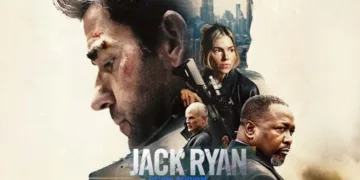











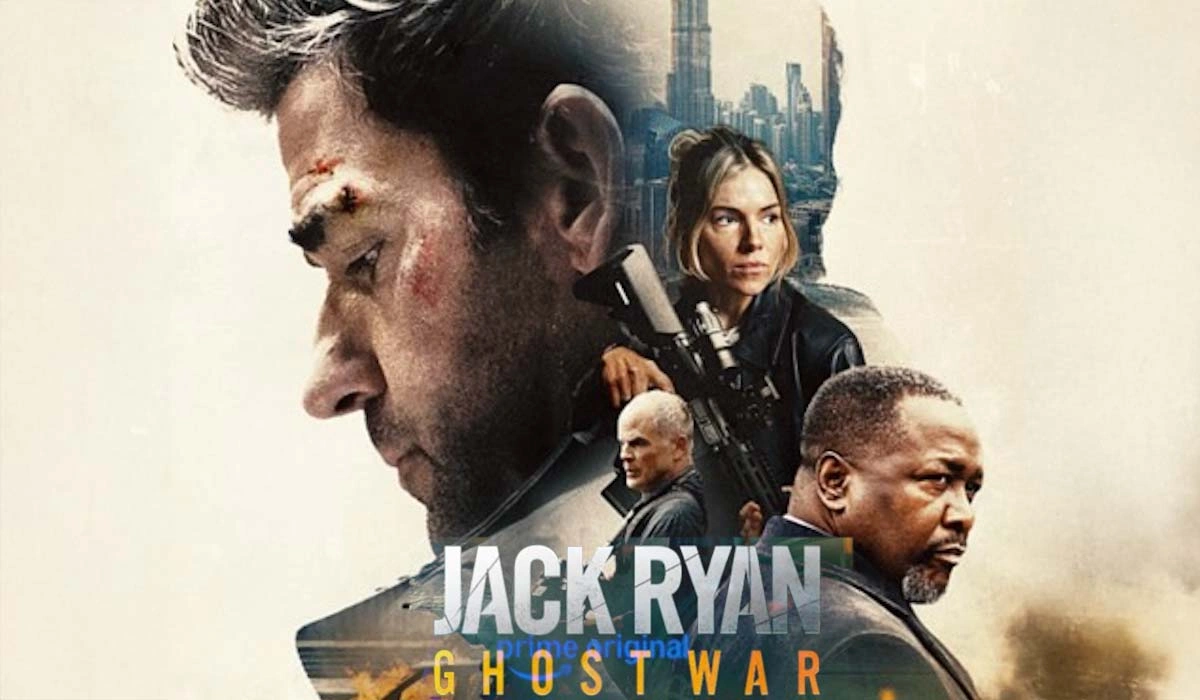
Tom Clancy’s Jack Ryan: Ghost War marks John Krasinski’s transition from the small screen to a feature-length format on Prime Video. Directed by Andrew Bernstein, the political thriller finds the titular analyst living a quiet civilian life in New York, employed at a financial risk-management firm.
This peace proves short-lived when CIA Deputy Director James Greer, portrayed by Wendell Pierce, recruits Ryan for an apparently simple intelligence pickup in Dubai. Rejoining his long-term colleague Mike November, played by Michael Kelly, Ryan enters a dangerous international web. The assignment collapses immediately when their primary contact is assassinated.
Ryan then links up with MI6 officer Emma Marlowe, played by Sienna Miller, to uncover a rogue black-ops organization known as Starling. Led by Liam Crown, a rogue operative trained by Greer during the War on Terror, this faction threatens global security. The narrative tracks their tactical maneuvers across the United States, the United Kingdom, and the United Arab Emirates as they attempt to dismantle an unsanctioned network.
Script Evaluation, Pace, and Structural Mechanics
Modern television has established a comfortable home for espionage storytelling, allowing multiple episodes to dissect geopolitical machinery at length. Condensing this expansive universe into a rigid 105-minute feature window introduces severe structural compression.
The screenplay, written by John Krasinski and Aaron Rabin from a story by Noah Oppenheim, forces a procedural property into a rapid pacing acceleration. This shift compromises the meticulous tactical surveillance and organizational methodology that defined the original streaming production. Speed replaces substance. The production discards granular intelligence gathering in favor of sustaining immediate narrative momentum.
This accelerated timeline reshapes the structural projection of the plot. By the end of the second act, the primary antagonistic scheme stands fully revealed. This early disclosure flattens the narrative, eliminating the potential for third-act complications or sophisticated structural swerves. The story marches toward a predetermined resolution without deviation.
This mechanical simplicity undermines the underlying thematic framework. The film touches on heavy concepts: institutional accountability, unilateral military execution, and historical blowback from early twenty-first-century operations. These ideas deserve rigorous examination.
The script uses dialogue-heavy scenes between Ryan and Greer to state these dilemmas plainly, substituting heavy exposition for true dramatic tension. Their debates on bureaucratic secrecy and ethical boundaries remain verbalized ideas, never integrated plot drivers.
The script frequently leans on familiar genre tropes, missing a prime opportunity to examine actual intelligence agency structures. The text treats institutional overreach through basic dialogue loops about walking away from darkness or entering the light. This reliance on binary motifs dilutes what could have been a sharp perspective on international relations.
Oppenheim’s previous dramatic work demonstrated a capacity for sharp political observation, yet this screenplay finds itself caught between two styles. It wants to maintain the intellectual reputation of the source material while serving the demands of a brief action vehicle. The final product settles for the comfort of a standard chase, leaving the challenging realities of modern statecraft unexplored.
Formal Analysis: Visual Identity, Aesthetics, and Action Choreography
Director Andrew Bernstein brings extensive television experience to this feature production, a background that heavily shapes the film’s visual grammar. The framing choices emphasize functional, clear setups designed for efficiency. This approach maintains strict aesthetic continuity with the television series, but it leaves the film without a distinctive cinematic personality.

The visual language during transition sequences relies on standard coverage, missing the slow-burn visual tension that masters of the political thriller genre traditionally construct through shadows and depth of field. The global locales receive polished treatment, with the production capturing the modern architecture of Dubai and the historic streets of London through crisp, clean wide-angle photography. These backgrounds display the visual polish of high-end travel advertising, stripped of any texture suggesting that dangerous espionage actually occurs in these spaces.
The lack of visual experimentation shows clearly during daytime exterior scenes, where the lighting remains bright and even, minimizing contrast. Classic espionage films use architecture to trap characters visually, creating an atmosphere of paranoia.
Bernstein avoids these stylistic risks, preferring centered framing and predictable eye-line matches that keep the audience entirely oriented. This choice prioritizes clarity over style, resulting in an experience that feels perfectly safe for a home viewing screen but fails to fill a theater canvas.
The action spatial design relies heavily on familiar tactical shootout patterns. When characters engage in combat within high-rise buildings featuring floor-to-ceiling glass windows, the sequence trades visceral stunt choreography for clean digital editing.
The shattering glass looks spectacular but carries minimal physical weight. The camera maintains a safe distance, tracking tactical movements with procedural correctness but filtering out the chaotic danger of a live firefight. This sterile execution extends to the street chase sequences across London. The camera placement captures vehicular momentum accurately, yet it lacks the gritty, immediate realism that defines memorable cinematic pursuits.
The auditory presentation mirrors this focus on standard execution. The acoustic environment balances crisp tactical gunfire with ambient background textures, ensuring every mechanical click sounds defined. The musical score, composed by Ramin Djawadi and William Marriott, takes a direct approach to scene punctuation.
The orchestration deploys loud, overt cues to signal danger, overriding the quiet spaces that might otherwise cultivate localized tension naturally. This dominant musical tracking forces specific emotional beats upon the viewer, overriding the natural rhythm of the performances. The film would benefit from a quieter soundscape, allowing the inherent danger of the situations to build through silence.
Character Dynamics, Performance Assessment, and Mechanical Synergy
John Krasinski delivers a dependable performance, maintaining his established interpretation of the title character. He brings his signature intelligence to the role, portraying Ryan as an analytical thinker forced back into active service. He struggles to maintain this grounded persona when the script demands standard action hero behavior.
The text pushes him toward gun battles, sidelining the intellectual breakthroughs that define the character, and creates a slight disconnect between his core identity and his physical actions. Wendell Pierce provides substantial weight as James Greer. His scenes capture the heavy burden of past tactical decisions, presenting a veteran agent facing the moral consequences of early twenty-first-century warfare. The friction between Ryan’s idealism and Greer’s pragmatic compromises forms the strongest dramatic material in the production.
Michael Kelly provides welcome energy as Mike November, utilizing precise timing to inject personality into a traditional corporate mercenary template. He handles formulaic dialogue efficiently, grounding his character’s loyalty in simple professionalism.
Sienna Miller approaches the role of Emma Marlowe with commendable restraint. She establishes a quiet skepticism and internal discipline, sidestepping the standard mysterious-ally approach entirely. Her performance hints at a psychological reality the screenplay itself fails to explore fully.
The project stumbles with its new antagonist, Liam Crown. Max Beesley plays the rogue soldier cleanly, but the script treats him as a simple vehicle for exposition. He delivers conventional speeches about global order, lacking the terrifying presence required to challenge Ryan on a personal level.
This flat antagonist design robs the climax of true peril, leaving the hero to face endless waves of faceless henchmen. Other supporting actors face similar structural limits. Betty Gabriel, portraying Elizabeth Wright, finds herself sidelined quickly, her character reduced to brief administrative check-ins.
This character treatment creates an emotional disconnect across the entire ensemble. By completely omitting Ryan’s domestic existence and his relationship with Cathy, the narrative sheds any sense of personal stakes. The characters function as operational pieces on a tactical board, stripped of the complexity that would make them feel like actual individuals.
The absence of brutal hand-to-hand combat elements further distances the audience from the physical reality of the situation. Without intimate stakes or a menacing foe, the performance chemistry operates in an emotional vacuum, turning what should be a gripping character study into a routine bureaucratic exercise.
The actors try to compensate through subtle physical choices. Krasinski uses tired posture and hesitant glances to convey Ryan’s reluctance, while Pierce relies on a heavy vocal cadence to suggest a lifetime of carrying state secrets. These small details show a cast working hard against the limitations of a thin text, attempting to construct a mature drama even when the surrounding framework treats them as cardboard pieces in an ordinary chase.
Tom Clancy’s Jack Ryan: Ghost War arrives as a highly anticipated streaming feature film on May 20, 2026. Viewers can watch the production globally on Amazon Prime Video upon its upcoming debut. The project acts as a direct narrative extension of the television series that previously concluded its multi-season run, gathering the main tactical espionage unit together for a brand new international assignment.
Where to Watch Tom Clancy’s Jack Ryan: Ghost War (2026) Online








Full Credits
Title: Tom Clancy’s Jack Ryan: Ghost War
Distributor: Amazon MGM Studios
Release date: May 20, 2026
Rating: R
Running time: 105 minutes
Director: Andrew Bernstein
Writers: Aaron Rabin, John Krasinski, Noah Oppenheim
Producers and Executive Producers: John Krasinski, Allyson Seeger, Andrew Form, Carlton Cuse, Graham Roland, John J. Kelly, Alexa Ginsburg
Cast: John Krasinski, Wendell Pierce, Michael Kelly, Sienna Miller, Betty Gabriel, Max Beesley, Douglas Hodge, JJ Feild, Mckenna Bridger
Director of Photography (Cinematographer): Arnau Valls Colomer
Editors: Jason Ballantine
Composer: Ramin Djawadi, William Marriott
The Review
Tom Clancy’s Jack Ryan: Ghost War
Tom Clancy’s Jack Ryan: Ghost War functions as a competent extension of its streaming predecessor, failing to justify its leap to the feature format. The condensed runtime sacrifices procedural complexity for rapid pacing, flattening the narrative tension by the second act. While John Krasinski and Wendell Pierce offer dependable performances, the formulaic script and safe directorial choices result in a standard chase thriller that lacks a distinct cinematic identity. It satisfies basic genre expectations without establishing a lasting impact.
PROS
- Dependable leading performances from John Krasinski and Wendell Pierce that maintain strong character continuity.
- Polished wide-angle cinematography that captures the international architecture of Dubai and London with crisp clarity.
- Swift narrative momentum that keeps the 105-minute runtime moving efficiently without unnecessary padding.
CONS
- Severe compression of procedural details and tactical surveillance mechanics during the transition to a shorter film format.
- A highly predictable plot structure that reveals the primary antagonistic scheme too early, eliminating late-stage tension.
- A weak antagonist who lacks physical or psychological menace, serving instead as a vehicle for basic exposition.
- An overbearing musical score that forces emotional beats rather than letting suspense build naturally through silence.