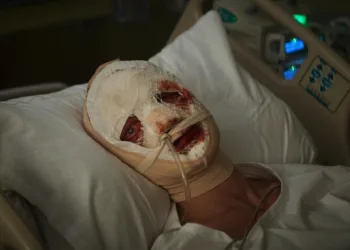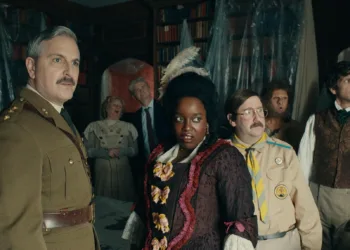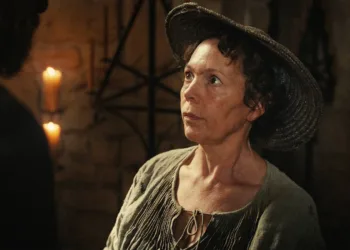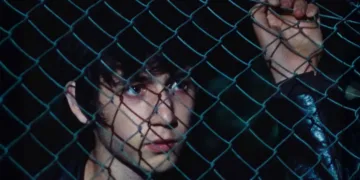













The provincial hush of Lisieux, Normandy, gives Goodbye Cruel World its severe, deceptively placid frame. Félix de Givry’s feature directorial debut, co-written with Marie-Stéphane Imbert, stages adolescent despair as a morbid act of authorship.
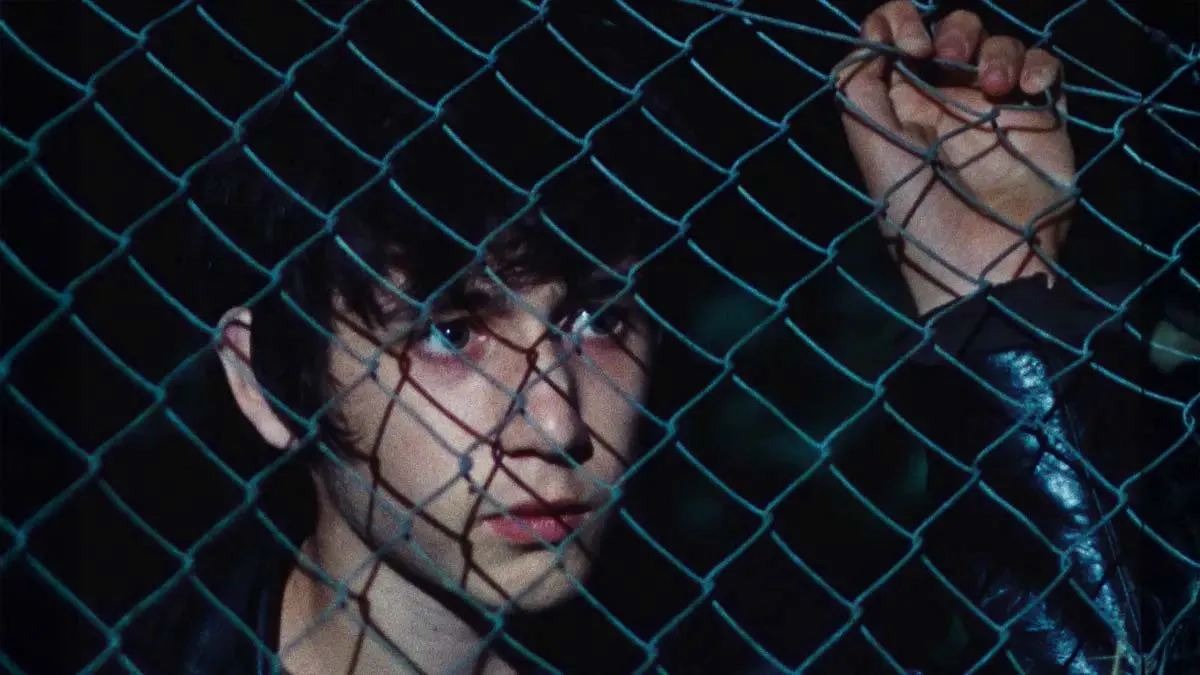
Otto, a fourteen-year-old played by Milo Machado-Graner, suffers severe bullying at his Catholic middle school, then mails exacting farewell letters to his classmates, naming his tormentors as murderers with the bluntness of a legal document drafted by a wounded child. He leaps from a high bridge into a local river. He survives the plunge, and then makes a stranger choice: he allows the world to treat him as dead.
From the hidden corners of his small hometown, Otto observes the police investigation and the local media circus that follow his supposed death. De Givry avoids the machinery of a standard missing-person procedural. His film moves with the logic of a grim fable, a somber adolescent fairytale shaped by dark romanticism and a clear distrust of forensic tidiness. The result is a sharp, melancholy entry in the cinema of teenage malaise.
The Geometry of the Living Ghost
Otto’s decision to preserve the fiction of his death gives the film its philosophical charge. The story shifts from isolation into radical self-reconfiguration. Otto becomes a living ghost, granted the rare and terrifying chance to study his social legacy while still breathing. Free will curdles into performance art. Identity becomes a disguise with legal paperwork trailing behind it.
This spectral vantage produces the film’s most acidic commentary on public performance. Otto watches television broadcasts in which the classmates who made his daily life unbearable now offer polished regret. Their remorse arrives neatly packaged, camera-ready, emotionally laminated.
The camera stays close to Otto as he absorbs this revision, letting the distance between lived trauma and public consolation widen in silence. No speech could improve the accusation. Teenagers, it turns out, can manage image control with the efficiency of minor politicians.
The geometry changes after Otto meets Léna, played by Jane Beever. She is a younger student who catches him scavenging for food, then hides him in a dusty, vacant annex of the hotel run by her mother. Her perspective enters the film gradually, and her role shifts from caretaker to accomplice in a planned cross-country flight. She steadies Otto without softening the danger around him. Their connection gives the film a shared, quietly defiant romanticism, one built from secrecy, hunger, and the desperate hope that elsewhere might exist.
The final act weakens that shape. The escape loses velocity, and De Givry inserts a sudden subplot that fractures the established rhythm. The detour feels loosely attached to the main arc before the film regains its balance. A ghost story can survive a wrong turn. This one does, though the floorboards creak.
Chiaroscuro of the Schoolyard
Tara-Jay Bangalter shoots the film on 16mm, giving its unreal premise a tactile grain and a bruised physical texture. The image feels handled, weathered, almost found. Early scenes use muted, desaturated tones that press against Otto’s despair with clinical chill. As Otto and Léna plan their escape, the palette warms and intensifies, turning color into a record of agency. The shift is expressive rather than decorative, a psychological barometer written in light.
The lighting design draws openly from noir tradition. Expressionistic framing and sharp divisions between darkness and illumination give Otto’s hiding places a moral pressure. In one bedroom sequence, moonlight cuts the image in half like a blade. In another, a flashlight catches wide, frightened eyes behind the slatted panel of a wardrobe, compressing the frame until air itself seems scarce. Chiaroscuro here is emotional architecture. Shadow does the talking, which is considerate of it.
The film’s sound and music deepen this manipulation of perception. Arnaud Toulon’s delicate, lullaby-like score repeatedly pulls the material toward fairytale territory, keeping the thriller elements suspended in a dreamier register. Françoise Lebrun’s third-person narration shapes the viewing experience with a detached, rhythmic calm.
Her voice sometimes describes onscreen movement with almost literal precision, creating an omniscient presence that feels strange, formal, and utterly non-judgmental. Current arthouse restraint often treats explanation as a felony; this film lets narration become atmosphere. The effect is fireside storytelling with a police report in the ashes.
Anatomy of a Silent Rebellion
The stylized world depends on Milo Machado-Graner’s control. Following his calibrated work in Anatomy of a Fall, he carries this film with sparse dialogue and a precise physical vocabulary. Otto’s trauma appears in small bodily events: a throat tightening, a lip twitch, an awkward posture held a moment too long. His performance understands that adolescent pain often announces itself through evasion. He withdraws, and the frame leans closer.
Jane Beever gives the film a grounded counterforce. Léna has a magnetic clarity that keeps the story from inflating into grand melodrama. Together, Beever and Machado-Graner preserve a simple adolescent focus, letting the philosophical weight remain attached to recognizable behavior. Their chemistry is quiet, guarded, and persuasive. It never begs for grandeur, which helps.
De Givry’s move from actor to director shows a strong feel for fluid narrative form. He treats time loosely, blurring chronological markers to reflect the hazy, distorted temporal sense of youth. Days seem to stretch, then vanish. Panic edits memory.
The film’s moral terrain stays gray, because Otto’s rebellion is both self-preservation and cruelty toward those left behind. His disappearance punishes the guilty, wounds the innocent, and gives him a temporary authorship over a life that felt stolen. De Givry presents that contradiction with sensitivity, shaping a humanist portrait of a child living inside an internal fracture that the world sees far too late.
Goodbye Cruel World (originally titled Adieu monde cruel) premiered on May 20, 2026, as the closing film of the Critics’ Week section at the 79th Cannes Film Festival. The French production tracks a 14-year-old boy who fakes his disappearance after a failed suicide attempt and goes into hiding, monitoring his small town’s reaction with the help of a classmate. Following its prestigious festival run, the film is distributed internationally by Playtime and will hit theatrical screens and subsequent video-on-demand platforms via Diaphana Distribution.
Full Credits
Title: Goodbye Cruel World
Distributor: Diaphana Distribution, Playtime
Release date: May 20, 2026
Running time: 93 minutes
Director: Félix de Givry
Writers: Félix de Givry, Marie-Stéphane Imbert
Producers and Executive Producers: Félix de Givry, Manon Messiant, Ugo Bienvenu
Cast: Milo Machado-Graner, Jane Beever, Erwan Kepoa Falé, Catherine Artigala, Françoise Lebrun, Emmanuelle Devos
Director of Photography (Cinematographer): Tara-Jay Bangalter
Editors: Lucas Doméjean
Composer: Arnaud Toulon
The Review
Goodbye Cruel World
Goodbye Cruel World is a visually striking debut that trade forensic logic for the delicate, haunting resonance of a modern fable. While a late narrative detour disrupts the pacing of the final act, Félix de Givry delivers a sensitive, deeply felt exploration of adolescent isolation. Anchored by Milo Machado-Graner’s remarkable, internal lead performance and gorgeous 16mm cinematography, the film subverts standard thriller tropes to offer an empathetic portrait of reinvention.
PROS
- Exceptional, understated physical performance by Milo Machado-Graner
- Tactile 16mm cinematography with masterful chiaroscuro lighting
- Unique, non-judgmental narration creates an immersive fable quality
CONS
- Pacing falters during the final cross-country segment
- A late subplot feels entirely disconnected from the main script
- Audiences seeking a strict procedural may struggle with structural implaudibilities