
















The modern film market often turns legacy properties into international partnership projects, and Tom and Jerry: Forbidden Compass, directed by Zhang Gang, fits that industrial pattern with unusual clarity. Produced as a 3D computer-generated collaboration between Warner Bros. and Chinese production houses, the film is built for global circulation from its first frame. Its story begins in a familiar Western urban space.
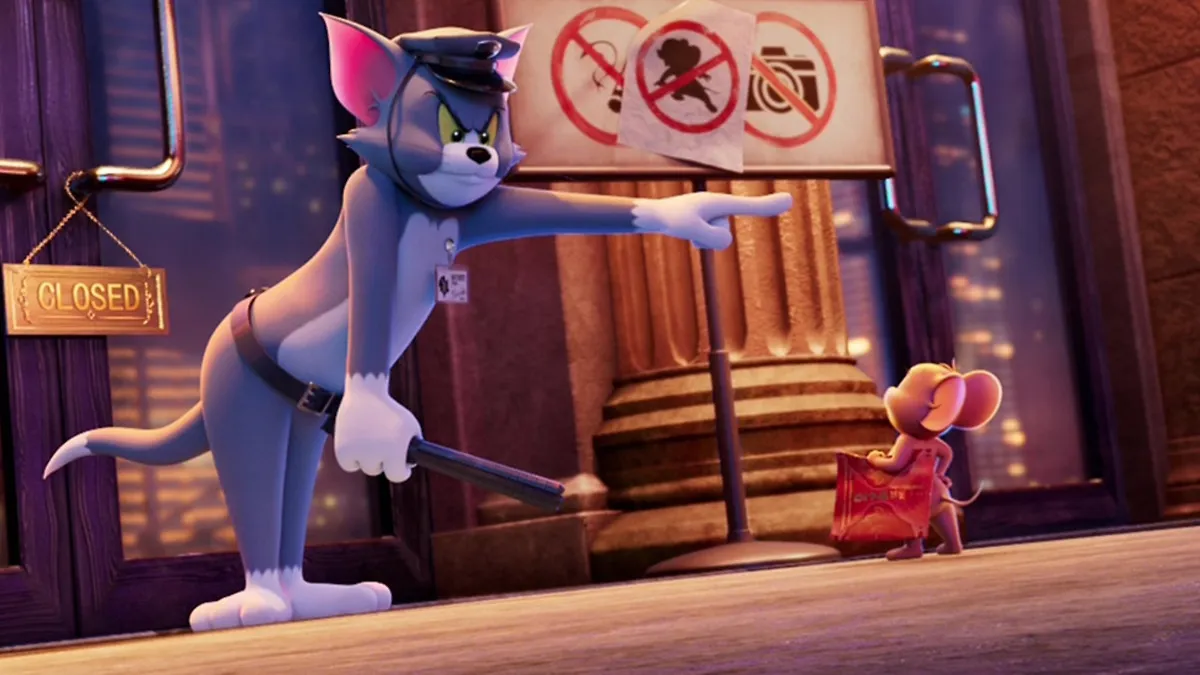
Tom works as an overcommitted security guard at a New York City museum, trying to preserve order while keeping Jerry beyond the doors. Their old rhythm of rivalry soon takes over. A frantic clash between them activates a legendary artifact on display, called the Astral or Forbidden Compass. The object opens an energetic portal, pulling the silent pair out of modern Manhattan and dropping them into a stylized ancient Chinese civilization built around the Golden City.
The Fractured Identity of Displaced Icons
Moving a mid-century American slapstick duo into a classical Eastern fantasy setting creates immediate friction between cultural image and narrative function. After Tom and Jerry crash into this unfamiliar world, the local population reads their arrival through its own mythic vocabulary and greets them as divine messengers.
That elevation changes the comic scale of the characters. The two figures who usually drive motion through pursuit, impact, and retaliation become secondary observers while local historical figures control the movement of the plot.
This displacement fractures their screen identities. The script separates them and assigns them to opposing sides of a regional conflict, which weakens the chase pattern established by William Hanna and Joseph Barbera. Tom’s alignment with local authorities and Jerry’s involvement with rival forces remove the shared competitive bond that gives the pair their shape.
The celestial dispute can proceed without them, revealing their presence as a corporate graft: familiar Western imagery attached to a local fable already capable of functioning on its own. Once the film removes the central mechanic of their relationship, it loses the kinetic grammar that has carried these characters across generations and borders.
The problem becomes cultural and formal at once. Slapstick needs a compact arena where action produces instant physical consequence, then loops back into another gag. The Golden City gives the film a large-scale epic conflict with heavy stakes, a structure that leaves the casual violence of Tom and Jerry feeling misplaced.
A besieged ancient city and a cat flattened by a frying pan ask for incompatible modes of attention. The local mythology cannot gather full emotional force, and the old cartoon anarchy cannot find clean comic timing. The result leaves the title figures stranded inside a story structure that has little meaningful work for them.
Celestial Bureaucracy and Flawed Worldbuilding
The Golden City plot runs on dense mythological machinery, leaving limited space for silent cartoon performance. The main conflict concerns the Phoenix Master, a supernatural figure facing a three-hundred-year deadline set by heavenly authorities.

Failure to retrieve the displaced compass before time expires will condemn him, along with his assistant, to permanent mortality. The assistant has already suffered the indignity of being transformed into a chicken. Opposing him is Mega-Rat, a resentful antagonist who commands a specialized rodent faction and seeks the artifact to alter the balance of power.
Within this struggle, Tom pursues Jade, an elegant white-furred opera cat dressed in a traditional red cheongsam. Their scenes expose a sharp stylistic imbalance. Jade speaks fully and performs operatic numbers, while Tom remains bound to classic silent pantomime.
The screenplay leans on the compass as a standard plot device and tries to make its character motivations legible through sentimental flashbacks. Those explanatory passages interrupt momentum and supply plain explanations that fail to generate much emotional investment.
The supporting cast’s heavy dialogue deepens the isolation of Tom and Jerry. In the traditional shorts, the whole world spoke the same silent language: bodies, music, props, and environmental reaction carried meaning. Here, the Phoenix Master and Mega-Rat explain the fantasy conflict at length, shifting the film from visual storytelling into verbal exposition.
Tom and Jerry react to speeches, which turns agents of comic chaos into passive listeners. That dependence on dialogue reveals a misunderstanding of silent animation’s expressive power. The film trades physical invention for a thick layer of mythological explanation that rarely feels inspired.
Visual Transition and Sensory Overload
The museum opening briefly suggests a stronger path. In that setting, the film uses classical animation logic with real charm, turning paintings and artifacts into clever, physics-defying gags. The visual language gives the pair room to bend space and consequence in ways that suit their history. That charm fades once the production enters the ancient realm and shifts fully into 3D digital animation. The environments display detailed textures and polished regional architecture, yet the character models for Tom and Jerry sit awkwardly inside that digital world.
Feature-length structure creates its own strain. Comedy built for short, self-contained theatrical segments loses force across a continuous narrative arc. The sound design and color timing mirror that difficulty. The film uses a hypersaturated palette, a nonstop musical score, and repeated firework explosions to keep energy high. The editing aims for constant stimulation, then turns exhausting. The rhythm moves far from the precise comic choreography that once made the characters feel sharp, dangerous, and funny.
The longer runtime asks for a dramatic arc that a simple chase premise cannot easily carry. The filmmakers respond by filling the space with sensory density. The third act becomes a swirl of airborne dragons and endless pyrotechnics, placing instant stimulation above coherence.
The film replaces comic rhythm with digital spectacle, losing contact with the formal intelligence of classical animation. What remains is a bright, polished film pitched at a single exhausting level, rich in surface shine and thin in the inventive spark needed to make Tom and Jerry matter inside this unfamiliar grand design.
Tom and Jerry: Forbidden Compass is a transnational, 3D computer-animated feature film that brings the legendary cat-and-mouse duo into an entirely new cultural setting. Produced as a collaboration between Warner Bros. and Chinese production houses, the movie follows the iconic rivals as a museum chase triggers a magical ancient artifact, transporting them back in time to a mythical version of ancient China. The film was released in theaters across the United Kingdom and Ireland on May 22, 2026, and is scheduled for a domestic theatrical release in North America later this year on September 9, 2026. Select international streaming options are currently emerging on regional platforms such as Prime Video.
Where to Watch Tom and Jerry: Forbidden Compass (2025) Online

Full Credits
Title: Tom and Jerry: Forbidden Compass
Distributor: Warner Bros. Discovery, Vertigo Releasing, Viva Pictures
Release date: May 22, 2026
Rating: PG
Running time: 1 hour 44 minutes
Director: Zhang Gang
Writers: Zhang Gang, Lindsay Katai, Bob Boyle, William Hanna, Joseph Barbera
Producers and Executive Producers: Chen Bofei, Ruoqing Fu, Jasmine Gao, Shaojing Yang, Huixia Zhang
Cast: Jiang Wen, Shun Zi, Lan Long, Tu Xiongfei, Li Baixin, Li Hanlin, Zhang Wenjie, Bai Weiche, John Shang, Ruan Yifei
Director of Photography (Cinematographer): Zhang Gang
Editors: Zhang Gang
Composer: Michael A. Reagan, Vivek Maddala, Hank Lee
The Review
Tom and Jerry: Forbidden Compass
Tom and Jerry: Forbidden Compass serves as a flashing example of corporate asset mismanagement. By dropping silent slapstick legends into a dense, text-heavy Chinese fantasy epic, the production strips away the foundational chase mechanics that define the franchise. The title characters become marginalized onlookers in their own feature film, buried beneath heavy exposition and an exhausting barrage of digital effects. While the cultural artistry of the environments is evident, the project ultimately fails to bridge its two distinct creative worlds.
PROS
- The opening museum sequence preserves the elastic, anarchic spirit of the original Hanna-Barbera theatrical shorts.
- The environmental design and architecture showcase detailed, polished regional artistry.
CONS
- The title characters are marginalized and reduced to secondary passive onlookers.
- The classic competitive chase dynamic is broken by arbitrarily splitting the duo onto opposing sides.
- The feature runtime relies on a relentless barrage of explosions and music that causes sensory fatigue.
- The heavy reliance on verbal exposition clashes with the silent performance style of the protagonists.