





























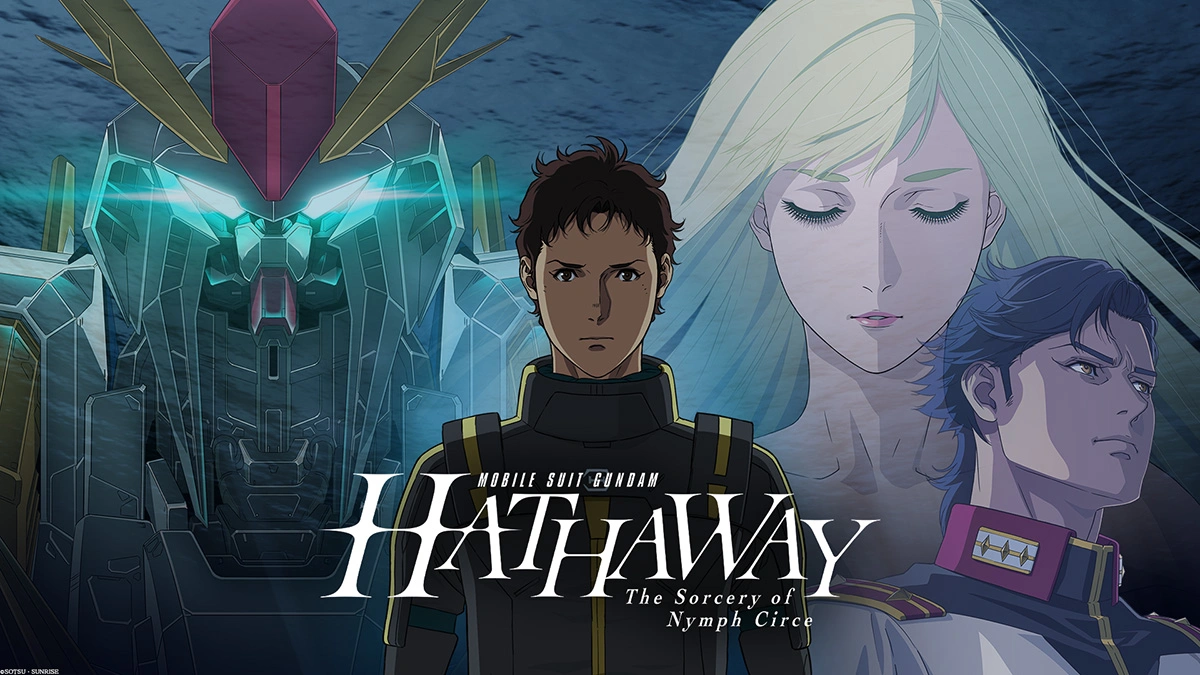

Mobile Suit Gundam Hathaway: The Sorcery of Nymph Circe operates as the second chapter in a planned film trilogy adapting Yoshiyuki Tomino’s light novels. Set in U.C. 105, it continues the timeline twelve years after the geopolitical rupture of Char’s Counterattack.
This period is defined by rising tension between an increasingly corrupt Earth Federation and Mafty, an insurgent group carrying out public assassinations against government officials. Hathaway Noa stands as the story’s key pressure point, living as a young man with a hidden role as the anonymous leader of the rebellion.
His chief military opponent is Colonel Kenneth Sleg, a magnetic Federation commander assigned to protect an approaching global summit in Australia. Gigi Andalusia, a mysterious socialite with an eerie intuitive gift, unsettles both men and pulls their focus away from clean strategic thinking. The film begins inside a dense military reality, asking viewers to engage with a specialized political conflict from the first stretch.
The Friction of War and Human Fractures
Yasuyuki Muto’s screenplay moves toward grounded, character-led military drama. The writing gives space to bureaucratic positioning, tactical planning, and psychological pressure, using those pieces to shape the story before large-scale mechanical combat takes over.
That structure reveals the strain inside Hathaway Noa. He carries the severe mental burden of revolutionary command, with past tragedies still pressing on him and his relationship with his actual girlfriend, Keila Dace, breaking down. Kenneth Sleg works through his own split field of attention, building the defensive perimeter for the Adelaide Conference and hunting the insurgent cell hidden near the northern Australian coast.
Gigi Andalusia interrupts this military pairing with a strange emotional and tactical charge. Her intuitive, near-precognitive ability makes her valuable to Sleg, who treats her like a living luck charm. Her movement from wealthy social spaces into active military zones creates personal friction that pushes both male leads to reassess their objectives. The supporting cast broadens the sense of institutional rot.
Also Read






Handley Yoxon’s arrival from the Criminal Police Organization brings a harsher form of state-backed cruelty into the Federation response. Lane Aim, a young Federation ace pilot, is driven by a need to recover from a humiliating past defeat against a mysterious Gundam unit. Through these human threads, the script shows political ideology breaking personal identity long before the machines enter combat. The characters feel like damaged agents inside a wider institutional tragedy.
Deliberate Tempos and Structural Fragmentation
Director Shûkô Murase uses a patient tempo that resists the usual rhythm of action cinema. The film spends long stretches on casual exchanges, slow movement from place to place, and ordinary domestic tasks. These quiet scenes build a heavy mood, then give way to unusual montage passages involving home redecoration and the silent collapse of personal relationships. The effect slows the plot’s drive and places mood above direct momentum.

The film’s structure grows more fragmented through sudden changes in viewpoint. Gigi’s hidden actions and private movements create an observational gap between viewer and protagonist. The audience sees the shifting board with greater clarity than Hathaway, which softens immediate suspense and changes the emotional alignment with him.
The script also depends heavily on franchise lore, giving little explanation for viewers new to this timeline. Historical callbacks and character cameos appear without contextual framing. Dedicated fans may value this firm commitment to a long-running continuity. Casual viewers may find the dense shorthand confusing, making the film feel sealed off and dependent on outside knowledge for full comprehension.
Technical Synthesis and Low-Light Warfare
The technical craft combines hand-drawn 2D character animation with 3D computer-generated environments and machinery. The results shift in quality. Some background details reach striking visual precision, including a photorealistic shot of a white curtain moving in the breeze and the rendering of ocean water.
Several computerized military transport ships look flat and blocky, with weak integration into the surrounding image. The staging is strongest during the frightening opening sequence, which presents a mechanized urban assault from the perspective of trapped civilians and stresses the scale and terror of the weapons.
A major visual decision places key nighttime scenes in near-total darkness. For minutes at a time, the image becomes a field of vague shapes and drifting voices. This high-contrast approach conceals violent imagery, yet it also reduces clarity during significant dialogue scenes. Hiroyuki Sawano’s sweeping symphonic score gives the geopolitical conflict a strong sense of weight.
The soundtrack also includes two jarring popular music choices. Contemporary R&B over the opening credits and classic American hard rock during the end crawl create a strange tonal collision with the bleak military drama. The final third-act clash offers a brief, polished mechanical battle, using sharp sound design and a heavy bass mix to convey the force of the machines. The film closes with production craft operating at a high level.
Mobile Suit Gundam Hathaway: The Sorcery of Nymph Circe is an anime sci-fi film that premiered in North American theaters on May 15, 2026, following its initial limited festival run earlier in the year. Acting as the middle entry in a cinematic trilogy, the story tracks the continued political unrest of the Universal Century timeline. Audiences can currently experience the heavy mechanical action and dense political drama exclusively on the big screen during its theatrical release window, courtesy of Bandai Namco Filmworks.
Where to Watch Mobile Suit Gundam Hathaway: The Sorcery of Nymph Circe (2026) Online
Full Credits
Title: Mobile Suit Gundam Hathaway: The Sorcery of Nymph Circe
Distributor: Bandai Namco Filmworks
Release date: May 15, 2026
Rating: NR
Running time: 108 minutes
Director: Shūkō Murase
Writers: Yasuyuki Muto, Yoshiyuki Tomino
Producers and Executive Producers: Naohiro Ogata, Yasuo Miyakawa, Shin Sasaki
Cast: Kensho Ono, Reina Ueda, Junichi Suwabe, Soma Saito, Kenjiro Tsuda, Saori Hayami, Fukushi Ochiai, Shunsuke Takeuchi
Editors: Daisuke Imai
Composer: Hiroyuki Sawano
The Review
Mobile Suit Gundam Hathaway: The Sorcery of Nymph Circe
Mobile Suit Gundam Hathaway: The Sorcery of Nymph Circe is an uncompromising, character-driven military drama that prioritizes political maneuvering over mechanical spectacle. While Shûkô Murase’s deliberate pacing and dense lore barriers will alienate newcomers, the film offers rewarding thematic depth and exceptional audio-visual highlights for dedicated fans.
PROS
- Grounded, mature screenplay that focuses on psychological tension and institutional corruption.
- Immersive audio design and a powerful symphonic score by Hiroyuki Sawano.
- Stunning, photorealistic background animation in standout sequences.
- Terrifying civilian perspective during the opening mechanized assault.
CONS
- Glacial pacing and unconventional montages that stall narrative momentum.
- Dense, unapproachable reliance on franchise lore with poor exposition for casual viewers.
- Extended sequences shot in near-total darkness that severely obscure visual clarity.
- Bizarre, immersion-breaking popular music choices over the credits.