







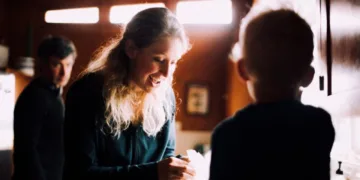













Nesting begins from one of the oldest human images, a mother and child, then strips away its cultural varnish until only fear, flesh, noise, and obligation remain. Writer-director Chloé Cinq-Mars builds the film around Pénélope, a new mother whose life after childbirth has become a private weather system of sleep deprivation, bodily pain, shame, and panic. The baby, Lou, is loved. That matters. He is also relentless, fragile, hungry, loud, and impossible to place outside her mind for a single second.
Rose-Marie Perreault plays Pénélope as someone living in a state of constant interior alarm. Her boyfriend Gaspard, a musician with the survival instincts of a decorative lamp, drifts through the house as if parenthood were an acoustic problem in another room. Then a late-night walk to a convenience store turns violent. Pénélope is caught in an armed robbery and believes the assailant is Charlotte, her dead sister. From that point, Nesting moves through motherhood, grief, and hallucination as if they were rooms in the same collapsing house.
The Mother Seen Too Late
The film’s sharpest idea is also its most socially abrasive: people love to discuss babies while failing to see the person keeping them alive. Pénélope is surrounded by concern, yet almost none of it reaches her. Lou is not gaining enough weight. Lou cries. Lou needs feeding. Lou needs protection. Every sentence begins with the child, and every silence swallows the mother.
Cinq-Mars makes postpartum depression feel less like a diagnosis and closer to a siege. The body is sore, the mind is fogged, the house has become a containment unit, and sleep has turned into contraband. Pénélope’s breastfeeding struggles, her fear of being judged, and her dread of medical authority carry a specific institutional horror. She cannot ask for help freely, because help may arrive dressed as punishment. That is the brutal joke of modern care systems: they ask mothers to be honest, then make honesty feel like evidence.
The film is at its most unsettling when Pénélope makes choices that place Lou in danger. She leaves him alone too long. She puts him down in unsafe spaces. She forgets him in the car. These scenes are agonizing because they refuse easy moral sorting. She is neither monster nor martyr. She is a person cracking under pressure while holding another life in her hands. That distinction gives the movie its ethical force.
Gaspard’s failure is quieter, which may make it worse. He does not need to be cruel. He only needs to sleep through the crying.
Ghosts, Sisters, and the Pattern-Hungry Mind
The robbery tears open the film’s second wound: Charlotte. Pénélope’s dead sister appears, or seems to appear, as an attacker in a red hoodie, turning a public act of violence into a private resurrection. From there, Nesting becomes less interested in solving the apparition than in charting what grief does when the present becomes unbearable.
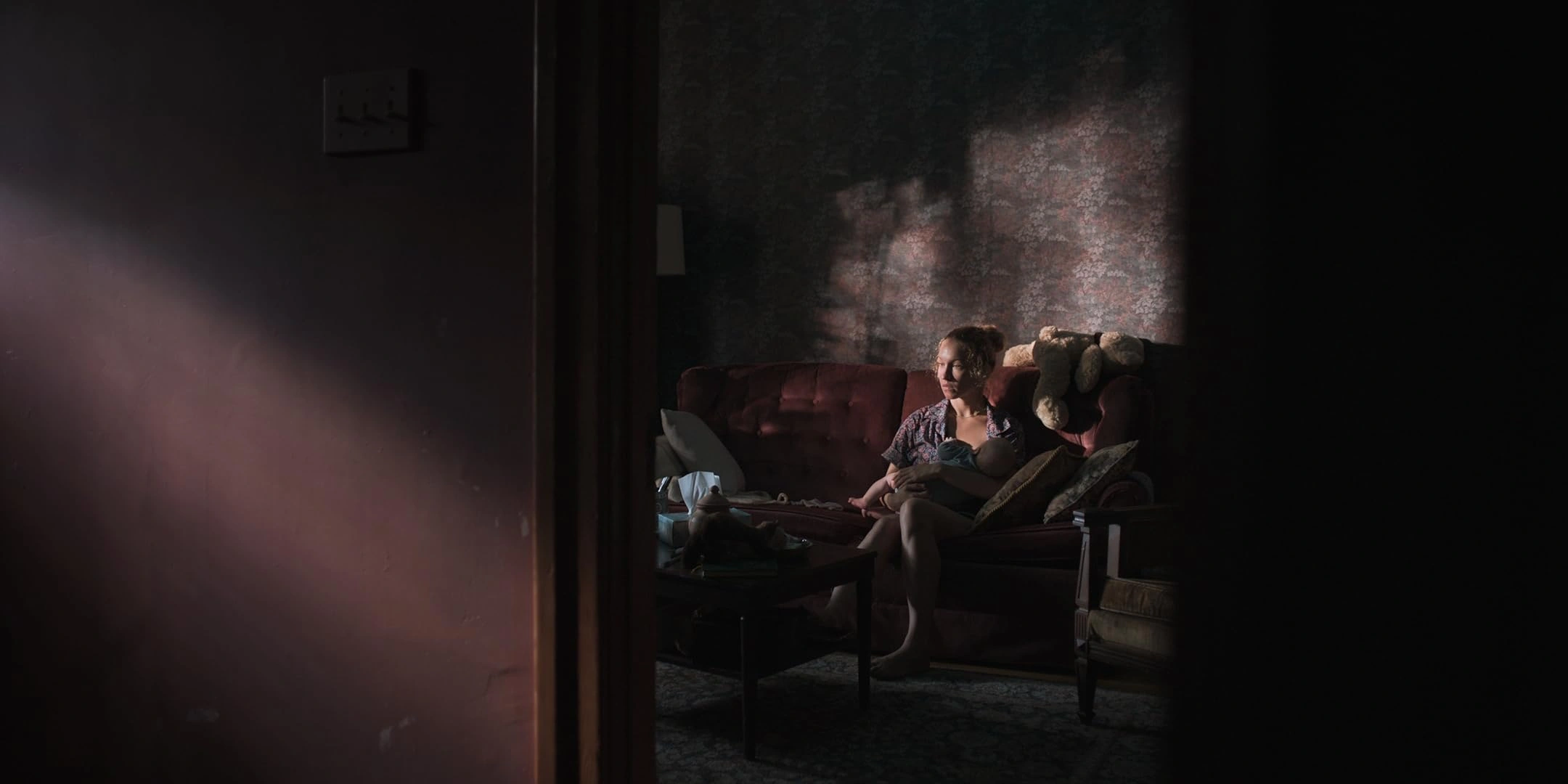
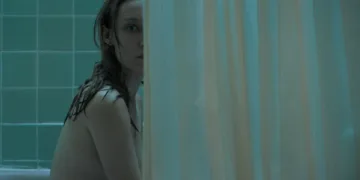
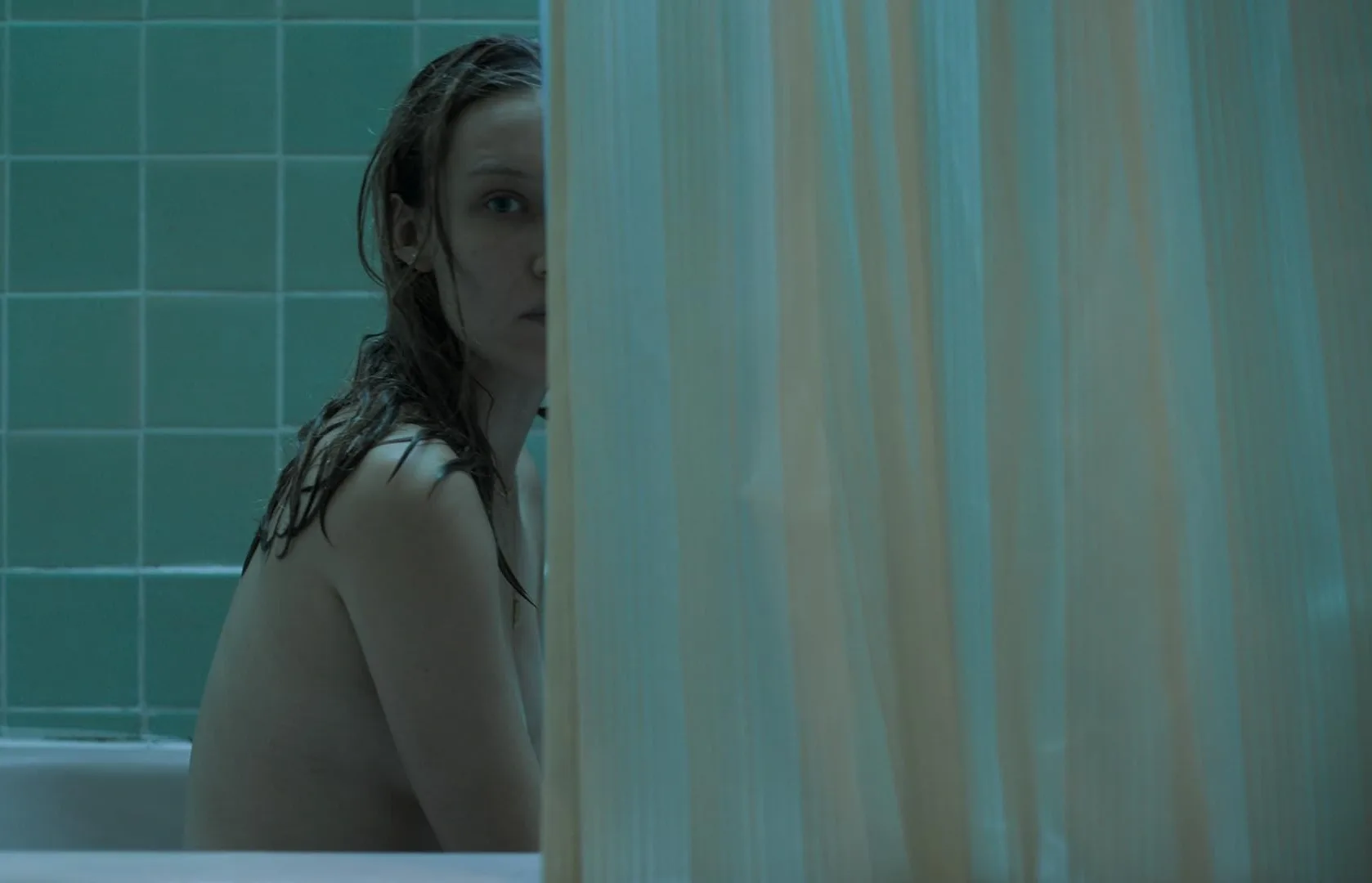
Trauma in the film behaves like a bad archivist. It files everything together. A crying infant, a near-fatal pregnancy, a dead sister, a gun, a bath, a lake, a squeak in the walls: the mind gathers them into one terrifying index. Pénélope starts to read the world as a set of warnings meant only for her. Mirrors misbehave. Time slips. Domestic rooms take on the hostility of interrogation chambers. Rats become an acoustic hallucination, or maybe a symbol of decay gnawing at the walls of her sanity. Subtle? No. Effective? Often.
The sister material does not always carry the same raw charge as the postpartum story. At times, Charlotte’s thread risks turning Pénélope’s immediate crisis into a tidier psychological mechanism, the sort of screenwriting machinery that arrives with labels neatly attached. Yet the fragmented structure has value. The film does not move like a puzzle box. It moves like a frightened brain trying to make a shape out of unrelated injuries.
That may frustrate viewers expecting clean genre architecture. Good. A collapsing mind rarely respects three-act etiquette.
Sound, Flesh, and the Horror of Near Harm
Perreault gives the film its nervous system. Her performance is physical in the most unforgiving sense: hunched shoulders, wet eyes, sudden fury, absent stares, little flashes of tenderness that vanish before they can warm the room. She can look fiercely attached to Lou in one moment and almost erased by him in the next. The party dance sequence matters because it briefly shows Pénélope before the total occupation of motherhood. For a few seconds, she has rhythm, desire, public space, a body that belongs to itself. Then Lou cries. The world snaps back.
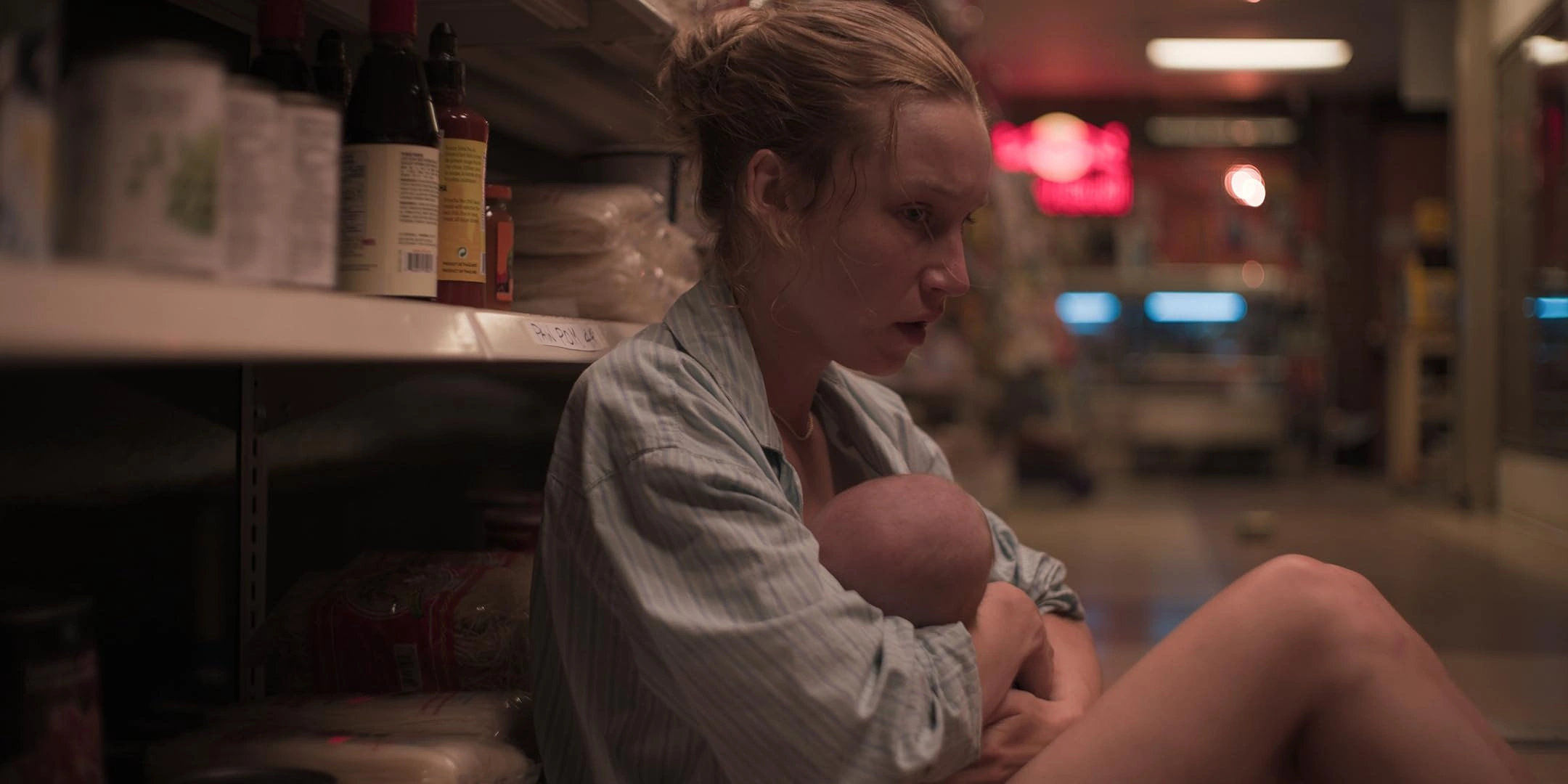
Cinq-Mars directs with a strong sensory hand. Saturated light, warped reflections, abrupt edits, and dreamlike transitions turn the film into a postpartum fever chamber. The horror does not depend on jump scares. It comes from proximity: the baby near danger, the mother near collapse, the viewer near a feeling they would rather intellectualize from a safe distance.
The sound design is both the film’s weapon and its most debatable excess. Lou’s crying, abrasive domestic noise, and scraping aural clutter create a suffocating sonic pressure. It works because Pénélope’s world should feel intolerable. It also risks becoming intolerable for the audience in a less productive way. There were moments when I felt less immersed than held hostage by the mix, which may be the point, or may be the film trusting its bluntest instrument a little too much.
Nesting is a slow burn, with its most overt horror saved for the final stretch. Its terror is not elegant. It is sticky, sleep-starved, and intimate. The film understands a frightening social truth: motherhood is still treated as instinct until it fails, then it becomes evidence. In that gap, Pénélope disappears.
Nesting, originally titled Peau à peau, is a Canadian-Swiss psychological horror drama written and directed by Chloé Cinq-Mars. The film premiered at the Fantasia International Film Festival on July 22, 2025, before receiving a limited theatrical release on May 26, 2026 and a VOD release on May 29, 2026 through Breaking Glass Pictures. The story follows Pénélope, a new mother struggling with postpartum depression, insomnia, and unresolved grief after the death of her sister. As of May 30, 2026, the film is available to rent or buy on Fandango at Home, with Prime Video also listing the film.
Where to Watch Nesting (2025) Online




Full Credits
- Title: Nesting
- Original Title: Peau à peau
- Distributor: Breaking Glass Pictures
- Release Date: July 22, 2025 at the Fantasia International Film Festival; May 26, 2026 in limited theatrical release; May 29, 2026 on VOD
- Running Time: 1 hour 43 minutes
- Director: Chloé Cinq-Mars
- Writers: Chloé Cinq-Mars
- Producers and Executive Producers: Nicolas Comeau, Jean-Marc Fröhle
- Cast: Rose-Marie Perreault, Simon Landry-Désy, Saladin Dellers, Matteo Aeschimann, Giovanni Amorim, Francesca Barcenas, Marie Bélanger, Alex Lauzon
- Director of Photography: Léna Mill-Reuillard
- Editors: Elric Robichon
- Composer: Nicolas Rabaeus
The Review
Nesting
Nesting is a bruising, sensory psychological drama that turns postpartum depression into intimate horror. Chloé Cinq-Mars captures motherhood as love under extreme pressure, while Rose-Marie Perreault gives Pénélope a raw, frightening humanity. The film’s sound design can feel punishing, and the sister trauma thread is less powerful than the motherhood material, yet its emotional force lingers. This is slow-burn horror with a sharp social nerve.
PROS
- Rose-Marie Perreault’s intense lead performance
- Honest treatment of postpartum depression
- Strong sensory direction
- Tense final act
- Sharp use of sound and visual distortion
CONS
- Sound design can become exhausting
- Slow pacing may test some viewers
- Sister trauma subplot feels predictable
- Horror elements arrive late