































Teach You A Lesson takes one of the most familiar K-drama pressure cookers, the school system, and turns it into a battleground where justice arrives wearing a government badge and a very serious expression. The Netflix series centers on the Educational Rights Protection Bureau, or ERPB, a newly formed agency tasked with investigating severe misconduct in Seoul schools. Its methods are about as subtle as a desk thrown through a window.
The story starts at Daehan High School, where Kim Gyeong-min lives under daily torment from Ryu Jun-hyeong, a bully insulated by his father’s political power. After Park Dae-seok dies by suicide following relentless abuse, the school’s moral rot becomes impossible to ignore. Enter Na Hwa-jin, an ERPB inspector who treats bullies like unfinished paperwork: unpleasant, overdue, and ready to be stamped hard.
The premise is pure revenge fantasy, yet it carries a sharp social sting. The series imagines what happens when victims lose trust in teachers, police, parents, and administrators, then someone walks in ready to answer cruelty with force. Is it justice? Is it state-approved intimidation with better lighting? The show knows the question is messy, which gives its violence a stronger bite.
Case Files, Broken Schools, and Escalating Mayhem
The series builds itself around a case-based format, giving each school its own ecosystem of fear. Daehan High functions as the opening indictment: students film violence instead of stopping it, teachers shrink before influential parents, and the principal treats truth as a political inconvenience. The pacing is blunt but effective, moving from victimization to exposure to punishment with the rhythm of a procedural that has swapped legal briefings for hallway beatdowns.
That structure expands quickly. Guun Hi-Tech School shifts the focus toward gang influence, where students chase criminal status with the tragic confidence of teenagers who think consequences are for other people. Bong Geun-de’s undercover role gives that arc a sly spark, since his soft presence clashes amusingly with the macho chaos around him. Soyeon Girls’ School then turns the lens toward cyberbullying and false accusations, using influencer culture as a weaponized classroom tool.
The show understands escalation. Each case begins with a private wound, then widens into a public failure. Victims suffer in silence, adults delay action, and the ERPB storms in once the damage has already curdled. Editing keeps the momentum high, often cutting between personal breakdowns, institutional panic, and Hwa-jin’s incoming wrath. It is hardly delicate storytelling, but delicacy would look rather odd here, like bringing a teacup to a street fight.
Running beneath the school cases is the serialized thread involving Minister Choi Gang-seok, the murdered teacher Choi Ga-yun, and political forces eager to frame the ERPB as a revenge machine. That larger arc gives the show a useful engine beyond each episode’s punishment cycle.
Heroes With Bruised Knuckles and Questionable HR Policies
Kim Mu-yeol gives Na Hwa-jin the kind of presence that makes a classroom feel too small for him. He plays the role with controlled fury, rarely wasting movement or expression. Hwa-jin does not enter scenes so much as confiscate them. His violence is staged for maximum catharsis: slaps that echo, kicks that punctuate scenes like punchlines, threats delivered with the chilly calm of a man who has already decided where everyone will land.

Lee Sung-min brings weight to Choi Gang-seok, the minister who created the ERPB after Ga-yun’s murder. Gang-seok could have been a simple righteous official, but the performance hints at a man using public duty to keep grief from devouring him. His composure has cracks, and those cracks matter. They make the ERPB feel less like a clean reform project and closer to a moral gamble dressed in bureaucratic language.
Im Han-rim’s arrival gives the team a welcome jolt. She mirrors Hwa-jin’s severity while bringing her own clipped, physical confidence, especially during the Soyeon Girls’ School case. Jin Ki-joo makes Han-rim intimidating without flattening her into a copy of Hwa-jin. Bong Geun-de, by comparison, offers softness and comic friction. His undercover work and bond with Hyeong-ju hint at a deeper emotional reason for his place in the bureau.
The supporting characters help ground the spectacle. Gyeong-min’s guilt and terror make the first case sting. Dae-seok’s fate haunts the school long after his death. Jun-hyeong embodies entitlement sharpened into cruelty, while Han Ye-ri updates the bully archetype for the livestream era, where reputation can be ruined before the bell rings.
Catharsis, Chaos, and the Sound of a Very Angry Chalkboard
Tonally, Teach You A Lesson is loud, violent, and proudly exaggerated. It borrows from vigilante dramas, school melodramas, action thrillers, and the old television pleasure of watching a rotten person get exactly what has been coming. There are echoes of classic undercover-school formats, yet the series replaces disguise with authority. Hwa-jin does not sneak into the system. He kicks the door open, hands over credentials, then starts correcting behavior with alarming enthusiasm.
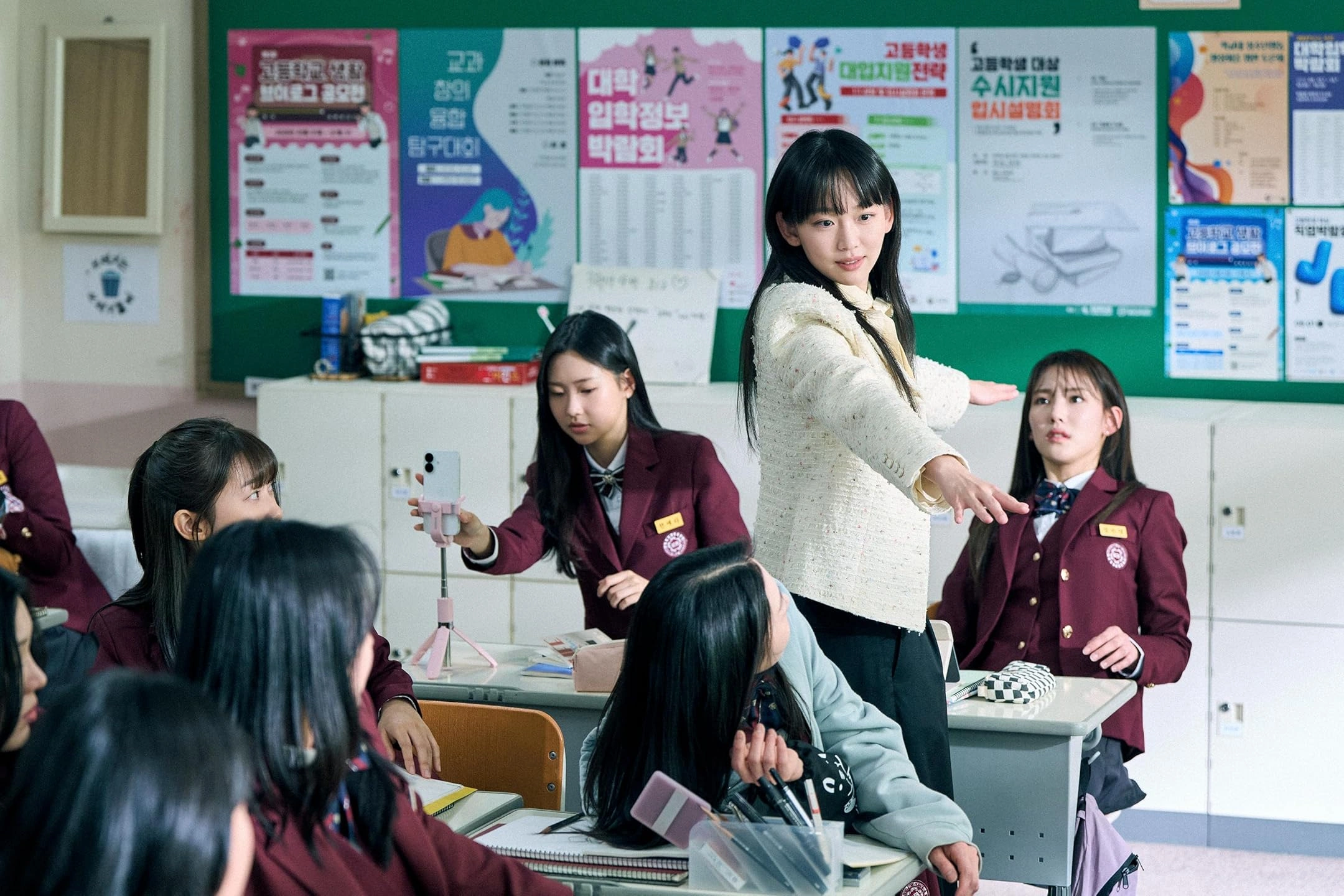
The direction leans into impact. Hallways become arenas. Cafeterias turn into humiliation stages. Garages transform into fight clubs with an educational mission, which may be the strangest sentence any school administrator could read before quitting. The action choreography favors blunt satisfaction over realism, and the sound design helps sell every slap, crash, and gasp. The show wants each punishment to land in the body before it lands in the mind.
Its cultural charge comes from the way it connects school violence, online mobs, parental power, and political cowardice. The series taps into anxieties around education systems that protect prestige before people. Its angriest moments work because the victims are trapped inside institutions built to help them.
The danger is obvious: the ERPB can look like another group of bullies with better suits. That moral unease keeps the series alive. If future episodes push harder against Hwa-jin and Gang-seok’s methods, Teach You A Lesson could become a sharper drama about justice, power, and the frightening comfort of watching someone else break the rules for the right target.
Teach You a Lesson is a South Korean action school-drama television series that premiered globally on Netflix on June 5, 2026. Based on the popular Naver webtoon Get Schooled, the narrative explores a fractured educational system plagued by extreme classroom violence, boundary-crossing teenagers, and toxic parents. In response, the government establishes the Educational Rights Protection Bureau, a special agency authorized to use physical intervention and unconventional methods to protect victims and reform schools. Audiences can stream all ten episodes of the limited series exclusively on Netflix.
Where to Watch Teach You A Lesson Online


Full Credits
Title: Teach You a Lesson
Distributor: Netflix
Release date: June 5, 2026
Rating: TV-MA
Running time: 52–72 minutes per episode
Director: Hong Jong-chan
Writers: Lee Nam-kyu, Kim Da-hee, Moon Jong-ho
Producers and Executive Producers: Ylab Plex, GTist, Bae Jong-byung
Cast: Kim Mu-yeol, Lee Sung-min, Jin Ki-joo, Pyo Ji-hoon, Kim Jong-soo, Ha Young
The Review
Teach You A Lesson
Teach You A Lesson is a bruising, highly watchable K-drama that turns school corruption into action-fantasy fuel. Its violence can be absurd, and its moral compass wobbles by design, yet the series has real force in the way it treats bullying, teacher harassment, political protection, and online cruelty. Kim Mu-yeol gives the show a fierce center as Na Hwa-jin, while the case-based format keeps the tension moving. It is messy, angry, cathartic television with a sharp hook.
PROS
- Strong central premise with immediate dramatic pull
- Kim Mu-yeol’s commanding performance as Na Hwa-jin
- Fast pacing and intense case-based structure
- Strong social themes around bullying, corruption, and teacher abuse
- Satisfying action scenes with clear cathartic appeal
- Expanding ERPB team adds energy and variety
CONS
- ERPB methods can feel ethically extreme
- Some action beats stretch credibility
- The formula may become predictable across episodes
- Political subplot needs sharper development
- The show sometimes risks turning intimidation into spectacle








Ben, I respect your article. It has given me a point of view that I was considering. I enjoyed that you also believe that the ERPB actions are a bit extreme but you do not dismiss their actions. I do believe adding more actors or actresses with more variety would allow the show to expand. However I do believe as a starting point they do have those. Even though the main character is more physically violent, the female main character is less violent, but more mentally unstable. They both give an authoritative approach, while having that slight balance from the deputy. When you think about it that way they give most violent, slightly violent and no violence. I do think that their characters have to be this way because when you think about it ERPB only intervenes after the worst case scenario has a risen. OVERALL, I ENJOYED YOUR ARTICLE AND LOVED THAT WE HAD SIMILAR MINDSETS WHEN REVIEWING THE SHOW. I look forward to more reviews from you.