


























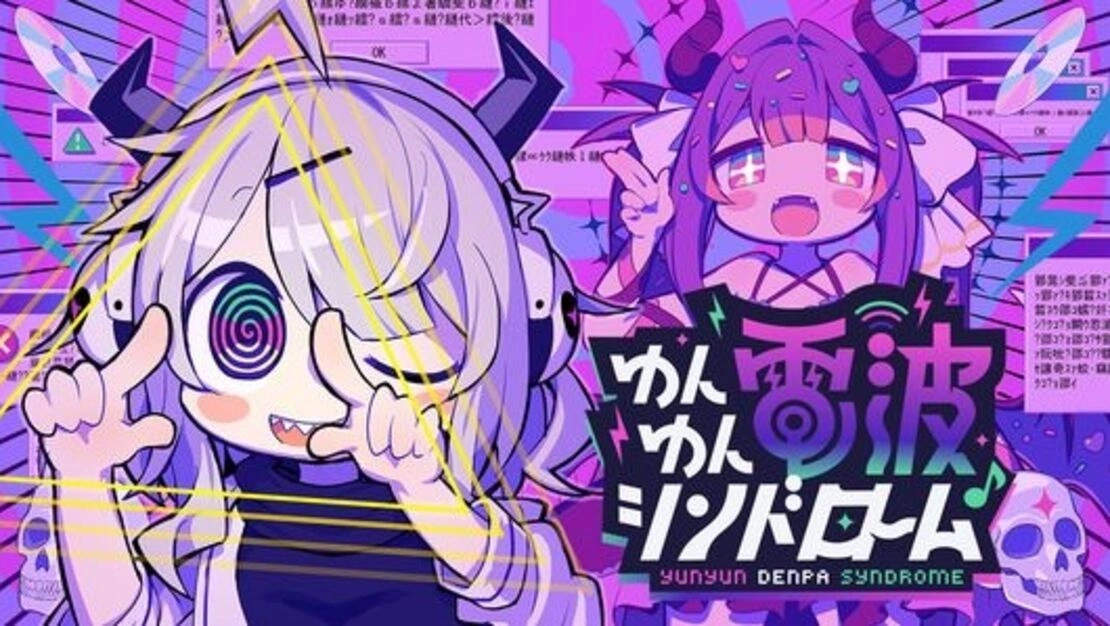

Yunyun Syndrome!? Rhythm Psychosis feels like a transmission from a laptop left open at 3 a.m., surrounded by crushed energy drink cans, anime merch, and one very worried search history. It is a four-lane rhythm game built around denpa culture, online obsession, psychological unease, and meme-fueled conspiracy spirals. Its heroine, Qtie, is a shut-in middle schooler whose world has narrowed around Yunyun, a demon girl from the fictional game Execution Angel Guiltina.
Then Yunyun appears through Qtie’s computer and begins sending “denpa signals,” pushing her devoted fan to post worshipful, chaotic, conspiracy-laced messages online. The premise sounds comic, and often it is, in the same way a cursed forum thread can be funny until it starts reading like a cry for help.
The game’s personality is loud, bright, abrasive, funny, unsettling, and raw. It mixes catchy rhythm play with social media satire, hikikomori anxiety, fandom fixation, and psychological horror. It speaks in the language of Japanese internet subculture, yet its anxieties feel global: loneliness, parasocial devotion, algorithmic belief, and the hunger to be seen by someone, anyone, even a fictional demon.
Four Keys, One Spiral
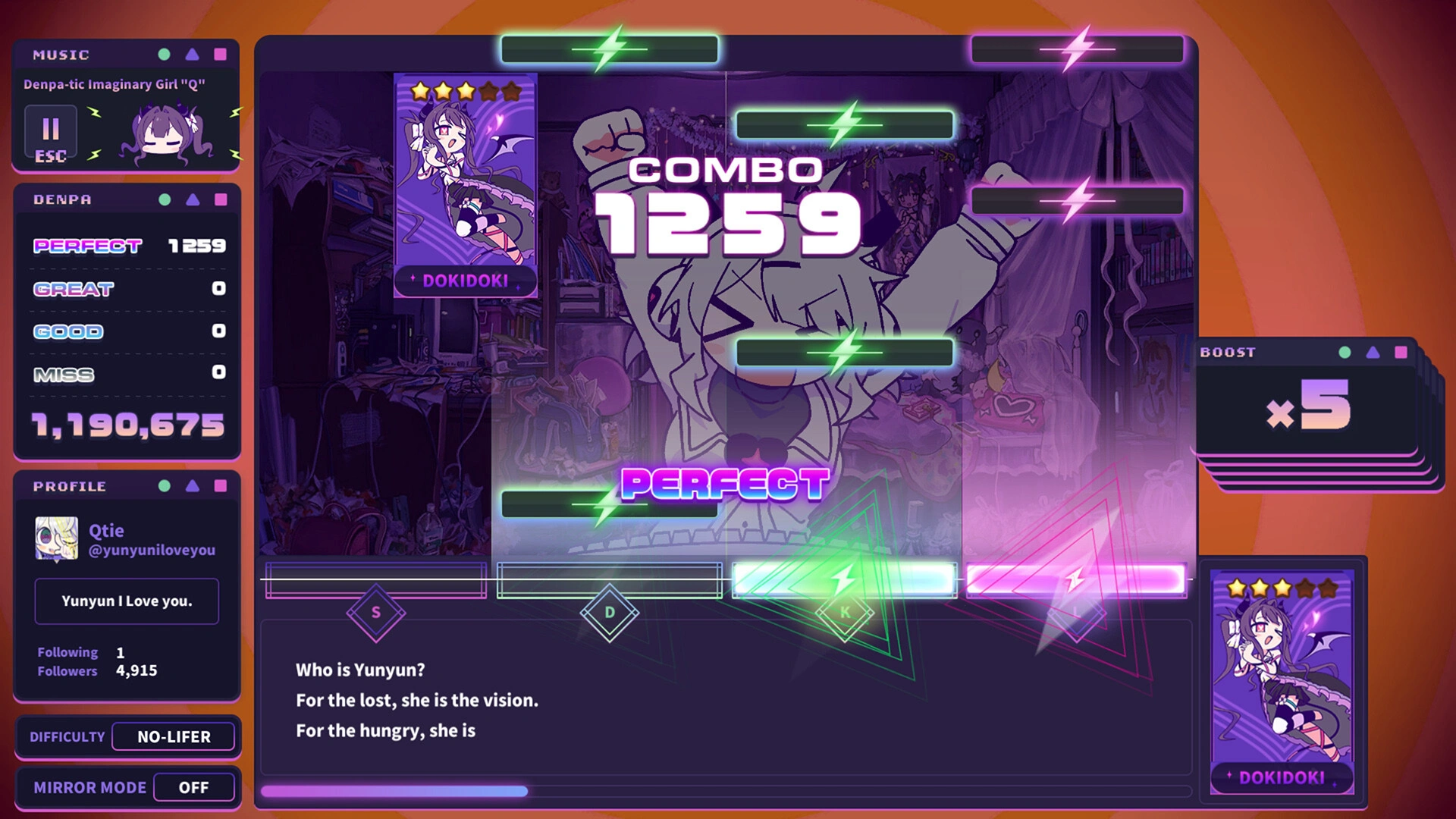
Mechanically, Yunyun Syndrome!? Rhythm Psychosis keeps its rhythm foundation approachable. The basic setup uses four lanes, mapped by default to keys such as S, D, K, and L. Notes fall into familiar categories: single taps, holds, and quick repeated inputs that test consistency rather than hand gymnastics. The layout is easy to understand, which matters in a game already asking players to absorb a storm of color, text, sound, and narrative strangeness.
That simplicity gives the game a rare kind of accessibility. A player without deep rhythm-game experience can settle into Normal mode quickly, while higher tiers such as Hardcore Gamer, Tryhard, and Degenerate offer denser charts for those who want pressure. The names are silly, yes, yet they fit a game that treats internet identity as both costume and wound.
The charts often land with satisfying musical logic. There are moments where the player stops consciously reading every note and starts trusting peripheral vision, timing, and repetition. That rhythm-game trance is still here, buried under layers of typing noises and Qtie’s frantic posting. The best tracks create a tight feedback loop between music, fingers, and screen, turning each song into an act of participation in Qtie’s mental broadcast.
The forgiving input system creates a sharper debate. Extra button presses are rarely punished, while missed notes or noticeably poor timing remain the main hazards. For casual players, this is a mercy. It keeps the story moving and lets the music carry the experience. For expert players who crave strict precision, it may soften the thrill of mastery. A dense section can sometimes be survived through frantic tapping rather than clean execution, which weakens the genre’s usual demand for discipline.
Around the rhythm play sits the stranger half of the design. Each completed song generates posts and cards. The player chooses three cards tied to Dokidoki, Yunyun, and Hype, then uses those resources to push Qtie’s online presence further. Dokidoki carries emotional charge and can feed into energy drink benefits. Yunyun supports idle-style progress, letting Qtie generate activity automatically for a time. Hype gives the player some control over which conspiracy theory gains traction.
This is where the game’s mechanics and narrative fuse. Playing songs is not separate from the story. It becomes the physical act of helping Qtie type, post, obsess, and amplify. The loop feels absurd at first. Then it becomes sticky. One song becomes one post, one post becomes one theory, one theory becomes another step toward the next denpa threshold.
Denpa Noise, Meme Archaeology, and Audio Overload
To understand the game’s cultural charge, denpa matters. The term carries a history tied to alienation, social disconnection, hallucination, technology, static, and signals from elsewhere. In pop culture, it has grown into an aesthetic of fractured perception: bright music, strange lyrics, electrical anxiety, and characters whose inner worlds do not fit the society around them.
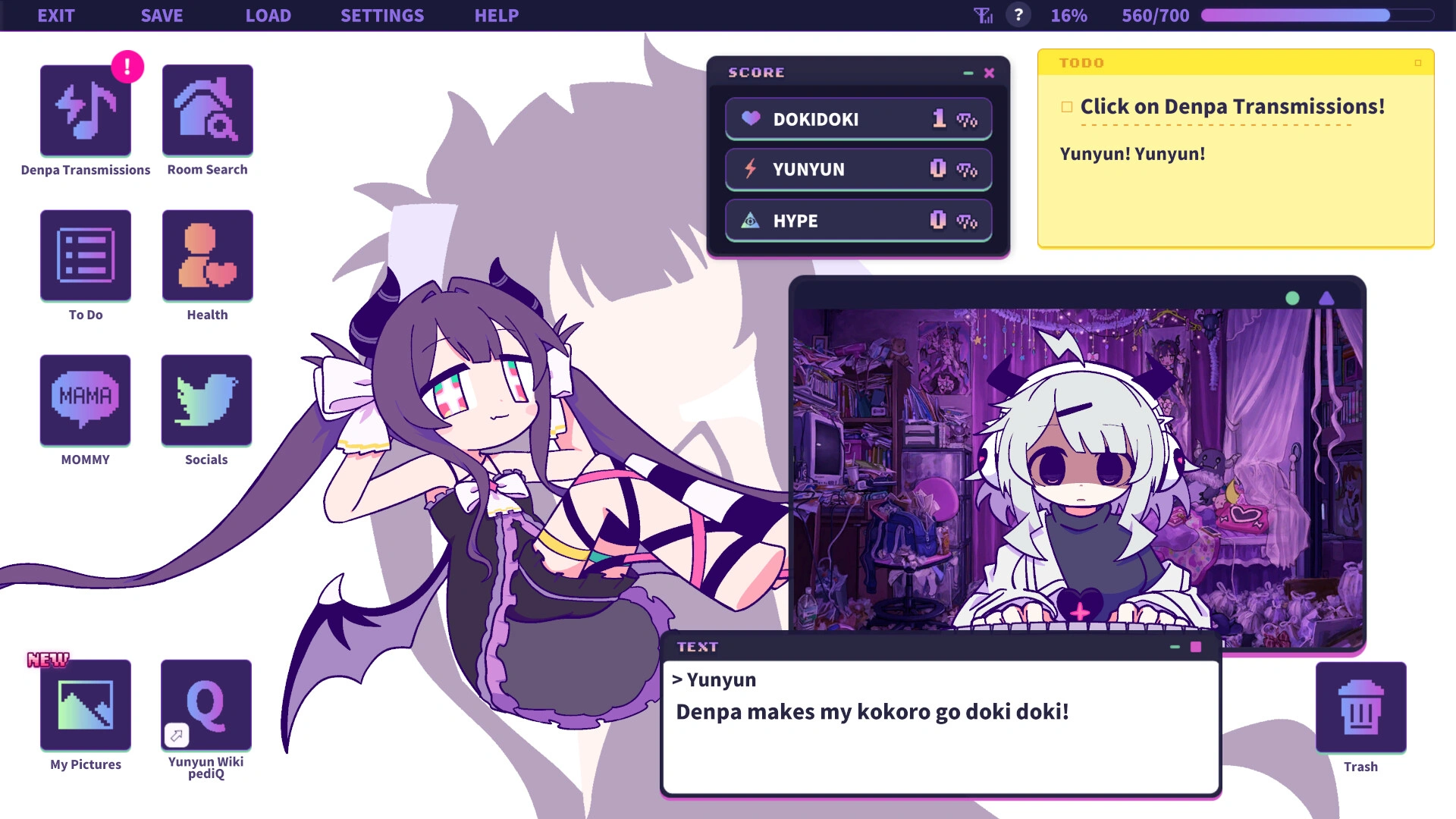
Yunyun Syndrome!? Rhythm Psychosis embraces that lineage with no interest in polite translation. Its colors clash. Its writing swerves between nonsense and pain. Its songs sound like internet debris reassembled into a shrine. Qtie’s bedroom becomes a cultural site, part hikikomori chamber, part fandom archive, part psychological trap. In a Japanese setting, this connects to familiar anxieties around withdrawal, social pressure, otaku identity, and digital refuge. For global players, it may land through parallel experiences: fandom addiction, online radicalization, meme logic, and the private loneliness hidden behind public performance.
The soundtrack feels pulled from online subcultures rather than a conventional rhythm-game catalog. Original songs sit beside meme-culture selections, Touhou fan tracks, music linked to Needy Streamer Overload, Muse Dash material, and older internet-era vocal oddities. It feels less curated in the museum sense and closer to someone emptying the contents of a very specific hard drive onto the floor.
The music is catchy, frantic, noisy, and proudly excessive. Bright melodies often sit over unstable energy, which mirrors Qtie herself: cute imagery on the surface, panic beneath it. That cross-cultural friction is part of the appeal. The songs may confuse players unfamiliar with denpa or doujin music, yet they also offer a vivid education in how internet scenes preserve their own folk traditions.
The audio mix is less easy to defend. Hit sounds confirm inputs, while constant typing links gameplay to Qtie’s posting. Both ideas are smart. Together, they can become exhausting. During intense songs, the sound effects compete with the music until everything becomes a single wall of noise. The clutter fits the theme of overstimulation, yet thematic accuracy does not erase fatigue. Sometimes the game wants your ears to suffer for the art, and sometimes your ears may file a formal complaint.
Qtie, Yunyun, and the Horror of Needing Someone
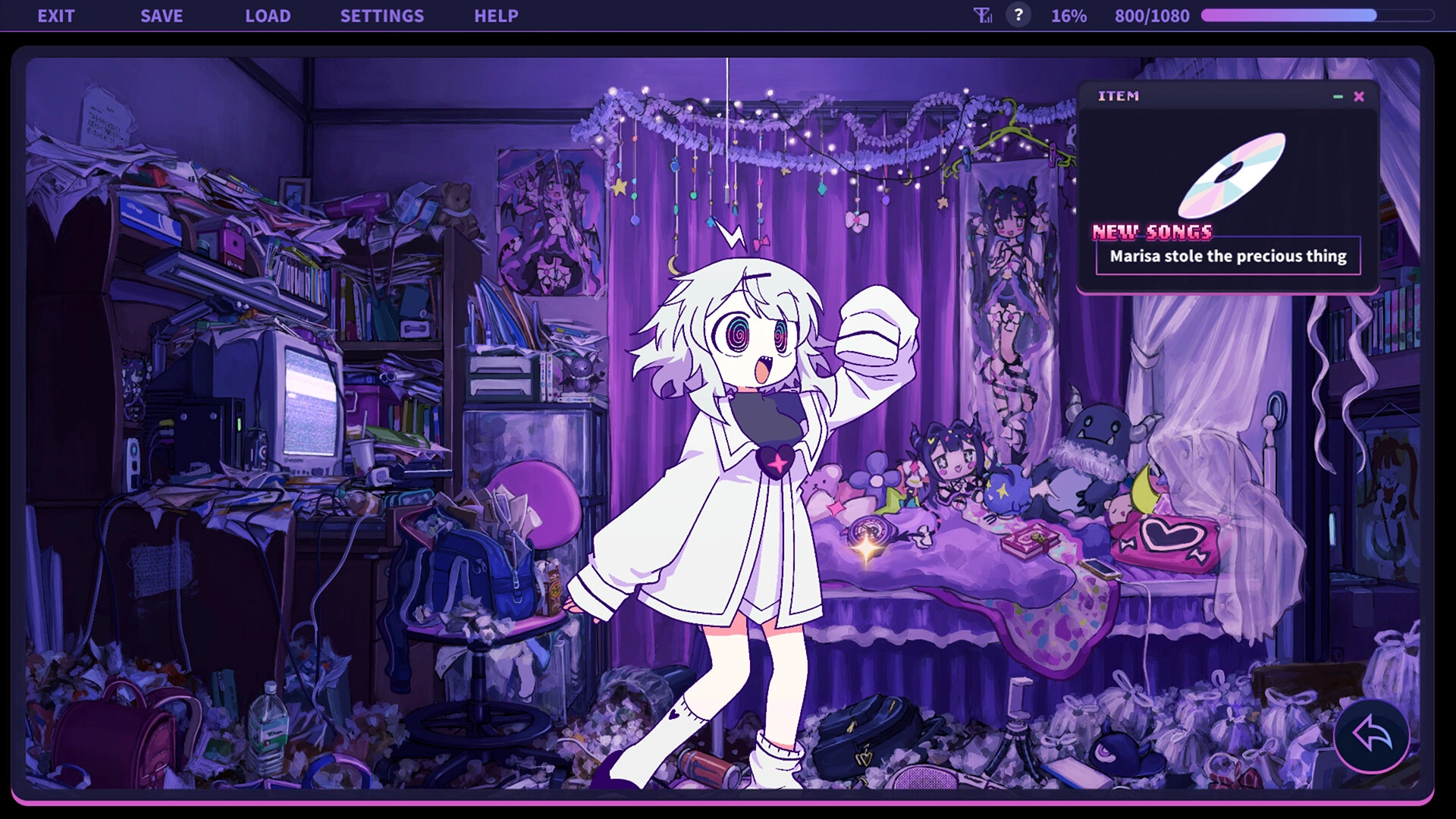
Qtie’s room tells the story before any exposition does. It is messy, purple-hued, packed with Yunyun merchandise, energy drinks, and the stale atmosphere of a life folding inward. Her obsession with Yunyun is a fandom fantasy, a coping mechanism, and possibly a symptom of something far darker. The game starts with silly worship of a fictional demon girl, then slowly lets sadness seep through the floorboards.
Yunyun’s role remains slippery. She may be Qtie’s imagined savior, a manifestation of obsession, a protective split in Qtie’s mind, or something predatory using devotion as a leash. The game is at its strongest when it refuses to settle that question too neatly. Yunyun’s repeated command to raise denpa levels turns into a design pressure, then a psychological one. The player wants progress. Qtie wants salvation. Yunyun wants the number to rise. Those desires begin to resemble each other in uncomfortable ways.
The writing’s tonal dissonance can be brutal. One moment, Qtie’s posts twist some absurd meme into a hidden-world conspiracy. The next, her room or diary points toward neglect, bullying, and emotional abuse. Her mother may restock energy drinks, yet that practical help comes with coldness and flashes of cruelty. Qtie wants to be loved, wants to be good, wants to matter. The game keeps placing those wants beside jokes about secret masters of the world, making the humor feel unstable underfoot.
That tension gives the game its cross-cultural weight. In Japanese media, the shut-in character can be played for comedy, pity, critique, or horror. Here, Qtie belongs to that tradition, yet she also speaks to a wider digital condition. Many cultures now have their own versions of the isolated young person whose social life runs through screens, fandoms, and feedback loops. Yunyun Syndrome!? Rhythm Psychosis turns that shared condition into a rhythm system.
The meta-narrative details sharpen the unease. The game’s “load dream” framing and the lack of a standard “new game” option imply that reality is already compromised. Locked files, passwords, diary entries, notes, and PC interactions reward close attention. This approach recalls visual novels and psychological horror games that treat menus, files, and interface elements as narrative space. The result is a game where the desktop feels like a stage, the bedroom feels like a confession, and every hidden file feels like a bruise.
Conspiracies as Gameplay, Satire, and Self-Destruction
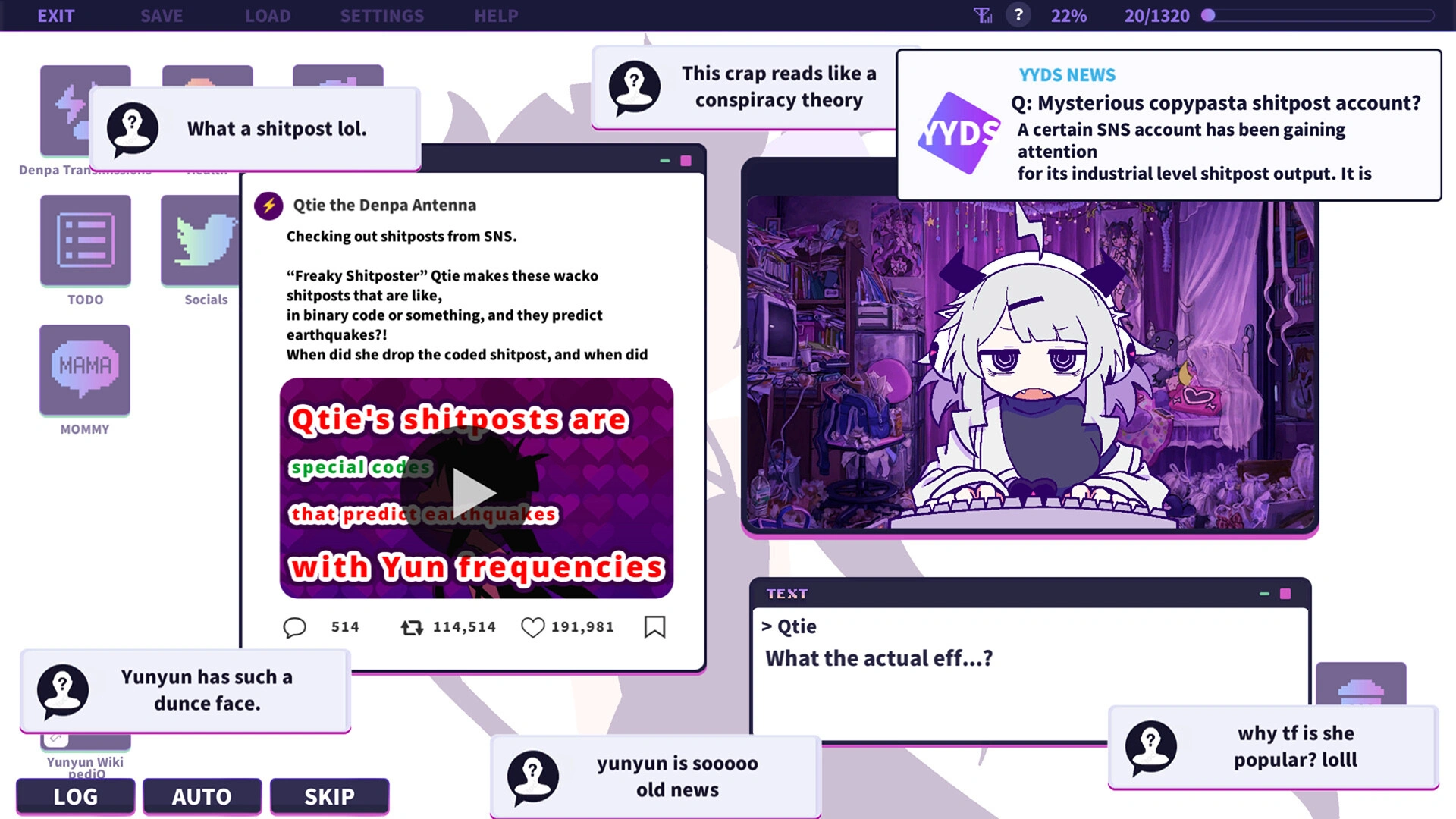
The posting system is one of the game’s smartest ideas. Qtie’s messages are semi-randomized through card choices and resource management, then filtered through a roulette-like process that turns strange posts into conspiracy theories. It is funny because the theories are ridiculous. It is grim because the process feels recognizable.
The satire ranges from nonsense to sharp cultural jab. Safety slogans become mind-control rituals. Digital money becomes divine surveillance. The sun becomes a human-made tool of obedience. Meme animals become emissaries of hidden powers. The absurdity is dressed in otaku chaos, yet the underlying logic mirrors real online radicalization: fragments of language gain meaning through repetition, audience reaction, and collective paranoia.
This is where Yunyun Syndrome!? Rhythm Psychosis feels informed by global media culture. Japanese denpa aesthetics give it shape, while the conspiracy engine taps into a worldwide crisis of belief. A post does not need to be coherent to spread. It needs rhythm, emotional charge, and a crowd ready to interpret it. The player is placed inside that machine, helping Qtie generate the very noise that consumes her.
The resources add a layer of strategy. Doki Doki, Yunyun, and Hype affect how quickly denpa rises and how theories develop. Energy Drinks can boost post ratings. Hype lets players choose specific theories, making progression less dependent on chance. Maxing theories can unlock theory-specific endings, which gives completionists a reason to chase every branch.
Those endings play like alternate descents. Some are comic. Some are disturbing. Many refuse neat closure. After a scenario erupts, Qtie often returns to her chair and keeps receiving signals. The effect is dreamlike, closer to a set of possible collapses than a traditional branching narrative. It can be confusing if approached with strict logic, yet that confusion fits a game about obsession, repetition, and unstable reality.
Momentum, Grind, and the Cost of the Signal
The first half of Yunyun Syndrome!? Rhythm Psychosis moves with impressive force. Goals are clear, story beats arrive often, Qtie’s online presence grows, a fake account complicates her rise, and each new unlock gives the player fresh material to process. The rhythm loop, conspiracy system, and psychological mystery work together with real momentum.
Then the pace slows. The denpa targets climb, story events spread out, and the tracklist of around 30 songs starts to feel smaller than it should. Replaying songs is expected in rhythm games, but here repetition is tied directly to story progress. That changes the emotional contract. Practicing a song for mastery feels different from grinding because the next scene is still several thresholds away.
The idle keyboard feature, which lets Qtie play songs automatically for a short stretch, is both clever and revealing. It gives tired players a way to keep progress moving, yet it also signals that the late-game loop has stretched too thin. If the game is willing to play itself for the player, the design may be admitting that its demands have outgrown its pleasures.
For a story-focused run, the game can sit around 10 hours, with extra time for higher difficulties, cleaner scores, hidden files, theory endings, and full completion. There is real value here for players drawn to rhythm games, experimental narrative design, and denpa culture. The concept has force. The writing cuts deeper than its manic surface suggests. The music has personality. The rhythm foundation welcomes players who might bounce off harsher genre entries.
The weaknesses are just as clear. The grind dulls the mid-to-late stretch. Repeated posts lose novelty. The audio mix can become tiring. High-level rhythm players may wish for stricter punishment and cleaner skill expression.
Yunyun Syndrome!? Rhythm Psychosis is abrasive, funny, sad, and hard to mistake for anything else. It turns fandom into ritual, rhythm into posting, and internet belief into a horror system. Its best ideas hit with alarming force, while its pacing sometimes fights against its own manic energy.
The Review
Yunyun Syndrome!? Rhythm Psychosis
Yunyun Syndrome!? Rhythm Psychosis is a strange, noisy, emotionally sharp rhythm game that turns internet obsession into both mechanic and nightmare. Its four-key play is accessible, its denpa soundtrack is infectious, and Qtie’s story has surprising sting. The late grind, crowded audio mix, and forgiving scoring hold it back, especially for rhythm purists, yet its identity is too bold to dismiss.
PROS
- Distinct denpa identity
- Catchy, chaotic soundtrack
- Strong narrative-mechanical link
- Qtie’s story has real emotional weight
- Accessible four-lane rhythm design
- Smart satire of online conspiracy culture
CONS
- Late-game grind hurts pacing
- Audio effects can overwhelm the music
- Scoring may feel too forgiving
- Repeated posts lose novelty
- Narrow appeal for players outside denpa or experimental rhythm games