























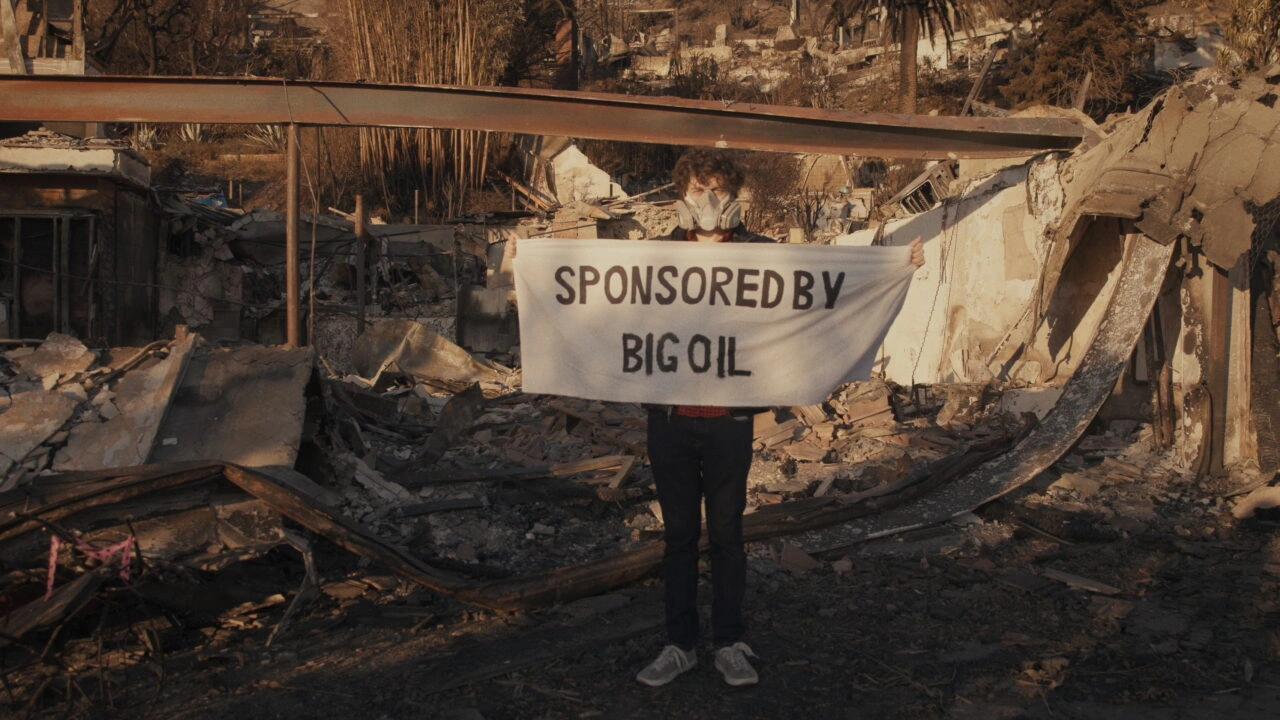
Just Look Up begins with a scene any documentary editor would be grateful to have in the bin. A formal event for Bank of America CEO Brian Moynihan is interrupted by members of Climate Defiance, who enter the room, accuse the bank of helping fund fossil fuels, unfurl a “Bank of Atrocities” banner, and get dragged out by security with the kind of unnecessary force that makes everyone in a suit look worse by the second.
It is a clean opening because it gives the film its whole shape in miniature. Emma Wall and Betsy Hershey are following a group built around interruption: of speeches, fundraisers, polite political rituals, and the old fantasy that climate politics can still be handled through soft language and patient procedure. The group’s founder, Michael Greenberg, wants to “shake society awake,” and the film spends its running time watching him test that phrase against bankers, senators, journalists, allies, grandparents, and his own staff.
The documentary is set through the torrid year of 2024, with Trump’s reelection eventually giving the material a firmer dramatic spine. Before that spine arrives, the film sometimes drifts. Climate change may be the subject, but the film is really about activist structure: who leads, who follows, who gets heard, who gets filmed, and who decides that a stunt has worked.
The Protest Loop
Climate Defiance has a repeatable format, and Just Look Up understands the mechanics of it. The activists get into an elite room, wait for a public figure to speak, interrupt with chants and banners, record the confrontation on phones, then turn the footage into social clips.
Brian Moynihan is one target. Joe Manchin is another. Banking executives and Democratic centrists become recurring obstacles in a campaign aimed less at denialists than at the “mushy middle,” Greenberg’s phrase for politicians who accept climate science, then keep moving at committee-room speed while the house burns.
The film is strongest before and after these actions. The planning sessions have the nervous charge of a low-budget heist movie. The debriefs are better still, because the group starts to sound less like a symbol and more like a workplace. Members assess timing, volume, camera placement, and security response. Every chant becomes an edit point. Every exit becomes usable footage. This is activism with a media plan attached.
Also Read






That clarity cuts both ways. Greenberg measures success through views, and the film keeps showing actions that produce them. What it rarely shows is the next link in the chain. Does a viral clip move a lawmaker? Does it shift a donor? Does it change the way a news outlet covers fossil fuel money? The documentary can prove attention. It struggles to prove leverage.
Michael Greenberg, Unfinished Character Study
Greenberg is an obvious documentary subject because he is many things at once: organizer, spokesman, fundraiser, queer Jewish stand-up comic, former nonprofit staffer, and the person most likely to turn a room’s discomfort into fuel.
The film catches him preparing Shabbat, performing open-mic comedy, speaking with his supportive grandparents, and making the case for confrontation as a moral necessity. These are good fragments. They suggest a person whose politics, faith, identity, humor, and ambition are tangled in ways the film can feel, then declines to untie.
The stand-up scenes are especially revealing because they show Greenberg using timing, tension, and self-exposure as tools. That clearly carries into the protests. He knows how to hold a room right up to the instant the room rejects him. A sharper film would have stayed with that connection: comedy as rehearsal for public conflict, activism as performance with stakes attached.
The key missed scene arrives in Greenberg’s apartment, where Climate Defiance staff discuss bringing in a co-executive director. The proposal sounds practical. The room seems ready for it. Greenberg resists. Faces tighten. A real organizational story briefly appears: the founder who built the machine may be the same person preventing it from growing cleanly. Then the film moves on. That is the documentary’s recurring structural problem. It finds pressure points, touches them, and backs away before they bruise.
Access Without Enough Interrogation
Wall and Hershey get close to Climate Defiance, and that access matters. Timothy Grucza’s camera rides with the activists through corridors, sidewalks, meeting rooms, and confrontations where security guards behave as if a banner were a weapon. The footage gives the viewer the physical grammar of direct action: the hush before entry, the first raised voice, the scramble, the push, the adrenaline dump afterward.
The film also catches the group’s political ecosystem. Ro Khanna appears in conversation. Pramila Jayapal, Summer Lee, Jamal Bowman, and Zohran Mamdani represent the kind of elected allies Climate Defiance wants to pull into louder public alignment. Those moments give the documentary a useful map of left politics in the Democratic orbit, especially once the election year begins to darken.
Still, Just Look Up leaves too many basic questions unanswered. How does Climate Defiance fund itself? What happens after arrests? What legal risks do members carry? What concrete wins count beyond social reach? How are targets chosen? Who can challenge Greenberg inside the group without being treated as a problem to manage?
The film does not need to become a spreadsheet. Nobody goes to a protest documentary for quarterly metrics, unless they have made several life choices worth revisiting. Yet a movement portrait needs a working skeleton. Here, the skeleton is visible only in flashes.
Just Look Up captures the urgency, courage, and theatrical intelligence of Climate Defiance. It also captures, sometimes by accident, the limits of a group still trying to decide if it wants to be a movement, a media engine, or Michael Greenberg’s extended megaphone. The footage is alive. The film around it needed a steadier hand with the scalpel.
Just Look Up is a feature-length documentary film that had its world premiere at the CPH:DOX festival on March 6, 2026, where it won the prestigious F:Act Award. It has since embarked on a prominent film festival run, making its North American premiere at the Tribeca Festival on June 11, 2026, followed by screenings at the Sydney Film Festival and Thessaloniki Documentary Festival. The film immerses the audience in the world of modern American environmental activism, tracing the trajectory of the youth-led protest group Climate Defiance and its passionate founder, Michael Greenberg. As of its current mid-2026 festival circuit run, wide public streaming or theatrical availability details are handled through international sales representatives at Range Media.
Full Credits
Title: Just Look Up
Distributor: Final Cut for Real, Guest House Productions
Release date: March 6, 2026
Rating: Unclassified 15+ (Festival Rating)
Running time: 93 minutes
Director: Emma Wall, Betsy Hershey
Writers: Emma Wall, Betsy Hershey
Producers and Executive Producers: Signe Byrge Sørensen, Natja Rosner, Adam McKay, Joshua Oppenheimer, Geralyn White Dreyfous
Cast: Michael Greenberg, Ro Khanna, Pramila Jayapal, Jamaal Bowman, Summer Lee, Zohran Mamdani
Director of Photography (Cinematographer): Timothy Grucza
Editors: Adam Nielsen
Composer: RØMANS
The Review
Just Look Up
Just Look Up has urgent footage, real access, and a strong eye for the nervous mechanics of direct action. Its protest scenes crackle, and Michael Greenberg makes for a fascinating central figure. The problem is follow-through. The film spots the richer story inside Climate Defiance, especially around leadership, funding, legal risk, and actual political leverage, then keeps moving before those questions can land. Alive in the moment, thin in the aftermath.
PROS
- Strong opening protest scene
- Revealing planning and debrief moments
- Close access to Climate Defiance
- Michael Greenberg has clear screen presence
- Election-year tension adds shape
CONS
- Repetitive protest structure
- Too many unanswered questions
- Greenberg remains underexplored
- Weak sense of concrete impact
- Internal group tensions get dropped