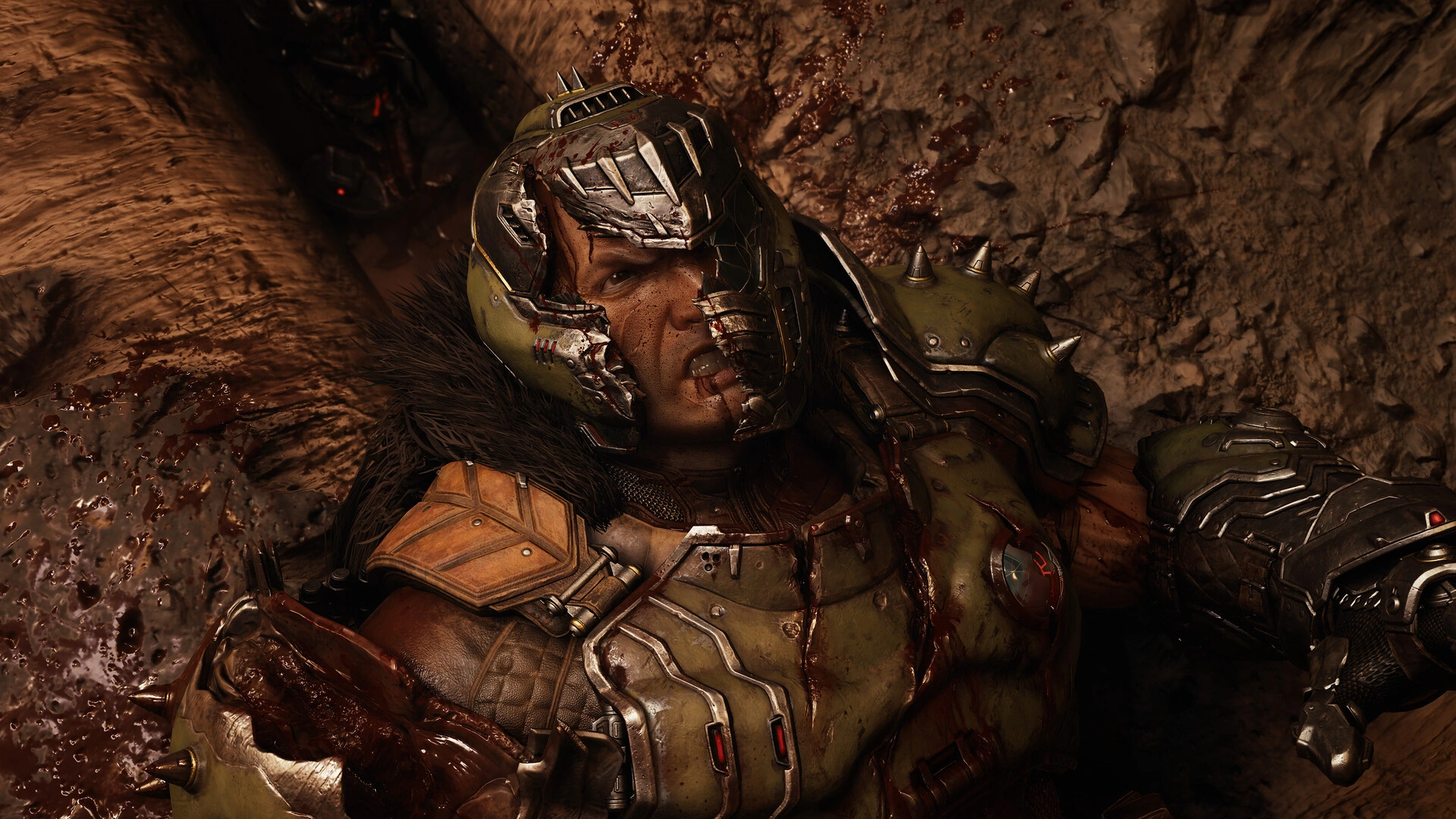
Losing the Shield Saw changes the first hour of Revelations from a familiar power fantasy into a mechanical reset. The Slayer enters Purgatory stripped of the tool that defined The Dark Ages, and the Chain Spear placed in his hands demands a harsher kind of precision. Green attacks can still be parried, but there is no shield held in reserve when the timing fails. You must strike into the attack, creating a direct collision between weapon and threat.
That single change alters the combat loop. The base campaign often asked players to hold ground, absorb pressure, and punish an opening. The spear asks you to create the opening yourself. Throw it into a demon and the chain pulls the Slayer toward the target while preserving directional control. You can rise above an enemy, swing around its flank, or cancel the approach into an aerial slam.
The returning dash completes that shift. A projectile sequence that once required several parries can now be escaped with a lateral burst, followed by a spear grapple over the attacking group. Revelations keeps the Slayer’s heavy movement and violent impact, then gives the player enough mobility to decide where that weight lands.
One Tool, Several Decisions
The Chain Spear works because its upgrades change decisions rather than raising damage numbers alone. Platinum purchases unlock a thrust, a ranged throw, and a ground slam, each tied to particular enemy problems. The thrust deals increased damage to heavy melee demons. The javelin throw punishes flying targets and can pierce the fence-like projectiles created by Mancubi. The upgraded slam forces enemies caught in its explosion to release health.
These abilities revive DOOM Eternal’s enemy-counter structure without forcing constant firearm rotation. A Cosmic Elemental sends homing creatures across the arena, so the spear throw becomes a targeted answer rather than another attack competing for attention. An Archvile arrives behind layered shields and begins summoning reinforcements, turning target priority into a timed problem: break the cage, interrupt the ritual, then survive everything already spawned.
The Shield Saw eventually returns, and switching between both tools creates the expansion’s strongest combat system. The shield can stop pressure, stagger enemies, and carve through armor. The spear can reposition the Slayer, isolate airborne threats, and create health through an upgraded slam. A single encounter might involve throwing the shield to stun one demon, grappling past another with the spear, landing behind the group, and firing the Super Shotgun before the formation can turn.
The controls sometimes resist that fluency. Shield and spear throws use different inputs, as do their defensive actions. During crowded fights, muscle memory can produce the wrong move at the worst time. Pressing the shield parry button while holding the spear launches the Slayer toward a target, which is a creative way to convert one mistake into three.
Arenas Built Around Movement
The four main levels sit between the broad battlefields of The Dark Ages and the aerial combat routes of DOOM Eternal. Grapple points are embedded in enemies rather than fixed around the environment, so movement depends on reading the current formation. A flying demon can serve as a temporary anchor, letting the Slayer gain height before dropping into a cluster with the spear slam.
This design keeps space tactical. Distance is a resource, height is an attack setup, and every demon can alter the route through an arena. On higher difficulties, standing still turns incoming projectiles into visual noise within seconds. Survival requires moving through the enemy group instead of retreating from it.
The difficulty rises sharply from the opening encounters. Players arriving without strong knowledge of the base arsenal will struggle, since the expansion assumes familiarity with parries, weak points, weapon functions, and resource generation. Adjustable parry windows soften the entry point, but the enemy compositions still test several systems at once.
Some later battlefields lack the visual identity of the frozen Hell and ruined structures encountered early on. The hidden endgame boss also relies heavily on screen-filling attacks, reducing the clean tactical readability found in the best encounters. The fight is difficult, yet difficulty becomes less interesting when the player cannot easily identify which system failed.
The Campaign After the Campaign
Purgatory serves as a hub between missions, offering puzzles, teleporter codes, locked routes, and spaces that open after new abilities are acquired. Its quieter pace gives players room to test movement without another army pouring into the room. Returning with the spear slam or a new traversal option reveals paths that were visible earlier but unreachable.
Completing the campaign grants the Master Key, which opens purple doors throughout Purgatory and the four levels. Behind them are combat trials, Platinum caches, upgrade materials, optional bosses, and pieces of the Astral Key. Time trials test execution under pressure, while strength challenges ask players to survive dense enemy waves with limited room for error.
Hidden stages styled after the 1993 DOOM supply short bursts of retro level design and reward pieces of a powerful classic shotgun. Their compact layouts offer a useful change of scale after the expansion’s giant arenas, though they end before their old-school rules can develop into full encounters.
Secret hunting is less considerate. Collectibles remain absent from the map until found, and completed levels cannot be revisited before the main campaign ends. Crossing a point of no return can lock away an upgrade or key fragment for several hours. Exploration becomes a memory test, and the punishment rarely teaches anything about the underlying systems.
Revelations gives experienced players a demanding set of mechanics to learn, combine, and eventually control. The Chain Spear changes movement, defense, resource generation, and enemy prioritization at once, making every successful arena feel earned through understanding rather than raw firepower.
The Review
DOOM: The Dark Ages | Revelations
9Score
DOOM: The Dark Ages | Revelations rebuilds the Slayer’s combat loop around movement, timing, and rapid tool switching. The Chain Spear creates meaningful choices in every arena, while the returning dash restores the spatial freedom missing from the base campaign. Some overlapping controls make early fights harder for the wrong reasons, and collectible restrictions punish exploration mistakes. Once its systems click, the expansion delivers id Software’s sharpest fusion of The Dark Ages’ weight and DOOM Eternal’s speed.
When you login first time using a Social Login button, we collect your account public profile information shared by Social Login provider, based on your privacy settings. We also get your email address to automatically create an account for you in our website. Once your account is created, you'll be logged-in to this account.
DisagreeAgree
Connect with
I allow to create an account
When you login first time using a Social Login button, we collect your account public profile information shared by Social Login provider, based on your privacy settings. We also get your email address to automatically create an account for you in our website. Once your account is created, you'll be logged-in to this account.