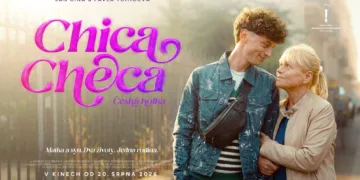



























Czech queer cinema has rarely granted its characters the luxury of an uncomplicated homecoming. Secrecy, isolation, and social punishment have often shaped such stories, especially those set beyond Prague. Šimon Holý takes the opposite route in Chica Checa, placing acceptance inside a small village and treating it as an attainable part of ordinary family life.
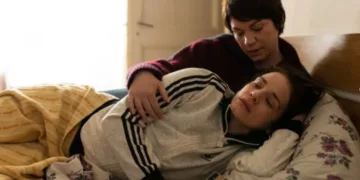
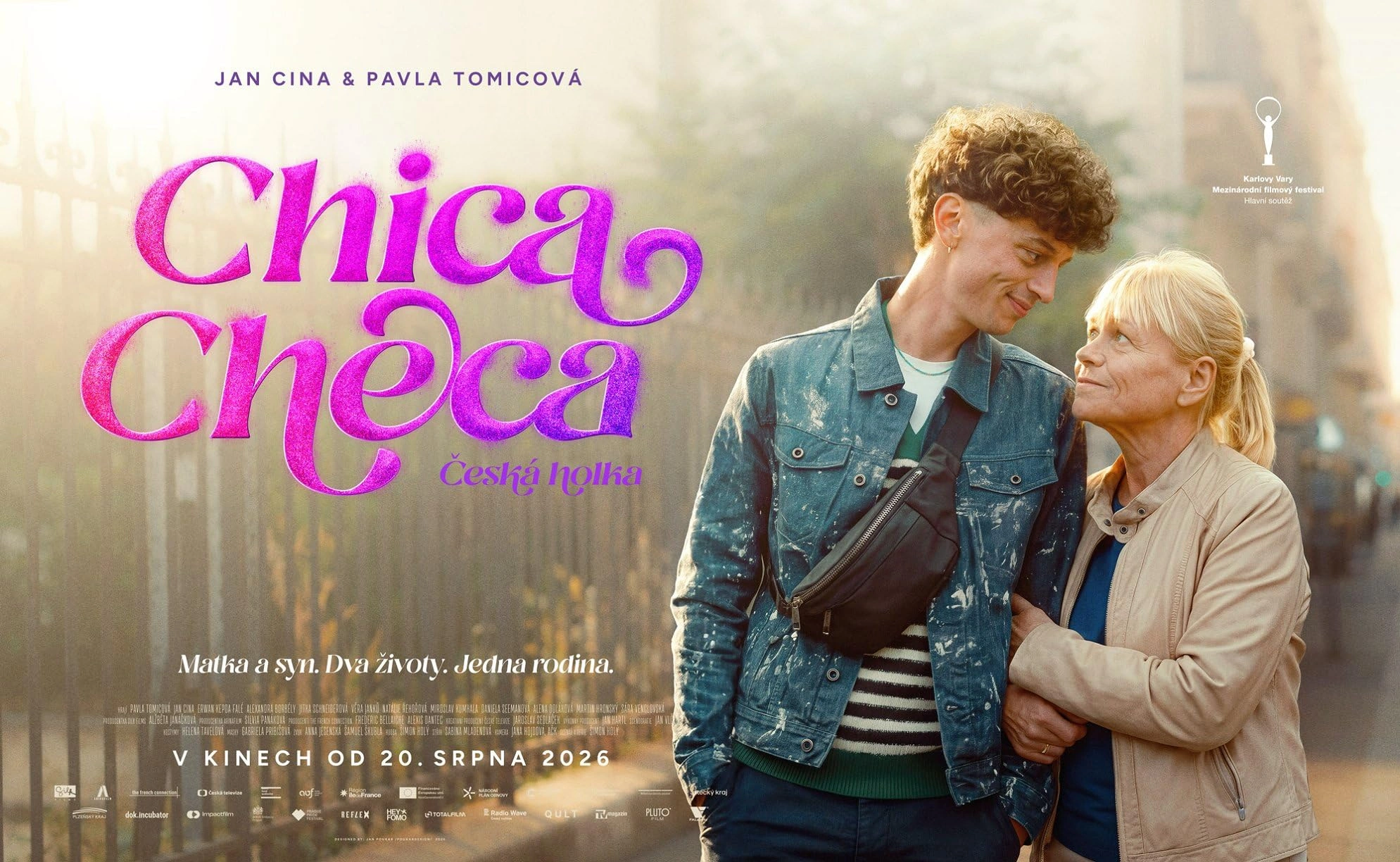
Zdena, played by Pavla Tomicová, is a widowed former postwoman caring for her dying mother while deciding what to do with a house that has become too large for her. Her son Lukáš returns from France after learning that his grandmother has little time left. The old woman asks to see Czech pop star Helena Vondráčková one final time, a request that Lukáš proposes fulfilling himself. Her sight and hearing are failing, and his professional drag persona could complete the illusion.
The arrangement turns a deathbed wish into an improvised bridge between two lives. It also exposes the central tension in Holý’s film: his belief in kindness feels culturally valuable, while his refusal to let hostility linger often makes that kindness look suspiciously effortless.
Hidden in Plain Sight
Lukáš has told his mother that he works in a French bank. He actually performs in Paris as the drag artist Chica Checa and lives with his boyfriend, Remi. His revelation arrives after Zdena worries that hospital staff might mistake him for gay if he impersonates Helena. Lukáš responds by correcting both her assumption and the false biography he has maintained.
The argument carries genuine force. Zdena’s shock is mixed with the humiliation of discovering how little she knows about her child, while Lukáš speaks with the fatigue of someone tired of editing himself for family consumption. Yet the following morning finds most of that pain already drained from the room. The film moves rapidly from confrontation to tentative cooperation.
Holý treats Zdena’s prejudice as a product of limited exposure. Her village is not presented as uniquely cruel. It is simply a place where queer residents have learned to remain unseen. When an acquaintance tells Lukáš that there are few people like him locally, he replies that there are plenty. She would be surprised. The line locates the film within a recognizably Central European tension between public conformity and private difference.
Also Read





The neighbors’ responses support Holý’s optimism. They offer mild jokes and familiar declarations that people should live as they please. Such reactions may sound dramatically convenient, yet their ordinariness is part of the point. Queer existence enters village life without turning the community into a tribunal.
The weakness lies in the film’s unwillingness to test this openness. Zdena repeatedly gathers the courage to tell someone that her son has a boyfriend, then receives another harmless response. A culture of silence cannot be dismantled solely through pleasant conversations, and Chica Checa rarely imagines what happens when affection meets resistance that refuses to soften.
Two Acting Traditions
Tomicová plays Zdena through constant physical expression. Her widened eyes, nervous smiles, and delayed reactions reveal a woman learning a new emotional vocabulary in real time. When she tells acquaintances about Lukáš, embarrassment and protectiveness pass across her face before she can settle on the words. The performance gives visible shape to social habits that the screenplay resolves too quickly.
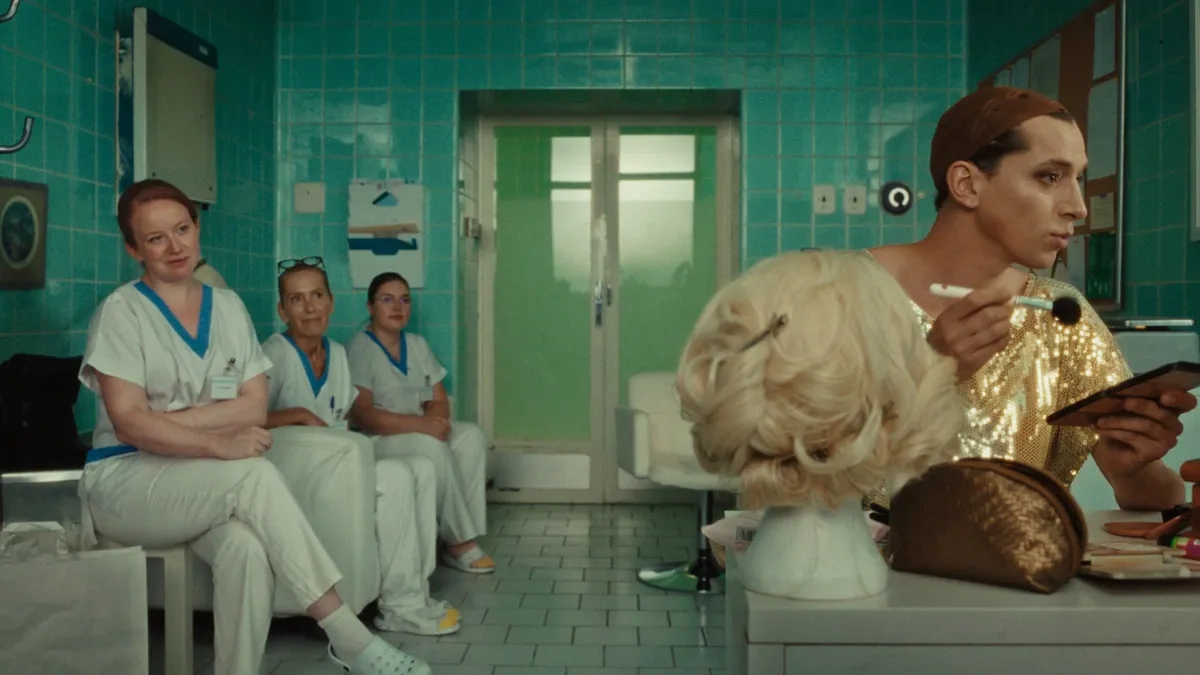
At times, her heightened manner pushes Zdena toward the broad register of a television comedy. Jan Cina works differently. His Lukáš is quieter and more naturalistic, with frustration held in his posture before it reaches his voice. Their scenes occasionally seem to belong to separate films: she occupies a cheerful village farce, while he carries the emotional history of concealment and a relationship in distress.
That clash becomes productive during the drag sequences. Cina’s dance training controls Chica Checa’s posture, gestures, and command of space. His impersonation of Helena for the hospital audience is staged with affection rather than spectacle. Holý uses drag sparingly, linking it to family care instead of turning it into an exotic attraction for viewers unfamiliar with the form.
The performance also changes Zdena’s understanding of her son. In Paris, she sees the confidence and professional discipline hidden behind his invented banking career. Drag becomes a cultural translation device: Lukáš does not explain himself through a speech, but through movement, music, costume, and the community that already knows him fully.
A Village Without Sharp Corners
Holý introduces enough dramatic material for a much harsher film. Zdena is considering an offer from a wealthy Slovak woman who wants to build a travel business. Lukáš’s relationship with Remi appears close to breaking. His grandmother is dying, his mother is grieving, and the family home may soon belong to someone else.
These threads rarely gather pressure. Lukáš suddenly accuses Zdena of being trapped in the past, then the dispute fades. Remi remains an attractive outline rather than a developed partner, leaving Lukáš’s private life less detailed than his stage persona. Zdena is described as socially withdrawn after her husband’s death, yet she attends a dance and later joins a house party. The contradictions feel less like character complexity than missing connective tissue.
The visual language carries similar uncertainty. Garish costumes and flat interiors sometimes give the production the appearance of mainstream Czech television, while occasional wide-lens shots arrive without a clear comic or psychological purpose. A fuller commitment to screwball energy might have turned these choices into style. Holý instead moves between naturalism and broad sentiment without establishing rules for either.
Still, the film’s optimism has a distinct regional charge. Zdena’s gradual acceptance does not require her to abandon village life or become cosmopolitan overnight. Lukáš does not return from Paris to rescue her from provincial ignorance. Each learns to see the other’s concealed existence: his as a queer performer, hers as a widow quietly searching for companionship and permission to begin again.
The cultural exchange runs both ways, and that is where Chica Checa finds its warmest truth.
The heartwarming co-production Chica Checa celebrated its grand world premiere earlier this month on July 4, 2026, competing in the main Crystal Globe category at the 60th Karlovy Vary International Film Festival. Audiences eagerly tracking the project can catch its upcoming nationwide theatrical rollout across the Czech Republic beginning August 20, 2026, courtesy of local distributor Falcon a.s. The narrative chronicles a widowed village mail carrier who attempts to fulfill her ailing mother’s final wish, only for the subsequent family reunion to expose her visiting son’s hidden alternative lifestyle as a Parisian drag queen.
Full Credits
Title: Chica Checa
Distributor: Falcon a.s., Pluto Film
Release date: July 4, 2026 (Karlovy Vary International Film Festival World Premiere), August 20, 2026 (Czech Republic Theatrical Release)
Running time: 97 minutes
Director: Šimon Holý
Writers: Šimon Holý
Producers and Executive Producers: Alžběta Janáčková, Silvia Panáková, Frédéric Bellaïche, Gábor Osváth
Cast: Pavla Tomicová, Jan Cina, Alexandra Borbély, Erwan Kepoa Falé, Jitka Schneiderová, Alena Doláková, Natálie Řehořová, Sára Venclovská, Věra Janků, Martin Hronský, Miroslav Kumhala, Ludmila Sonková
Director of Photography (Cinematographer): Jana Hojdová
Editors: Sabina Mladenová
Composer: Šimon Holý
The Review
Chica Checa
Chica Checa offers a rare Czech coming-out story shaped by warmth rather than punishment, and its cultural specificity gives that optimism genuine value. Pavla Tomicová its cultural specificity gives that optimism genuine value. Pav and Jan Cina create an affectionate mother-son bond, while the hospital drag performance turns performance into an act of family care. Yet Šimon Holý resolves prejudice, grief, romance, and displacement so quickly that kindness begins to feel like narrative convenience. The film’s gentle vision deserves respect, even when its craft cannot fully support it.
PROS
- Warm central relationship
- Culturally specific queer perspective
- Expressive lead performances
- Purposeful use of drag
- Hopeful rural setting
CONS
- Conflicts resolve too easily
- Uneven tonal registers
- Lukáš lacks private depth
- Inconsistent character details
- Distracting visual choices