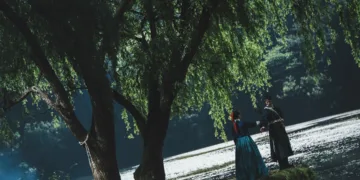































The royal family has a ghost problem, which is awkward for a King who insists ghosts do not exist. Set in a fictionalized Joseon-era Korea, The East Palace begins its eight-episode run with a Crown Prince dead beside the palace pond. He is the third heir to suffer the same fate, and the timing revives a tragedy from thirty years earlier, when several princes died under similarly unnatural circumstances. The Queen Dowager remembers. The King prefers that everyone else forget.
His public position is that spirits cannot touch royal blood. His private response is to seek the monk who contained the earlier threat. The monk is too old to return, so he recommends Gu-cheon, a lowborn spirit slayer who can see the dead and enter the Realm of Gwi. Gu-cheon refuses. The King has him kidnapped.
It is a wonderfully efficient introduction to both men. Gu-cheon has no respect for rank, ceremony, or employment. The King respects all three, provided he controls them. His offer is simple: save the last surviving prince or receive a very personal demonstration of royal authority.
Saeng-gang, a court lady who can hear spirits, is assigned to monitor him. She is also the King’s unrecognized daughter, a fact that turns her position into a cruel administrative joke. She lives inside the palace, serves its rulers, and receives none of the protection her blood should grant her.
The premise has plenty of moving pieces, yet the first episode arranges them cleanly. A murdered heir, an afflicted child, a reluctant exorcist, an abandoned daughter, and a monarch hiding family history all converge before Gu-cheon’s first sword has finished breaking. Palace bureaucracy has rarely moved this quickly.
Ghosts With Grievances
The spirits in The East Palace arrive with classifications, habits, and specific appetites. Gu-cheon explains gwi-mae, won-gwi, and ggeomeoksali in scattered lessons that grow naturally from the investigation. The last of these drains Yang energy from living bodies, placing Gu-cheon at a disadvantage because he has very little Yang to spare. Saeng-gang has plenty.
Their opposing spiritual conditions create a practical partnership before either character develops an emotional reason to trust the other. Gu-cheon can see and fight the dead. Saeng-gang can hear them and survive encounters that leave him weakened. Yin and Yang become less a decorative motif than a working arrangement.
The Realm of Gwi gives this system its strongest visual identity. Gu-cheon’s crossings carry him from the palace’s cold blues and damp stone into a crimson reflection filled with distorted spaces and hostile motion. Director Choi Jung-kyu shoots these transitions with the energy of animation, letting bodies stretch, weapons strike with exaggerated force, and spirits move at speeds that feel wrong for anything once human.
The first confrontation with the pond spirit sets the standard. Prince Yeongan convulses under possession while Gu-cheon enters Gwi to face the creature directly. He cuts off its head. It grows another. His sword shatters. The spirit rises again, taller and angrier, apparently unimpressed by conventional workplace procedures.
Gu-cheon’s most revealing response is a question. He asks what grievance drives it to murder the royal bloodline. That inquiry separates the series from a basic monster hunt. These ghosts carry resentment created by betrayal, violence, and concealed crimes. Killing one can stop an attack. Understanding one means confronting the people who caused it.
The creature designs support that idea. Practical makeup and digital effects give each spirit a body shaped by its suffering. Some remain recognizably human. Others look as though anger has rebuilt them badly. The grotesque details matter because the monsters never feel selected from a generic effects catalogue.
The action is sleek and bloody, though several night battles are lit so dimly that the choreography becomes guesswork. A few modern music cues also wander into the palace like tourists who missed the dress code. The dead are frightening enough. They do not need a playlist.
Two Reluctant Allies
Nam Joo-hyuk plays Gu-cheon as a man who has converted exhaustion into a personality. He drinks, sleeps, complains, and treats royal etiquette as an optional hobby. His refusal to help can become irritating in the early episodes, especially while Prince Yeongan is visibly dying a few rooms away.
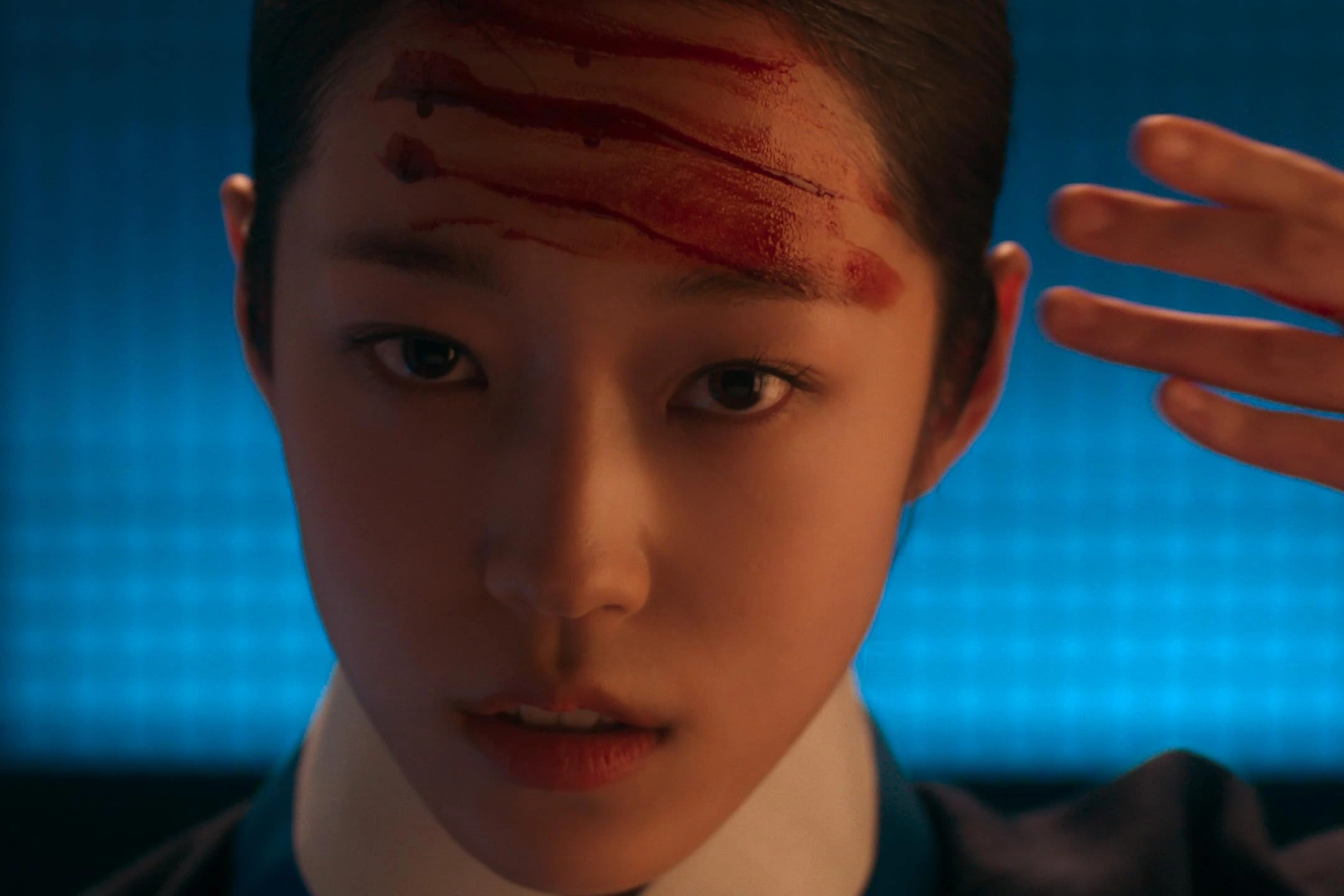
The performance gradually exposes what the attitude is protecting. Gu-cheon has spent years seeing pain that other people cannot perceive. Entering Gwi hurts him. Returning does not leave the experience behind. Watch how his posture changes before each crossing, or how quickly his sarcasm disappears when Saeng-gang is threatened. The jokes are not confidence. They are insulation.
Saeng-gang has built a different defense. Roh Yoon-seo keeps her upright, controlled, and painfully aware of palace hierarchy. She follows protocol until protocol protects the people who harmed her. Then the restraint begins to crack.
Her ability to hear spirits has isolated her since childhood, and her place at court extends that isolation into adulthood. She works within reach of her father while being denied the status of his daughter. The King still uses her loyalty, sending her to report on Gu-cheon and push the investigation forward.
Roh gives Saeng-gang practical force. She is skilled with a bow, quick to challenge Gu-cheon, and capable of acting without waiting for rescue. Her later confrontation with the Queen Dowager is especially sharp. Years of anger push against courtly discipline, and every pause feels like Saeng-gang deciding how much truth the room can survive.
Her chemistry with Gu-cheon grows through irritation rather than instant affection. She believes his indifference is selfish. He thinks her loyalty to the palace is dangerously naïve. Their arguments have a loose, sibling-like rhythm, with Gu-cheon supplying provocation and Saeng-gang supplying consequences.
Romantic tension flickers around the edges, yet companionship proves richer. They teach each other how to use the abilities that ruined their separate lives. They rescue each other. They become allies once they realize the palace has lied to both of them. He sees too much. She hears what refuses to stay silent. Together, they make a surprisingly functional complaints department.
The Royal Family Business
Cho Seung-woo’s King can shift from paternal fear to political menace within a single exchange. He dismisses spirits before his court, threatens Gu-cheon in private, and conceals the history needed to end the curse. His affection for Prince Yeongan feels sincere. So does his belief that the throne permits any cruelty required to preserve it.
Cho plays those impulses without smoothing the contradiction. The King can be smug, furious, calculating, and briefly tender. His face often changes before his voice does, giving a warning that the person across from him usually ignores. Royal audiences would be shorter if people watched his eyebrows.
Jang Young-nam matches him as the Queen Dowager. She carries grief from the earlier deaths, yet sorrow has hardened into control. Her quiet gaze can dominate a scene before she raises her voice, and her exchanges with Saeng-gang expose the gulf between protecting a family and preserving a dynasty.
The political plot works because the supernatural threat grows directly from royal conduct. Each new spirit points toward a crime the palace buried. Each concealed fact gives the curse another reason to persist. Gu-cheon may be hired to destroy a monster, yet Saeng-gang understands that the real obstacle is a ruling family trained to treat memory as a security risk.
The show repeatedly pairs opposites: the palace and Gwi, Yin and Yang, parent and abandoned child, living offender and dead witness. These patterns could feel tidy, but the performances keep them human. Prince Yeongan’s possession, played with alarming physical commitment by Jo Dan, turns dynastic consequence into the sight of a child’s body failing under an inherited punishment. The ghosts want recognition. The palace wants discretion. One side screams less politely.
Twists in the Spirit Rules
The season’s first half moves with impressive discipline. Episode 1 establishes the dead Crown Prince, Gu-cheon’s abduction, Saeng-gang’s divided loyalty, Prince Yeongan’s possession, and the failed attack on the pond spirit. Episode 2 expands the rules of Gwi while allowing the central pair’s hostility to generate comedy.
Later chapters build clues through spirit encounters, suspicious behavior, physical evidence, and conversations that carry hidden motives. The eight-episode format keeps the investigation from stalling, and the midpoint changes the central question. Gu-cheon and Saeng-gang stop asking how to kill one spirit and start asking what happened thirty years ago.
That shift gives the royal family drama its best material. Betrayals land harder than sword strikes because they force each character to reconsider the person standing beside them. The cast handles those reversals with enough control to keep the emotional line intact.
The writing becomes less reliable as the finale approaches. New rules governing possession, Yang energy, Gwi, and spiritual power appear or bend whenever another reveal needs room. Confessions arrive with missing motivation. Concealed identities and surprise connections pile up until the mythology seems to require a palace accountant.
Some dialogue also explains feelings and supernatural mechanics that the actors have already made clear. This is a series with expressive faces, elaborate production design, and monsters capable of turning their heads the wrong way. Trust the room.
Still, the excess never fully breaks the season. The visual craft remains polished, the combat retains its snap, and the central partnership holds steady while the plot ties itself into increasingly decorative knots. By the final stretch, cutting down a vengeful spirit looks easy. Getting the royal family to admit what it did may require another season.
This South Korean dark fantasy series premiered on July 17, 2026, and is available to stream on Netflix. The story follows an arrogant ghost-slayer and a court lady with the ability to communicate with the dead as they are summoned by the King to investigate a deadly curse haunting the royal family.
Where to Watch The East Palace Online


Full Credits
Title: The East Palace
Distributor: Netflix
Release date: July 17, 2026
Running time: Approximately 60 minutes per episode
Director: Choi Jung-kyu
Writers: Kwon So-ra, Seo Jae-won
Producers and Executive Producers: Showrunners, Imaginus
Cast: Nam Joo-hyuk, Roh Yoon-seo, Cho Seung-woo, Jang Young-nam, Park Soo-yeon, Noh I-jin, Hong Seo-jun, Choi Hyuk-joo
Composer: Kim Joon-seok, Jung Se-rin
The Review
The East Palace
The East Palace gives royal corruption a ghost problem and lets both sides behave badly. Its crisp palace imagery, grotesque spirit designs, and lively combat make the Realm of Gwi worth visiting, while Nam Joo-hyuk and Roh Yoon-seo turn forced cooperation into convincing trust. The final episodes stack twists until the mythology starts requiring clerical support, yet the cast keeps the family betrayals sharper than the swords. A stylish, bloody court fantasy whose ghosts are easier to understand than its rulers.
PROS
- Distinctive spirit and creature designs
- Strong Gu-cheon and Saeng-gang partnership
- Rich palace sets and costumes
- Excellent royal ensemble performances
CONS
- Overloaded late-season twists
- Spiritual rules bend too freely
- Some battles are poorly lit
- Occasional intrusive music choices