






























Greta Álvarez knows why she was conceived. The first episode places her voice over the clinical image of an egg being fertilized as she explains that her parents selected her to become a bone-marrow donor for Lucy, the older sister diagnosed with leukemia as a baby. It is an efficient opening because it gives The Map of Longing its central dramatic problem before introducing its romance: Greta has spent her entire life serving a purpose assigned to her by somebody else.
The transplant allows Lucy and Greta to grow up together, but Lucy’s illness remains the organizing force inside the Álvarez household. Their parents direct their energy toward the child who may die, while Greta relies heavily on her grandfather and learns to treat her own needs as secondary. Lucy eventually dies at 26, leaving Greta without the person she loves most and without the role that once explained her existence.
Alice Kellen’s novel gives this six-episode Netflix adaptation a strong structural device. On Lucy’s first birthday after her death, Greta visits her sister’s favorite burger restaurant and meets Will Tucker, a bartender she has never seen before. He carries a wooden, book-shaped game filled with numbered compartments. Lucy called it “The Map of Longing,” and each compartment contains a challenge Greta must complete. It is a grief drama built like a scavenger hunt. That arrangement sounds dangerously cute. Sometimes it is.
Recovery by Number
Greta initially refuses to read Lucy’s letter or accept the game, and Will refuses to hand it over unless she agrees to play. Their standoff gives the premiere a useful source of friction, particularly when Greta attempts to settle the issue through a staring contest. Will claims he has not smiled in two years. The line announces his emotional damage with the subtlety of a name tag.
Greta returns after drinking alone and eventually takes the first challenge: attend a support group for people who have lost relatives. The task gives the series its recurring pattern. Lucy identifies an emotional blockage, Greta resists the proposed solution, and the episode pushes her toward a small act of movement.
This framework keeps the story focused, but it also turns recovery into a sequence of scheduled appointments. Each task arrives with an implied lesson, so Greta’s path is rarely difficult to predict. Therapy, family confrontation, independence, and romantic openness appear as stations along a route Lucy has already designed.
The writing works better when Greta disrupts that route. She attends the support group while remaining skeptical. She attempts to involve her mother, who spends her days staring at the television in a depressive fog, yet one session cannot repair the distance between them. Her father retreats into work, preserving the appearance of function while avoiding the house and everyone inside it.
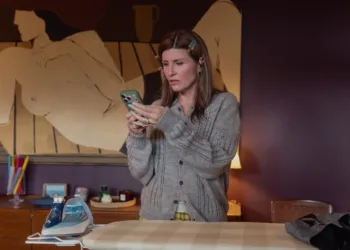
The family home provides the clearest account of their condition. Unwashed dishes, discarded tissues, and neglected rooms make grief physical without turning every scene into a speech. Greta can leave for Will’s warm bar or his cozy trailer, but she still has to return to the place where Lucy’s absence has settled into the furniture.
Greta Becomes a Person
Alícia Falcó gives the series its emotional credibility. The premiere sometimes writes Greta as a familiar romantic heroine: impulsive, talkative, disarming, and apparently capable of irritating a mysterious man into loving her. Falcó keeps those scenes lively, especially during Greta and Will’s first confrontations, but the performance gains weight once the writing allows Greta to become less charming.

Her strongest scenes hold several feelings at once. Greta loved Lucy deeply, yet she also grew up beneath the pressure of Lucy’s illness. She misses her sister, resents the childhood that disappeared into hospital visits, and feels guilty for imagining a future organized around her own desires. Falcó does not flatten these contradictions into a clean grief arc. Her anger frequently arrives before she can explain it, then collapses into shame.
Georgina Amorós faces a different problem as Lucy, who appears through flashbacks, imagined conversations, and memories polished by loss. The series sometimes makes Lucy seem unusually wise, as if death granted her complete knowledge of everyone’s emotional needs. Amorós protects the character from becoming a plot device by giving her teasing exchanges with Greta a casual sisterly rhythm.
One of the season’s best moments occurs when Lucy’s favorite song plays at Will’s bar. Greta imagines her sister singing at the far end of the room, then accepts Will’s hug without treating comfort as betrayal. The scene works because it does not require Greta to choose between remembering Lucy and participating in the present.
The Man Holding the Map
Pablo Álvarez has immediate chemistry with Falcó. Will sitting beside Greta while she sleeps off her drinking outside the bar reveals his tenderness before the script explains it. Their arguments carry enough spark to support the romance, and his guarded manner gives Greta somebody to investigate while he guides her through Lucy’s challenges. The problem arrives when secrecy must become character.
Will’s wealthy background, estrangement from his family, and past cruelty emerge later through concentrated exposition. The series proposes two versions of him: the callous man he once was and the sensitive bartender transformed by tragedy and his connection to Lucy. The distance between those versions is too large for the explanation provided. Álvarez can play guilt, reserve, and romantic concern, but he cannot supply the missing steps in Will’s development.
This imbalance affects the season’s shape. Greta changes through resistance, setbacks, family conflict, and specific choices. Will changes because the story says he already did. His past enters mainly to interrupt the romance, then recedes once it has performed that function.
The narrow focus also deprives the supporting cast of useful pressure. Greta’s grandfather receives a few warm scenes that hint at the childhood he helped stabilize. Her mother’s depression and her father’s avoidance could have supported fuller arcs. The support group introduces people capable of challenging Greta’s assumptions, then sends them to the narrative waiting room.
The Map of Longing gives its heroine a carefully plotted route out of paralysis. Falcó makes every hesitant step feel earned. Will, meanwhile, arrives holding the instructions and never quite becomes somebody who could have written his own.
The series premiered on Netflix on July 17, 2026. Following the unexpected death of her sister Lucy, Greta discovers a game left behind called “The Map of Longing,” which challenges her to face her grief and embark on a journey of self-discovery alongside a mysterious stranger named Will.
Where to Watch The Map of Longing Online


Full Credits
Title: The Map of Longing
Distributor: Netflix
Release date: July 17, 2026
Running time: 6 episodes
Director: Laura M. Campos, Gemma Ferraté
Writers: Isa Sánchez
Producers and Executive Producers: Netflix
Cast: Alícia Falcó, Pablo Álvarez, Georgina Amorós, Laia Marull, Mario de la Rosa, Ramón Barea
The Review
The Map of Longing
The Map of Longing builds a tidy dramatic route through grief, with each challenge pushing Greta toward the life she never formed outside her sister’s illness. Alícia Falcó gives that structure its emotional credibility, especially when Greta’s love for Lucy collides with resentment, guilt, and relief. The supporting family arcs remain underwritten, while Will’s transformation from privileged cruelty to sensitive romantic guide asks for faith the script has not earned. The series reaches genuine feeling whenever it stops arranging recovery and lets Greta resist it.
PROS
- Alícia Falcó’s layered lead performance
- Effective challenge-based structure
- Believable sisterly chemistry
- Specific portrayals of family grief
- Warm, inviting visual atmosphere
CONS
- Will remains thinly developed
- Unconvincing redemption backstory
- Supporting characters lack space
- Predictable healing milestones
- Uneven first-episode characterization