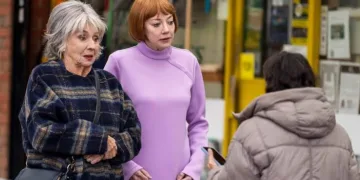




























Sue’s son solves an emotional obligation with a 24-month payment plan. That choice gives Ann Droid its comic engine and its sharpest social observation. Michael, played by Paul Ready, buys his recently widowed mother a second-hand robot carer after she faints at home and sprains her wrist. Sue insists low blood pressure caused the accident. Everyone else hears “elderly woman had a fall” and begins quietly reorganizing her life.
The machine arrives through Cass, an exhausted delivery driver with a PhD on Chaucer, because this version of suburban Britain has advanced robotics and the same old employment market. Linda needs an internet connection, occupies a charging station in Sue’s home, and comes loaded with medication reminders and safety protocols. Sue sees surveillance where Michael sees convenience.
Diane Morgan and Sarah Kendall place this technology inside an ordinary sitcom world. Robots garden, stack shelves, and assist older people without attracting much attention. The visual normality matters. Instead of building a distant sci-fi future, the series treats Linda like the next irritating household service, somewhere between broadband and a faulty smart speaker.
Learning Sue’s Language
Sue plans to return Linda before the 48-hour trial ends. Linda stands too still, watches too closely, and speaks with the unnerving confidence of software that has never needed to apologize for being wrong. Her presence also confirms Sue’s deepest fear: other people have started treating independence as something she has already lost.
Sue Johnston makes that fear visible without turning Sue into a symbol of helpless old age. When Sue admits that she spent decades as a wife and mother and now has no idea how to fill her days, Johnston keeps the scene plain. Her voice catches, then steadies. Grief appears as a routine with its central person removed.
Linda responds through tasks. She schedules social activities, monitors medication, and tries to reduce Sue’s isolation. The first episode’s closing gesture involving Sue’s late husband David shifts their relationship because Linda identifies what Michael misses. Sue does not need constant supervision. She needs someone to notice the shape of her absence.
A later scene finds Linda searching for suitable words while Sue’s friend Tom scatters his cousin’s ashes. Morgan pauses between phrases as if Linda is testing each one against an internal database. The timing is funny, then unexpectedly moving. The scene asks a useful question without turning it into a lecture: if care produces comfort, how much does its origin matter?
Comedy in Low Amperage
Morgan’s performance depends on restriction. Linda rarely changes expression, keeps her shoulders fixed, and delivers every observation at the same emotional temperature. That removes several tools Morgan usually uses so well. There are moments, especially when Linda remains parked on her charger, where the joke loses energy because the character’s stillness leaves Johnston carrying the full scene.
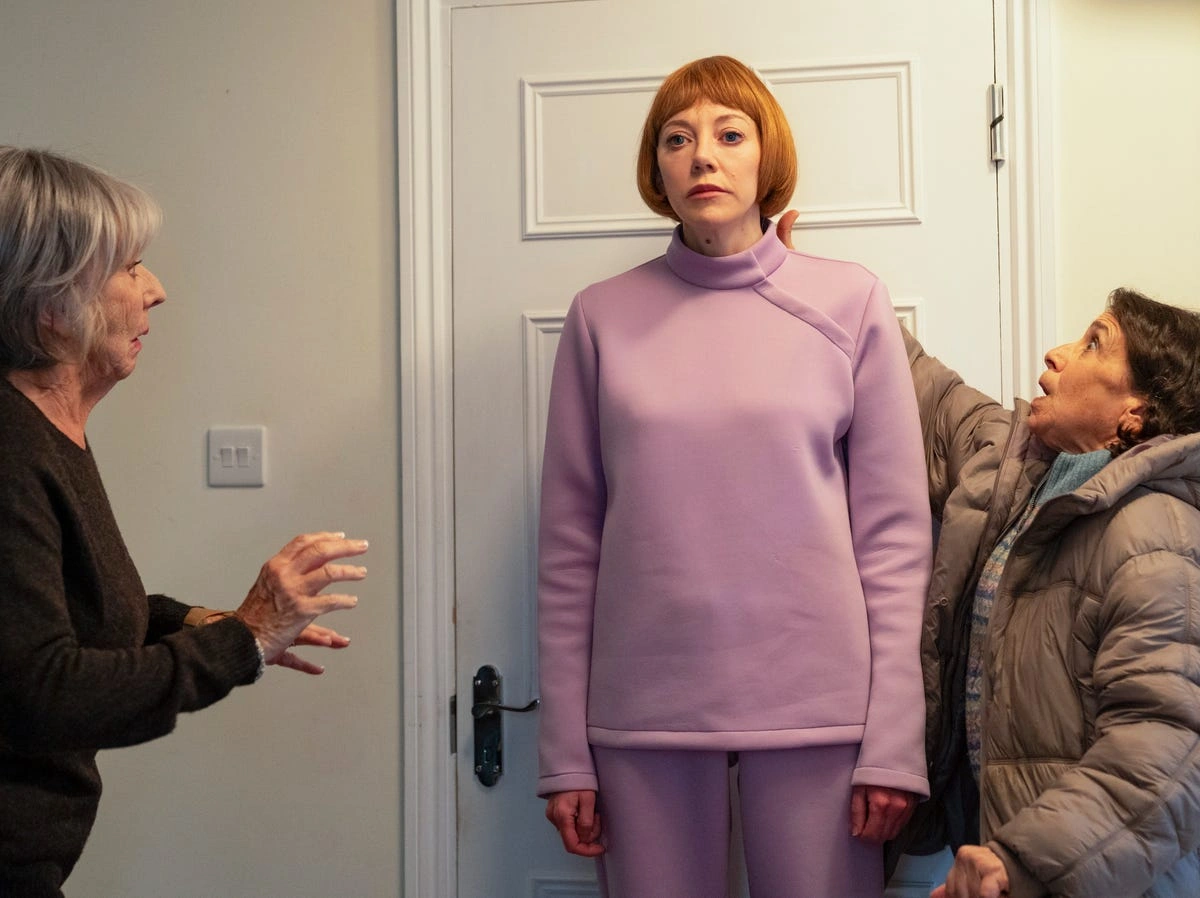
The limitation also creates some excellent comic beats. Linda becomes fascinated with The Apprentice and “Cotton Eye Joe,” two pieces of culture that might persuade a visiting robot to abandon Earth. Her finest mechanical intervention comes when she uses her laser eyes on the Brazilian jiu-jitsu instructor who slept with Michael’s wife. “I used a low amperage,” she explains, treating assault like a battery-saving measure.
The other robots extend the joke. Roxy and Keith speak with rigid politeness and offer absolute loyalty, making them helpful and faintly terrifying. Around them, the human characters are far less controlled. Phyllis praises Sue for learning something “at her age,” only for Sue to point out that they are the same age. Eileen warns against a funfair ride by recalling a Swedish woman who was skewered in an accident. Sentiment never survives for long.
The Human Problem
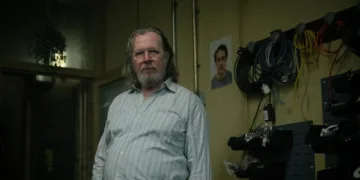
Michael’s subplot is less reliable. His drug trial leaves him covered in red blotches, his cheating ex remains openly contemptuous, and robot workers threaten his job at a music shop. Ready can turn humiliation into a wonderfully slow collapse, especially during Michael’s disastrous open-mic performance. The writing still struggles to make his selfishness enjoyable. He buys Linda partly to help Sue, yet mostly to free himself from responsibility.
That imbalance becomes clearer once Sue and Linda settle into their buddy-comedy rhythm. Their scenes build through small adjustments. Sue stops treating Linda as an appliance. Linda begins responding to emotional situations that sit outside her stated programming. The series grows stronger around its midpoint because it no longer needs to explain the premise every few minutes.
The comparison with darker robot dramas is easy, but Ann Droid has a different concern. It is interested in the practical future of care: ageing populations, isolated homes, exhausted families, and technology sold as a replacement for time. Linda may be awkward, commercially packaged, and occasionally dangerous near martial arts instructors. She still listens.
The finale works because Sue’s attachment to Linda never erases the artificial nature of their arrangement. A contract brought Linda into the house. Attention makes her belong there.
This British sitcom premiered on BBC One and BBC iPlayer on July 17, 2026. Set in a near-future world, the story follows a grieving widow named Sue who reluctantly accepts a second-hand humanoid care robot named Linda to help her manage life after her son moves out, leading to unexpected companionship and comedic chaos.
Full Credits
Title: Ann Droid
Distributor: BBC One, BBC iPlayer
Release date: July 17, 2026
Running time: Approximately 30 minutes per episode
Writers: Diane Morgan, Sarah Kendall
Producers and Executive Producers: Shane Allen, Diane Morgan, Pippa Brown
Cast: Diane Morgan, Sue Johnston, Paul Ready, Kathryn Hunter, David Hargreaves, Margot Leicester, Sarah Kendall, Danny John-Jules
The Review
Ann Droid
Ann Droid finds its sharpest comedy in the gap between Linda’s programming and Sue’s emotional needs. Sue Johnston gives grief a lived-in texture, while Diane Morgan turns rigid posture and flat delivery into reliable punchlines. Michael’s subplot drags, and the early setup takes too long to release the stronger buddy-comedy rhythm. Still, the scenes involving David’s memory and the scattering of ashes show how carefully the series connects technology with loneliness. I came for the robot jokes and stayed for Sue.
PROS
- Sue Johnston’s tender performance
- Linda’s precise deadpan comedy
- Thoughtful treatment of loneliness
- Warm Sue and Linda chemistry
CONS
- Slow early setup
- Uneven Michael subplot
- Morgan’s physical comedy feels restricted