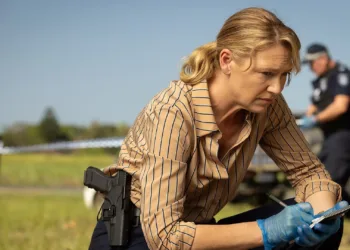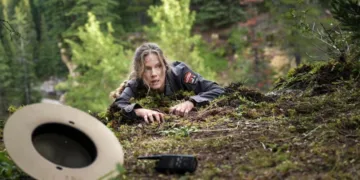











Anna Pigeon keeps packing her life into temporary ranger houses because staying somewhere would require admitting that somewhere matters. That restless instinct gives USA Network’s adaptation of Nevada Barr’s mystery novels its best character idea, one that Tracy Spiridakos can communicate with a raised eyebrow or a clipped answer long before the script explains it aloud.
Created by Morwyn Brebner, the series places Anna at Glacier National Park, with Alberta standing in for Montana through enormous mountain ranges, rushing rivers, forests, cliffs, and the sort of golden-hour photography that makes even a murder investigation look ready for a tourism brochure. Anna was once a Broadway stage manager in New York. After her husband Zach was killed during a home invasion, she became a law-enforcement park ranger and began moving from assignment to assignment.
Glacier is supposed to be another stop. Her young colleague Zoey Bear Child sees her as a mentor, fellow ranger Manny Lopez has become a friend, and bartender Jesse Garland has become something considerably less complicated. Anna still plans to leave. Then ranger Sheila is murdered.
The death forces Anna to remain in the one place she was preparing to abandon, turning a weekly crime procedural into a quieter story about what happens when running away stops working. The series has the right character for that tension. Its scripts are much less certain about what to do with her.
Spiridakos Against the Script
Spiridakos makes Anna convincing through movement first. When she climbs, pursues a suspect, handles a weapon, or takes control of an emergency, there is little hesitation in her physical performance. That matters for a character whose résumé sounds slightly absurd when spoken aloud: Broadway stage manager becomes armed national park ranger becomes local crime solver.
Her humor helps too. Anna can treat littering with mock severity, snap at somebody who is wasting her time, then switch into genuine concern when a ranger or tourist is threatened. Spiridakos finds a useful overlap between sarcasm and warmth. You can see why Zoey admires her without needing a scene where Zoey explains the relationship. Unfortunately, explanation is one of the show’s favorite tools.
FBI agent Frederick Stanton gets a particularly clumsy example when he essentially recites Anna’s biography back to her, mentioning her arts degree, East Coast parents, psychiatrist sister, and preference for bouncing between shabby ranger houses. It is information written for us while pretending to be conversation between two people who already know it.
The early self-talk is even stranger. Anna wanders through the park identifying objects aloud, including the memorable moment when she looks at a discarded can and says, “Beer can?” Her habit fades after the premiere, but the replacement is an internal monologue about grief and nature that appears around episode openings and endings.
Voice-over can be a useful tool when it reveals something the images cannot. Here, it often tells us Anna is introspective while her behavior shows a woman arranging her life specifically to avoid introspection. Watching her refuse permanence, drink heavily, sleep with Jesse without asking for emotional security, and keep moving toward physical danger tells us far more about Zach’s death than a polished meditation ever could.
Her sister Molly creates a similar problem. Played by Tricia Helfer, she phones Anna from New York and functions as therapist, sibling, and exposition delivery system at once. When Molly tells Anna that attractive men are her weakness, the insight lands somewhere between psychiatric diagnosis and teasing text message.
Jesse at least fits Anna’s emotional logic. Their relationship asks little from her, and Cooper Levy plays him with enough easygoing charm to make that arrangement plausible. His talent-show strip routine suggests the series is also aware of why he has been cast. Television remains television.
Mystery of the Week, Memory of the Hour
The basic procedural engine is simple. A death, disappearance, suspicious stranger, or dangerous situation appears somewhere around Glacier, Anna starts asking questions, and the culprit is usually identified before the episode ends. That structure gives the series an easy rhythm. It also exposes how often the park setting is cosmetic.

One episode sends Anna into a decades-old bank robbery mystery. Another centers on a family secretly living inside the park. A rainstorm strands her with tourists while suspicion grows that one of them may be a murderer. Children get placed in danger, old secrets resurface, suspects lie badly, and people have a remarkable habit of becoming very talkative once Anna confronts them. The frustrating part is that the show has access to a much better procedural system whenever it lets the wilderness change how a mystery works.
Consider Anna’s encounters with the mountain lion. The animal cannot be questioned, intimidated, or folded into a traditional suspect list, so the scenes force Anna to read tracks, movement, distance, and danger differently. The landscape becomes part of the storytelling process rather than wallpaper behind it.
Sheila’s death receives similar care. The sequence in which Anna and the other rangers move their colleague’s body lingers for a few extra beats. Nobody needs to announce that losing one of their own has changed the station. The blocking does the work. The group physically carries the weight together.
The later episodes involving Anna being pushed into a pit sharpen this idea further. Now the terrain traps her, limits her options, and connects immediate survival to the trauma she keeps suppressing. Her past is no longer something narrated over pretty trees. It affects how she responds under pressure.
Those episodes reveal what the show could build its identity around. A ranger procedural should give its hero problems that police officers in conventional crime dramas could not solve the same way. Glacier provides cliffs, wildlife, isolation, storms, limited access, and hours between help. Whenever the writing actually uses those things, the familiar mystery format gains texture. Whenever it does not, another suspect confesses and another beautiful valley waits patiently in the background.
Good Rangers, Thin Enemies
Paulina Alexis gives Zoey Bear Child the strongest supporting presence because her relationship with Anna develops through behavior. Zoey watches Anna closely, follows her into investigations, pushes against her instinct to leave, and treats her as somebody worth learning from. Anna, who insists on avoiding attachments, keeps behaving like a mentor anyway.
Zoey’s Indigenous identity is handled with welcome ease. It informs who she is without swallowing every scene she appears in. Crystle Lightning’s Frieda Dierkz helps by ensuring Zoey is not the series’ sole Native character, while Frieda’s lively presence gives the ranger office some personality beyond police-procedural functionality.
There is still an uncomfortable limitation to how the show uses its Montana setting. Across the episodes supplied for review, violence against women repeatedly centers white female victims. That choice sits oddly beside a series clearly aware enough of the region’s Indigenous communities to build Native characters into its ranger ensemble.
Manny Lopez has another potentially rich parallel with Anna. He is a veteran living with PTSD, meaning both characters carry trauma into a profession built around protecting other people. The early episodes give Manuel Rodriguez-Saenz pieces of that history without consistently finding stories that make Manny’s experience active.
Ronnie Rowe’s Frederick Stanton fares better because his FBI agent can flirt with Anna and challenge her professionally in the same scene. Their encounters give Spiridakos someone capable of returning her energy. Then there is Jeremiah Paulson.
Kim Coates plays the wealthy landowner as a man who seems to arrive already expecting ominous music. His hostility toward the park and Anna gives the season a recurring enemy connected to environmental exploitation, but his dialogue rarely permits ambiguity. At one point he calls Anna a rapidly aging widow whose touch ruins everything. It is the kind of insult that tells us a villain is cruel while quietly reminding us that somebody had to type it into a screenplay. Coates can do menace. Here, the character keeps announcing it for him.
The Mountains Never Miss
Lea Thompson, who directs several episodes and serves as an executive producer, understands the most valuable production asset immediately: location. Wide frames allow mountains to dwarf the rangers beneath them, river scenes carry constant motion through otherwise quiet conversations, and golden-hour light gives the park an inviting quality that makes the crimes feel slightly more invasive.
The night photography deserves specific credit. Scenes in forests or remote areas retain enough detail to read faces, movement, and terrain without turning darkness into black sludge. It sounds like a minor accomplishment until you watch a television drama where an expensive night shoot becomes a collection of vaguely moving silhouettes.
The camera becomes less confident indoors. Several dialogue scenes rely on static coverage with limited blocking, leaving actors standing or sitting while plot information passes between them. For a series built around a protagonist who hikes, climbs, investigates wilderness, and repeatedly places herself in physical danger, the visual grammar can become surprisingly sedentary.
The difference becomes clear during the pit sequence or the mountain lion encounters. Space suddenly matters. Where Anna stands, what she can reach, how far help is, and what lies outside the frame all become part of the suspense. Cinematography stops decorating the story and begins explaining it.
That is the version of the series worth developing: Spiridakos moving through an environment that constantly changes the rules of the case, Zoey and the ranger community giving Anna reasons to stay, and mysteries shaped by the land rather than merely photographed against it. For now, the mountains are doing their share of the work. They are waiting for the writing to catch up.
Anna Pigeon premiered on August 7, 2026, on the USA Network. The crime drama follows a former city dweller who begins a new life as a park ranger after suffering a personal tragedy, only to find herself investigating complex crimes within America’s national parks.
Full Credits
Title: Anna Pigeon
Distributor: USA Network
Release date: August 7, 2026
Rating: TV-14
Running time: 60 minutes
Director: Lea Thompson, Matthew Hastings, Samir Rehem, Peter Stebbings
Writers: Noelle Carbone, Mika Collins, Marsha Greene
Producers and Executive Producers: Morwyn Brebner, Cineflix Studios, December Films, SEVEN24 Films
Cast: Tracy Spiridakos, Ronnie Rowe, Paulina Alexis, Tricia Helfer, Kim Coates, Melanie Scrofano, Manuel Rodriguez-Saenz, Ryan Northcott
Director of Photography (Cinematographer): Paul Sarossy
Editors: Sandy Pereira
Composer: Jonathan Goldsmith
The Review
Anna Pigeon
Anna Pigeon has the ingredients of a sharper procedural than the one it currently delivers. Tracy Spiridakos gives Anna enough bite, humor, and physical confidence to keep predictable cases moving, while the Alberta wilderness supplies images the plotting rarely matches. The strongest episodes make cliffs, storms, wildlife, and isolation part of the mystery itself. Too often, though, blunt exposition, obvious culprits, and Jeremiah Paulson's cartoonish villainy flatten that potential. There is a good park-ranger crime show hiding here. The scenery finds it first.
PROS
- Tracy Spiridakos carries the lead role
- Beautiful wilderness photography
- Strong Anna and Zoey dynamic
- Park-specific dangers improve the mysteries
CONS
- Predictable weekly cases
- Heavy-handed exposition
- Thin season-long villain
- Uneven supporting characterization