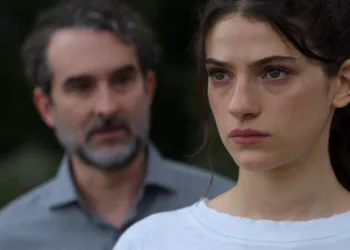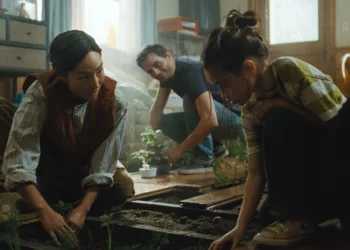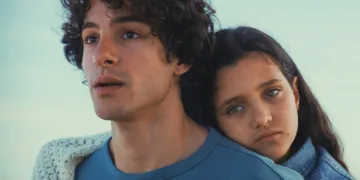











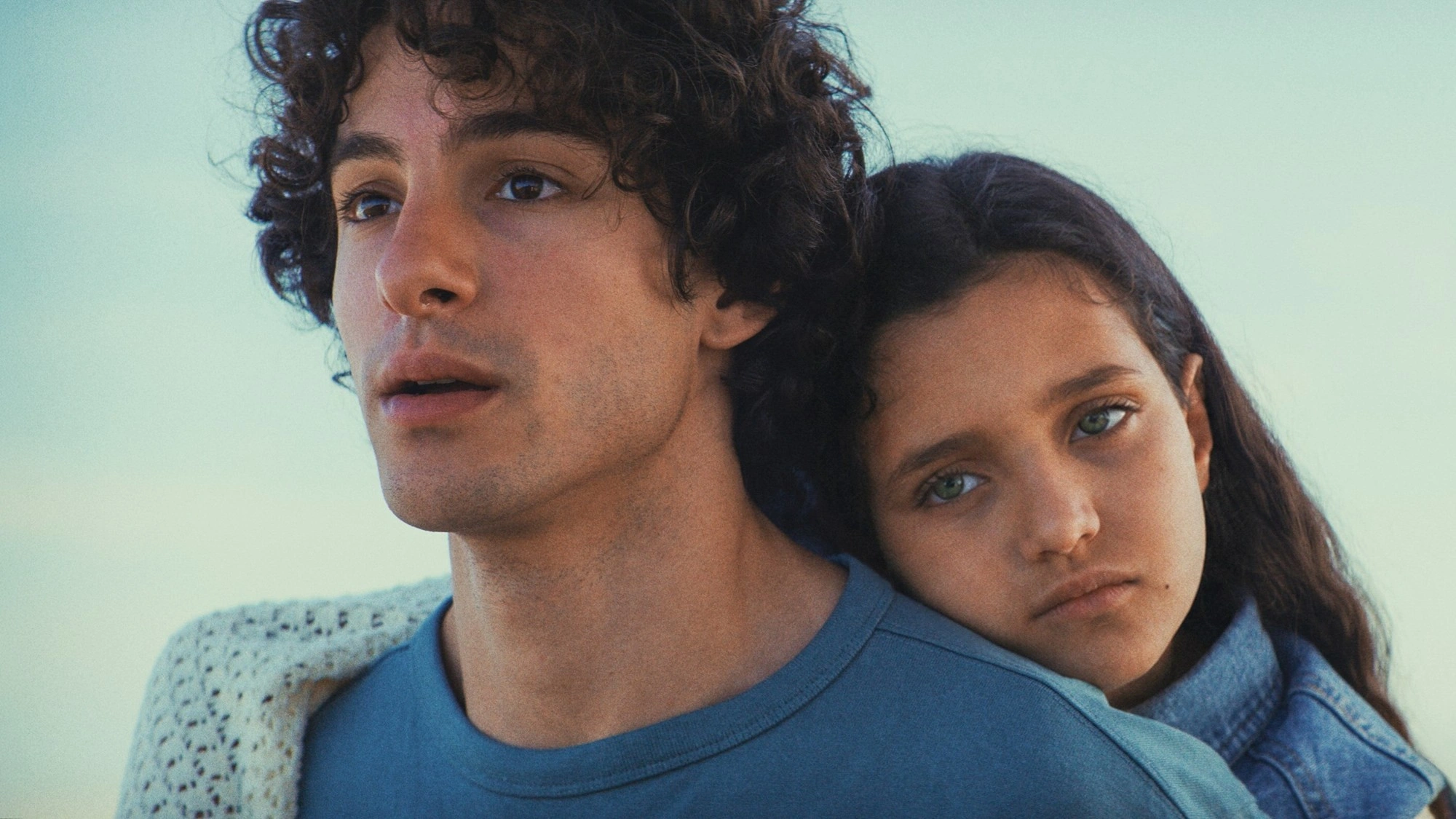

The cruelest idea in The Green Eyes is that Chaya already considers France home while the French state still considers her presence provisional. Three years after fleeing Iraq, the 11-year-old lives with her older brother Nour and their widowed father in the Landes region, where school, friendships, forests and coastline have gradually become ordinary. Then a letter arrives. Their asylum application has been rejected, and the ordinary life they have built becomes temporary overnight.
Fanny Liatard and Jérémy Trouilh treat that bureaucratic decision as an intimate form of violence. Nobody storms the family’s home. No villain arrives to threaten them. A piece of paper simply declares that belonging has expired.
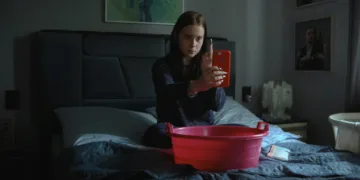
The siblings are already carrying the death of their mother, lost during their migration to France. Their father responds to the new crisis through movement, leaving for Spain in search of money and another possible escape route. Nour responds by stopping altogether. He falls into a deep, coma-like sleep associated with resignation syndrome, leaving Chaya to make sense of an illness that medicine can describe far more easily than it can resolve. Her explanation is simpler: Nour is hiding in his dreams.
The Child Who Keeps Moving
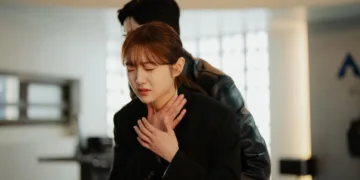
Douae Butarbuch M’Zaouki gives Chaya a stubborn physical energy that keeps the film from collapsing beneath its subject. She watches adults discuss foster care, medical treatment and legal procedure, then keeps returning to the one problem none of them can solve: her brother will not wake up.
Liatard and Trouilh wisely resist turning Chaya into a miniature adult. Her resourcefulness remains tangled with childhood logic. If Nour has hidden somewhere inside his dreams, then finding him requires entering that space. The reasoning sounds fantastical to everyone around her. From Chaya’s position, it is perfectly practical.
That perspective allows The Green Eyes to approach forced migration without reducing the family to a political case study. Chaya knows little about the machinery deciding her future, but she understands its effects. Home can disappear because someone she has never met signs a document. Her brother can become unreachable. Adults who care about her can still participate in systems that separate her from him.
Also Read





The supporting characters never acquire the same definition. Anamaria Vartolomei’s Marion offers warmth as Chaya’s teacher, while Arcadi Radeff’s Benjamin becomes another point of support around the siblings. Both are credible presences, yet the screenplay rarely grants them desires disconnected from the family’s emergency. Chaya feels alive beyond the plot. Several adults feel summoned by it.
Where Black Water Rises
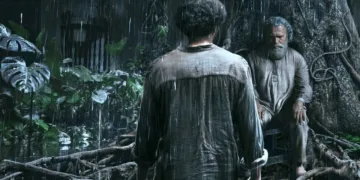
The directors’ strongest response to Nour’s condition arrives through images rather than explanation. Chaya’s attempt to reach his dream world transforms familiar environments into spaces flooded by black, ink-like water. Victor Seguin’s cinematography lets that darkness seep into the geography the siblings once associated with safety.
The Landes setting gives the film an unusually expressive physical vocabulary. Pine forests stretch toward the coast. The Contis Lighthouse rises from its strange inland position. Drone shots repeatedly place Chaya inside landscapes large enough to suggest freedom, while her legal situation keeps shrinking the territory available to her.
Nature becomes the film’s quiet political provocation. The sea does not ask Chaya for residency papers. The forest does not distinguish between citizen and refugee. These ideas emerge cleanly from the locations themselves, without requiring the dialogue to explain them.
Other symbols announce themselves too aggressively. Migrating cranes recur as an obvious parallel for the family’s displacement, their elegance unable to disguise how carefully the metaphor has been positioned. The black water is stronger because it carries uncertainty. It can suggest memory, grief, fear or the subconscious without settling into one convenient meaning.
Sound works with similar restraint during the material surrounding the children’s mother. Rather than reconstructing her death through explicit images, the film allows fragments of sound to carry the memory. Trauma returns as something heard before it can be faced.
When the Fable Outruns the Drama
The movement toward magical realism creates the film’s most memorable passages, yet it also exposes a difficult contradiction. Resignation syndrome grows here from a political condition. Nour’s sleep follows years of uncertainty, bereavement and the renewed threat of displacement. Once Chaya begins pursuing him through a dream realm, the institutions creating that despair recede from view. Fantasy gives the siblings a language for pain, but it occasionally grants the story an escape from the harsher implications of its own premise.
The structure struggles with this separation. Chaya becomes active inside one realm while Nour remains physically absent and the adults attempt solutions elsewhere. Cutting among these threads should tighten the crisis. Instead, they frequently diffuse one another because the characters confronting different parts of the problem rarely share the same dramatic space.
The screenplay moves quickly enough that this thinness becomes especially apparent near the final stretch. Chaya’s increasingly dangerous choices arrive before relationships around her have accumulated the necessary weight. Her bond with Nour survives that compression because earlier scenes establish how instinctively she protects him. Her relationships with Marion, Benjamin and her father receive less room, so later developments must borrow emotion the film has not fully built.
There is something revealing in that imbalance. The Green Eyes can imagine Nour’s despair as an entire flooded world, yet it gives far less space to the ordinary human network surrounding him. The film understands displacement beautifully as an image. It understands it less completely as a collection of lives.
The Green Eyes premiered as the opening film of the 79th Locarno Film Festival on August 5, 2026, and is scheduled for theatrical release in France on November 11, 2026. The film follows an eleven-year-old Iraqi refugee in France who attempts to rescue her brother from a deep coma-like state known as resignation syndrome after their family’s asylum request is denied.
Full Credits
Title: The Green Eyes
Distributor: Filmcoopi Zürich AG (Switzerland), Haut et Court (France)
Release date: August 5, 2026 (Locarno Film Festival)
Running time: 118 minutes
Director: Fanny Liatard, Jérémy Trouilh
Writers: Fanny Liatard, Jérémy Trouilh, Guillaume Laurant
Producers and Executive Producers: Julie Billy, Carole Scotta
Cast: Douae Butarbuch M’Zaouki, Sayyid El Alami, Anamaria Vartolomei, Arcadi Radeff, Omar Aljbaai
Director of Photography (Cinematographer): Victor Seguin
Editors: Tina Baz, Daniel Darmon
Composer: Amine Bouhafa
The Review
The Green Eyes
The Green Eyes finds its strongest language in Chaya’s refusal to accept the bureaucratic finality surrounding her family. Douae Butarbuch M’Zaouki gives that resistance real force, while the black water, pine forests and Contis Lighthouse turn displacement into something eerily physical. The magical realism is less persuasive when it softens the political violence that caused Nour’s withdrawal, and thin supporting characters leave the final stretch carrying emotional weight it has not fully earned. Its images linger longer than much of its drama.
PROS
- Douae Butarbuch M’Zaouki’s assured performance
- Striking Landes cinematography
- Eerie black-water dream imagery
- Effective sound-driven depiction of trauma
CONS
- Underwritten supporting characters
- Hurried final stretch
- Uneven real-world and fantasy balance
- Symbolism can feel imposed