


























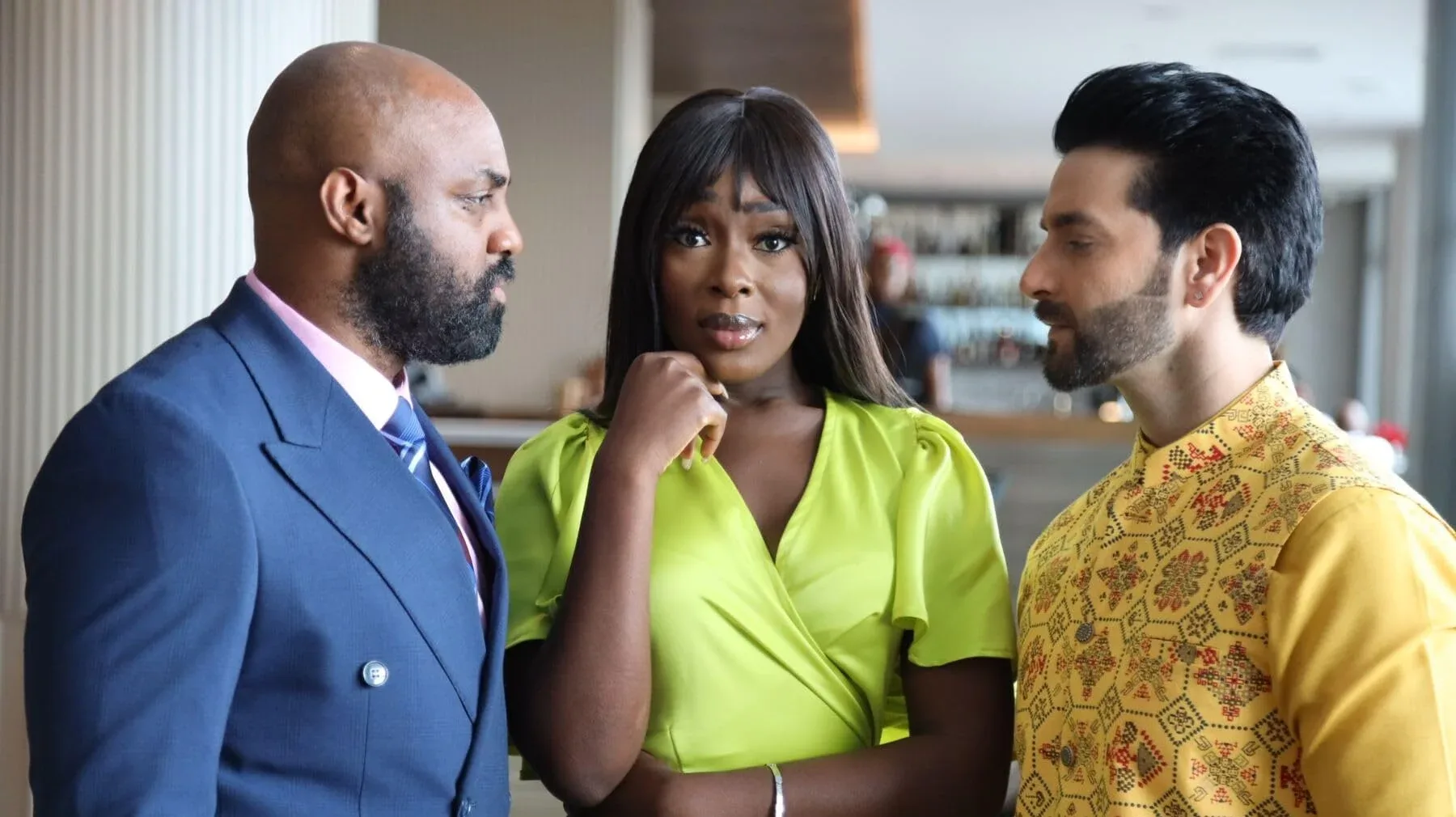

Eyimofe Fregene has built a hotel from plans drawn by the wife he drove away. That detail carries a sharper accusation than most of the dialogue in On Different Grounds. The billionaire businessman has spent years living inside something Isioma designed while preserving his anger at her decision to pursue a career. Mildred Okwo’s romantic dramedy keeps returning to this contradiction, sometimes deliberately, sometimes because Jennifer Eliogu and Bob-Manuel Udokwu make it impossible to ignore.
Their daughter Aurora is supposedly the person getting married. Abena Akuaba plays her as a young woman squeezed between obedience and desire, preparing to marry Tobore, the suitably wealthy son of a connected family, while still carrying feelings for childhood sweetheart Rajesh. Tobore even describes relationships through corporate criteria such as “value check” and “due diligence,” which tells Aurora nearly everything she needs to know about the romance awaiting her. She accepts the wedding on one condition. Eyimofe must invite Isioma.
The arrangement gives Aurora two schemes at once. She wants to reunite her parents, and she hopes a softened father might accept Rajesh. It is a tidy piece of romantic machinery, close to old screwball logic: trap former lovers in proximity, surround them with meddling relatives, then let irritation remember that it once had another name. Okwo has the right pieces. Her screenplay simply keeps moving them too quickly.
Second-Chance Chemistry
The strongest scenes belong to Eyimofe and Isioma because Eliogu and Udokwu understand that reconciliation becomes interesting only while resistance survives. Isioma arrives as someone who has constructed an independent life after being told marriage required surrendering her professional ambitions. Eliogu gives her conversations with Eyimofe a controlled temperature.
She can exchange a barb, receive one back, and leave a small pause hanging afterward that suggests the argument has been rehearsed internally for years. Udokwu answers her with imposing stiffness, playing Eyimofe as a man accustomed to treating authority as evidence that he must be correct. His family reunion proves inconveniently democratic.
Their scenes work best when Okwo allows both performers to occupy the same social space and let pride determine the blocking. A hotel full of relatives becomes an emotional interrogation room with catering. Everyone knows the history, everyone has an opinion, and the former couple can rarely speak without an audience ready to interpret the evidence.
Also Read






The younger triangle lacks that charge. Aurora develops a conspicuous cough around Rajesh, an excessively broad comic signal for attraction that belongs to a lighter film than the one surrounding Isioma. Akuaba’s restrained performance also leaves limited friction between Aurora and Tobore.
If she is trapped between paternal expectation and romantic desire, the trap rarely feels tight enough. That imbalance quietly changes the film. Aurora’s wedding ceases to be the emotional destination and becomes the device that locks two older people in the same building. A useful kidnapping, romantically speaking.
The Family Tribunal
Okwo has considerably better luck whenever the extended families flood the frame. Nkem Owoh, Ebele Okaro, and Uche Jombo bring a practiced physical looseness to the gathering. Greetings become performances. Side comments become territorial claims.

A relative entering a room can alter its power structure before anyone reaches the next line. Fadekemi Olumide-Aluko’s elitist sister, Ocee and Ozee Mbadiwe’s troublesome twins, and the heavily pregnant wedding planner add further pressure to a celebration already behaving like a diplomatic summit with floral arrangements.
Okwo’s direction is clearest here. She can populate a room with competing personalities and keep the comic geography readable. Reactions matter as much as dialogue. A disapproving face caught beside an argument can change the joke, while the continual circulation of relatives prevents Eyimofe from controlling the social environment as easily as he controls his businesses.
The writing is less confident about pain that cannot be converted into banter. Aurora and Audrey were raised separately, one by Eyimofe and the other by Isioma. Audrey has also lived without meaningful support from a billionaire father who transferred his resentment toward her mother onto the child. That should leave scar tissue.
Instead, several confrontations move from injury toward acceptance with startling efficiency. The film recognizes the elephant, gives it a chair, then appears surprised when nobody wants to discuss why it is there.
This is where the crowded ensemble becomes both asset and alibi. Another aunt can enter. Another joke can fire. Another wedding problem can require attention. Motion keeps unresolved history from sitting still.
Different Families, Familiar Rules
The wedding also gives Okwo space to stage Igbo, Itsekiri, and Yoruba identities through etiquette, greetings, status, class, and family allegiance. These details generate some of the film’s liveliest satire because the comedy comes from people observing different social rules while occupying the same rooms.
The advertised Nollywood-Bollywood connection proves far thinner. Rajesh and his father Sanjay supply the Indian side of the equation, yet their presence never substantially reshapes the film’s visual language or romantic structure. Calling this a grand industrial collision requires a fairly generous definition of collision.
The deeper cultural argument sits with Isioma. Eyimofe once demanded that she choose between professional self-determination and the family. Decades later, his wealth has preserved his authority but has done little to prove the righteousness of that decision. The hotel itself quietly mocks him. He built his monument using her design.
Okwo occasionally buries such elegant ironies beneath prolonged jokes and hurried emotional repairs, yet the veteran cast keeps uncovering them. Eliogu can turn a look across a crowded room into evidence of an old life that never entirely disappeared. Udokwu can let Eyimofe’s certainty crack for half a second before rebuilding it. The camera does not need chiaroscuro to expose this man. Give him a bright wedding hall, an ex-wife, and several opinionated relatives. There is nowhere left to hide.
On Different Grounds premiered in cinemas on June 12, 2026, with distribution by Cinemax. Billed as a cross-cultural romantic comedy bridging Nollywood and Bollywood, the film follows a divorced billionaire couple who are forced to reunite for their eldest daughter’s wedding, unaware that she has hatched a secret plan of her own.
Full Credits
Title: On Different Grounds
Distributor: Cinemax
Release date: June 12, 2026
Running time: 1 hour 59 minutes
Director: Mildred Okwo
Writers: Nicolette Ndigwe-Kalu, Diche Enunwa, Temitope Bolade-Akinbode, Oyediya Joy Uwaoma
Producers and Executive Producers: Nicolette Ndigwe-Kalu, Emperor Chris Baywood Ibe, Serengeti Network
Cast: Bob-Manuel Udokwu, Jennifer Eliogu, Ifeanyi Kalu, Abena Akuaba, Vineet Raina, Uche Jombo, Bambam, Uche Montana, Nkem Owoh, Ebele Okaro
The Review
On Different Grounds
The film’s richest conflict belongs to Eyimofe and Isioma, whose old marriage carries sharper emotional geometry than Aurora’s intended romantic triangle. Jennifer Eliogu and Bob-Manuel Udokwu turn bruised pride into wary attraction, while the surrounding relatives keep the wedding alive with precisely judged comic disorder. The script is less disciplined: estrangement, parental neglect, and sibling resentment often disappear before they have been properly confronted. Mildred Okwo keeps the crowded rooms legible, but some relationships are resolved with suspicious speed.
PROS
- Strong Eliogu and Udokwu chemistry
- Excellent veteran ensemble
- Lively family comedy
- Controlled wedding chaos
- Sharp cultural friction
CONS
- Underpowered younger romance
- Rushed reconciliations
- Thin sister relationship
- Uneven comic timing