


















Childhood feels unusually physical in Eklipse. Tomy and Chris spend the summer of 1999 hauling milk, shoveling manure, treating cows, stacking stones across a stream and disappearing into the woods with sticks raised like rifles. Manuel Wetscher lets those activities occupy real screen time, which gives the boys’ friendship weight before anything threatens it.
Tomy, played by Moritz Hohlrieder, is staying on an alpine dairy farm with Chris, played by Finley Brown, and his uncle Georg. His father Franz is in hospital with what Tomy has been told is pneumonia. His mother Elfie knows the fuller truth: Franz has AIDS, and the adults have agreed that silence will protect their son.
That choice turns out to be the film’s governing mistake. Wetscher, drawing from his own family history, keeps Franz mostly absent and concentrates on the people living around his illness. The result is a coming-of-age story where a child first encounters mortality through rumor, coded language and the behavior of adults who suddenly become terrible actors.
Friendship Under Pressure
Hohlrieder and Brown make Tomy and Chris believable before the script asks their friendship to fracture. Their dam-building scene is especially good. They plug gaps with moss, argue over placement and work with the grave concentration children reserve for projects that adults would dismiss as play. Later they share drinks, spit at each other, fool around with their hair and lip-sync to music.
One small scene quietly changes the temperature. Elfie watches the boys miming along to a song while Tomy’s hair sticks up with soap. Her eyes fill with tears. Tomy notices. He cannot interpret the look, but Wetscher lets us feel the moment when a child realizes that adults are seeing something he cannot.
The break comes through a milk-truck driver, who tells Chris that Tomy’s father has “the gay disease.” Chris has already absorbed the religious idea that AIDS represents punishment, so misinformation begins reorganizing everything he feels about his friend. Shared drinks, spit and casual physical closeness suddenly become frightening.
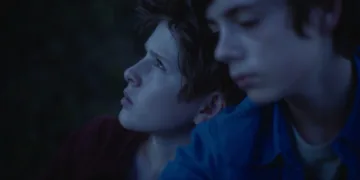
Brown handles that shift through hesitation before hostility. Chris pulls away, watches Tomy differently and eventually shuts him out. Wetscher gives their distance a visual form in a shot that places the boys at opposite ends of the frame with a doorway between them. It is simple composition, but it tells us exactly what dialogue cannot.
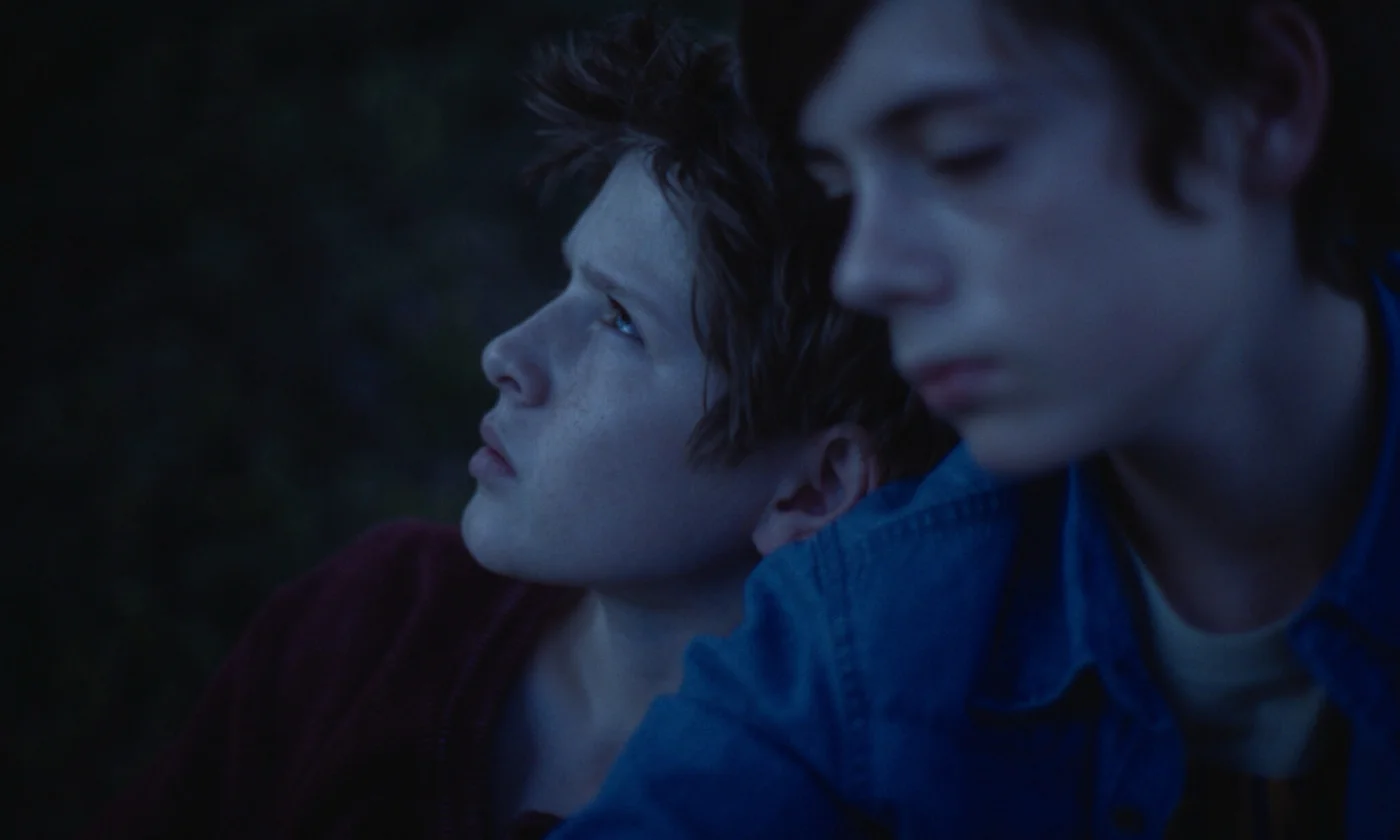
There is another tension running beneath Chris’s fear. While secretly watching Peter and Hanna have sex, Chris rests his head against Tomy’s shoulder. Tomy responds with a casual “Don’t be so gay.” The film never defines what Chris feels, which suits a boy who barely has the language to ask himself.
Elfie’s role is less fully developed. Georg tells her that Tomy needs the truth, and she refuses because Franz does not want him to know. Her decision drives much of the damage, yet the film stays so close to the boys that her recognition of that damage receives little space.
Milk, Mud and Memory
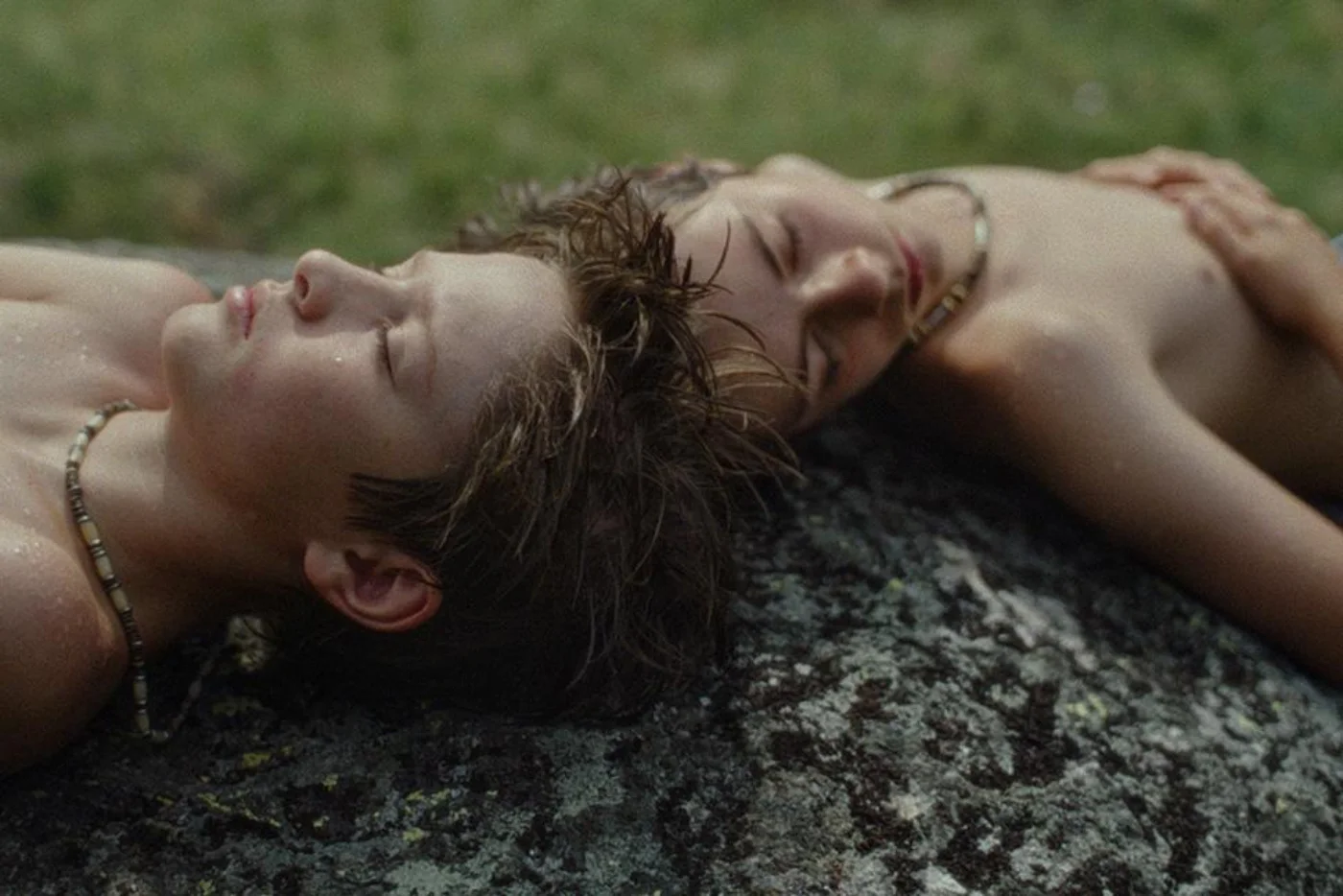
Simone Hart’s cinematography makes the Tyrolean Alps beautiful without cleaning them up. Warm summer light gives the meadows and mountains an almost hazy softness, while the farm itself remains full of manure, infected udders, mud, mosquitoes and repetitive labor.
Wetscher occasionally finds humor inside that earthiness. One cut moves from Peter and Hanna having sex in a cowgirl position to the milking of an actual cow. It is cheeky, but it also fits a film fascinated by bodies, fluids and the awkward overlap between childhood curiosity and adult sexuality.
That fascination becomes darker once Chris hears about AIDS. Milk, blood, spit and water recur across the film, and ordinary bodily exchange starts to carry imagined danger. The fear comes from ignorance rather than anything the boys can actually see.
The sound design is just as precise. Tomy hears ants scratching, birds calling, cowbells ringing and water moving through the stream. Once adults start withholding information, whispers and half-heard conversations enter the same sensory field. He can hear that something is wrong long before anyone gives him the words for it.
Wetscher also inserts VHS footage of his own late father and family. The softer home-video images sit beside the fictional story like preserved pieces of memory rather than explanatory flashbacks. A recording of the band Franz once played in with Georg works similarly, giving Tomy contact with a father who exists mostly through absence.
The Shadow of 1999
The approaching solar eclipse gives the film an obvious metaphor, but Wetscher earns it through the way information is hidden. The adults obscure Franz’s illness. Chris receives a distorted version first. Tomy watches familiar relationships move into shadow without understanding why.
One of the gentlest scenes comes when Tomy explains the Earth, Moon and Sun to Chris using rocks. Hohlrieder traces their movement with his hands, turning basic astronomy into an extension of the boys’ private language. It is a lovely scene because the film has already shown how quickly that language can collapse.
The 1999 setting deepens the anxiety. Talk of technological failure, the millennium and the eclipse hangs around the farm, while AIDS stigma remains embedded in the community’s assumptions. A bartender’s guarded response and Peter’s willingness to exploit what he knows show how private illness can become social currency in a small place.
Wetscher’s strongest decision is keeping Franz out of view. The film is less interested in the medical reality of AIDS than in the damage caused by people projecting fear onto it. Tomy loses the security of his friendship before he fully understands his father’s condition. Childhood ends through information arriving in the wrong order, from the wrong people, carrying all the wrong meanings.
Eklipse premiered at the 83rd Venice International Film Festival in September 2026 within the Orizzonti section. Set during the summer of 1999 against the backdrop of an impending solar eclipse, the coming-of-age drama follows a young boy spending his holiday on his uncle’s farm who confronts harsh family secrets and rural prejudice.
Full Credits
Title: Eklipse
Distributor: Eutopia Film, Albolina Film
Release date: September 2026 (Venice International Film Festival)
Running time: 1 hour 31 minutes
Director: Manuel Wetscher
Writers: Manuel Wetscher, Bernhard Jarosch
Producers and Executive Producers: Bernhard Holzhammer, Victor Kössl, Wilfried Gufler, Debora Nischler
Cast: Moritz Hohlrieder, Finley Brown, Hannes Perkmann, Lenz Moretti, Lisa Schützenberger, Barbara Romaner, Michael Pascher
Director of Photography (Cinematographer): Simone Hart
Editors: Anna Kirst
Composer: Marco Schröder, Johannes Winkler
The Review
Eklipse
Eklipse turns a childhood friendship into a painfully precise study of how prejudice travels. Manuel Wetscher keeps Franz mostly off screen, letting a truck driver’s cruel warning, Chris’s sudden withdrawal, and Tomy’s confused attempts to reconnect show how AIDS stigma infects people who barely understand it. Moritz Hohlrieder and Finley Brown make the boys’ closeness feel wonderfully unforced, while Simone Hart’s warm mountain imagery and the film’s finely layered soundscape preserve the sensory texture of one disappearing summer. A few adult relationships remain underdeveloped, but the boys’ rupture lands with quiet force.
PROS
- Excellent young lead performances
- Painfully believable friendship
- Rich alpine cinematography
- Exceptional environmental sound design
- Personal VHS footage used with restraint
CONS
- Elfie’s reckoning feels abbreviated
- Some adult relationships lack development
- Eclipse motif could carry greater dramatic weight